Kirjojen hintavertailu. Mukana 12 152 606 kirjaa ja 12 kauppaa.

Kirjailija

Nicholas Maxwell

Kirjat ja teokset yhdessä paikassa: 24 kirjaa, julkaisuja vuosilta 1998-2025, suosituimpien joukossa Data Matters. Vertaile teosten hintoja ja tarkista saatavuus suomalaisista kirjakaupoista.

24 kirjaa

Kirjojen julkaisuhaarukka 1998-2025.

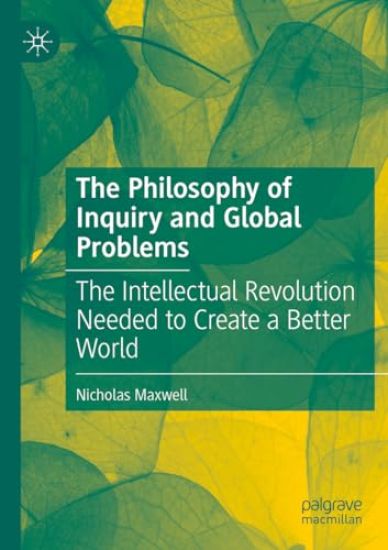
The Philosophy of Inquiry and Global Problems

The Philosophy of Inquiry and Global Problems

Nicholas Maxwell

Springer International Publishing AG
2025
nidottu
We urgently need to bring about a revolution in universities around the world, wherever possible, so that academic inquiry puts all four rules of rational problem solving into practice, and becomes rationally devoted to helping humanity learn how to make progress towards a better world.
The Philosophy of Inquiry and Global Problems

The Philosophy of Inquiry and Global Problems

Nicholas Maxwell

Springer International Publishing AG
2024
sidottu
Universities have long been dominated by a philosophy of inquiry that may be called knowledge-inquiry. This holds that, in order to do justice to the basic humanitarian aim of helping to promote human welfare, academic inquiry must, in the first instance, seek knowledge and technological know-how. First, knowledge is to be acquired; once acquired, it can be applied to help promote human welfare. But this philosophy of knowledge-inquiry is an intellectual and humanitarian disaster. It violates three of the four most elementary rules of rational problem solving conceivable, and as a result fails to give priority to the task of helping humanity resolve those conflicts and problems of living, such as the climate and nature crises, that need to be resolved if we are to make progress to a better world – a world in which there is peace, democracy, justice, liberty, and sustainable prosperity, for all. Very few academics today are aware of this rationality scandal. We urgently need to bring about a revolution in universities around the world, wherever possible, so that academic inquiry puts all four rules of rational problem solving into practice, and becomes rationally devoted to helping humanity learn how to make progress towards a better world. Knowledge-inquiry needs to become wisdom-inquiry, rationally devoted to helping humanity create a wiser world.
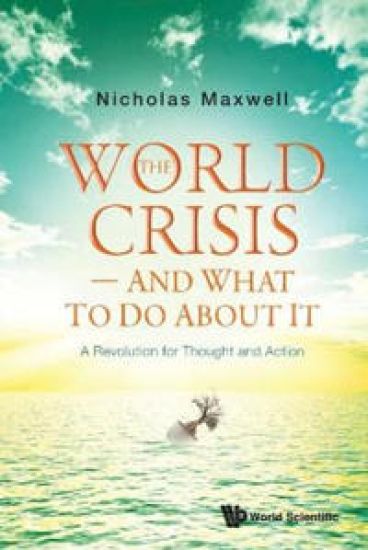
World Crisis, The - And What To Do About It: A Revolution For Thought And Action

World Crisis, The - And What To Do About It: A Revolution For Thought And Action

Nicholas Maxwell

World Scientific Publishing Co Pte Ltd
2021
sidottu
Science and technology have made the modern world possible, but also created all the global problems that threaten our future: the climate crisis, the COVID-19 pandemic, mass extinction of species, environmental degradation, overpopulation, lethal modern war, and the menace of nuclear weapons. Nicholas Maxwell, world-renowned philosopher of science and author of 14 books, argues that all these problems have come about because humans have solved only the first of two great problems of learning — how to acquire scientific knowledge and technological know-how — but not the second — how to create a civilized, wise world.The key disaster of our times is that we have science without wisdom. At present, universities all over the world are devoted to the pursuit of specialized knowledge and technology, or 'knowledge-inquiry'. Maxwell contends that they need to be radically transformed so that their basic function becomes to help humanity tackle global problems, with a more rigorous and socially beneficial perspective he calls 'wisdom-inquiry'. The World Crisis — And What to Do About It spells out in detail the changes that need to be made to academic inquiry, why they need to be made, and how they would enable universities to help humanity actively and effectively tackle and solve current global problems.Related Link(s)
World Crisis, The - And What To Do About It: A Revolution For Thought And Action

World Crisis, The - And What To Do About It: A Revolution For Thought And Action

Nicholas Maxwell

World Scientific Publishing Co Pte Ltd
2021
nidottu
Science and technology have made the modern world possible, but also created all the global problems that threaten our future: the climate crisis, the COVID-19 pandemic, mass extinction of species, environmental degradation, overpopulation, lethal modern war, and the menace of nuclear weapons. Nicholas Maxwell, world-renowned philosopher of science and author of 14 books, argues that all these problems have come about because humans have solved only the first of two great problems of learning — how to acquire scientific knowledge and technological know-how — but not the second — how to create a civilized, wise world.The key disaster of our times is that we have science without wisdom. At present, universities all over the world are devoted to the pursuit of specialized knowledge and technology, or 'knowledge-inquiry'. Maxwell contends that they need to be radically transformed so that their basic function becomes to help humanity tackle global problems, with a more rigorous and socially beneficial perspective he calls 'wisdom-inquiry'. The World Crisis — And What to Do About It spells out in detail the changes that need to be made to academic inquiry, why they need to be made, and how they would enable universities to help humanity actively and effectively tackle and solve current global problems.Related Link(s)
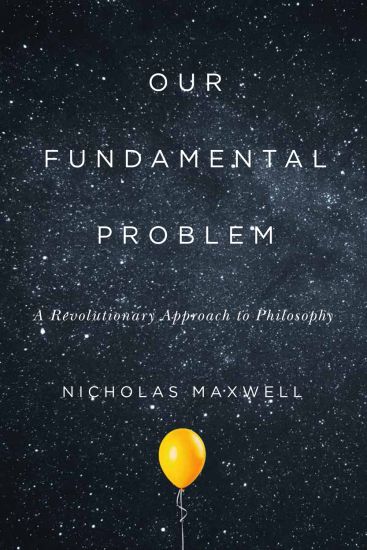
Our Fundamental Problem

Our Fundamental Problem

Nicholas Maxwell

McGill-Queen's University Press
2020
sidottu
How can the world we live in and see, touch, hear, and smell, the world of living things, people, consciousness, free will, meaning, and value - how can all of this exist and flourish embedded as it is in the physical universe, made up of nothing but physical entities such as electrons and quarks? How can anything be of value if everything in the universe is, ultimately, just physics? In Our Fundamental Problem Nicholas Maxwell argues that this problem of reconciling the human and physical worlds needs to take centre stage in our thinking, so that our best ideas about it interact with our attempts to solve even more important specialized problems of thought and life. When we explore this fundamental problem, Maxwell argues, revolutionary answers emerge for a wide range of questions arising in philosophy, science, social inquiry, academic inquiry as a whole, and - most important of all - our capacity to solve the global problems that threaten our future: climate change, habitat destruction, extinction of species, inequality, war, pollution of earth, sea, and air. An unorthodox introduction to philosophy, Our Fundamental Problem brings philosophy down to earth and demonstrates its vital importance for science, scholarship, education, life, and the fate of the world.
Our Fundamental Problem

Our Fundamental Problem

Nicholas Maxwell

McGill-Queen's University Press
2020
nidottu
How can the world we live in and see, touch, hear, and smell, the world of living things, people, consciousness, free will, meaning, and value - how can all of this exist and flourish embedded as it is in the physical universe, made up of nothing but physical entities such as electrons and quarks? How can anything be of value if everything in the universe is, ultimately, just physics? In Our Fundamental Problem Nicholas Maxwell argues that this problem of reconciling the human and physical worlds needs to take centre stage in our thinking, so that our best ideas about it interact with our attempts to solve even more important specialized problems of thought and life. When we explore this fundamental problem, Maxwell argues, revolutionary answers emerge for a wide range of questions arising in philosophy, science, social inquiry, academic inquiry as a whole, and - most important of all - our capacity to solve the global problems that threaten our future: climate change, habitat destruction, extinction of species, inequality, war, pollution of earth, sea, and air. An unorthodox introduction to philosophy, Our Fundamental Problem brings philosophy down to earth and demonstrates its vital importance for science, scholarship, education, life, and the fate of the world.
The Metaphysics of Science and Aim-Oriented Empiricism

The Metaphysics of Science and Aim-Oriented Empiricism

Nicholas Maxwell

Springer Nature Switzerland AG
2019
sidottu
This book gives an account of work that I have done over a period of decades that sets out to solve two fundamental problems of philosophy: the mind-body problem and the problem of induction. Remarkably, these revolutionary contributions to philosophy turn out to have dramatic implications for a wide range of issues outside philosophy itself, most notably for the capacity of humanity to resolve current grave global problems and make progress towards a better, wiser world. A key element of the proposed solution to the first problem is that physics is about only a highly specialized aspect of all that there is – the causally efficacious aspect. Once this is understood, it ceases to be a mystery that natural science says nothing about the experiential aspect of reality, the colours we perceive, the inner experiences we are aware of. That natural science is silent about the experiential aspect of reality is no reason whatsoever to holdthat the experiential does not objectively exist. A key element of the proposed solution to the second problem is that physics, in persistently accepting unified theories only, thereby makes a substantial metaphysical assumption about the universe: it is such that a unified pattern of physical law runs through all phenomena. We need a new conception, and kind, of physics that acknowledges, and actively seeks to improve, metaphysical presuppositions inherent in the methods of physics. The problematic aims and methods of physics need to be improved as physics proceeds. These are the ideas that have fruitful implications, I set out to show, for a wide range of issues: for philosophy itself, for physics, for natural science more generally, for the social sciences, for education, for the academic enterprise as a whole and, most important of all, for the capacity of humanity to learn how to solve the grave global problems that menace our future, and thus make progress to a better, wiser world. It is not just science that has problematic aims; in life too our aims, whether personal, social or institutional, are all too often profoundly problematic, and in urgent need of improvement. We need a new kind of academic enterprise which helps humanity put aims-and-methods improving meta-methods into practice in personal and social life, so that we may come to do better at achieving what is of value in life, and make progress towards a saner, wiser world. This body of work of mine has met with critical acclaim. Despite that, astonishingly, it has been ignored by mainstream philosophy. In the book I discuss the recent work of over 100 philosophers on the mind-body problem and the metaphysics of science, and show that my earlier, highly relevant work on these issues is universally ignored, the quality of subsequent work suffering as a result. My hope, in publishing this book, is that my fellow philosophers will cometo appreciate the intellectual value of my proposed solutions to the mind-body problem and the problem of induction, and will, as a result, join with me in attempting to convince our fellow academics that we need to bring about an intellectual/institutional revolution in academic inquiry so that it takes up its proper task of helping humanity learn how to solve problems of living, including global problems, and make progress towards as good, as wise and enlightened a world as possible.
Science and Enlightenment

Science and Enlightenment

Nicholas Maxwell

Springer Nature Switzerland AG
2019
nidottu
This book argues that two great problems of learning confront humanity: learning about the nature of the universe and about ourselves and other living things as a part of it; and learning how to become civilized. The author proposes that with the creation of modern science in the 17th century, the first problem was essentially solved. But the second problem has still not been solved today, and that combination of solving the first problem, but failing to solve the second one, puts us in a situation of unprecedented danger. All our current global problems are the result. The 18th century Enlightenment tried to solve the second great problem of achieving world enlightenment by learning from the solution to the first problem, but in implementing this idea, they made three serious blunders. These ancient blunders are still built into academia today. Correct the three blunders we have inherited from the Enlightenment, and we would have what we sourgently need: institutions of learning, universities and schools, rationally designed and devoted to helping us resolve our conflicts and global problems, and thus make progress towards a good, genuinely civilized world. Science and Enlightenment: Two Great Problems of Learning will interest a broad audience, ranging from academics, university students and teachers; journalists, politicians and general readers concerned about global problems and the fate of the world.
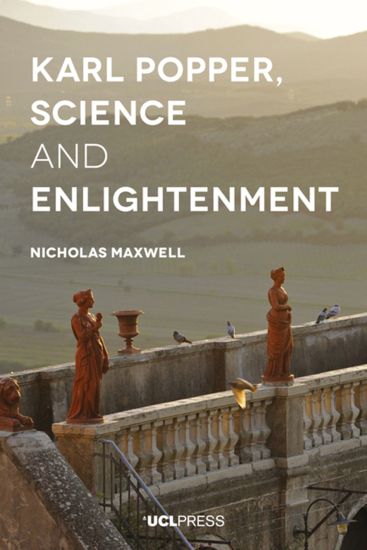
Karl Popper, Science and Enlightenment

Karl Popper, Science and Enlightenment

Nicholas Maxwell

UCL Press
2017
nidottu
Could science, if properly understood, provide us with the methodological key to the salvation of humanity? That is a chief question coursing through the works of Karl Popper, who famously maintained that science cannot verify theories but only refute them, thereby bringing about progress. Nicholas Maxwell's new book disputes this line of argument. By proposing a new conception of scientific methodology on disunified theories--which can be applied to all worthwhile human endeavours with problematic aims--this book calls for a new revolution in inquiry to help humanity advance towards a more civilized and enlightened world.
Karl Popper, Science and Enlightenment

Karl Popper, Science and Enlightenment

Nicholas Maxwell

UCL Press
2017
sidottu
Could science, if properly understood, provide us with the methodological key to the salvation of humanity? That is a chief question coursing through the works of Karl Popper, who famously maintained that science cannot verify theories but only refute them, thereby bringing about progress. Nicholas Maxwell's new book disputes this line of argument. By proposing a new conception of scientific methodology on disunified theories--which can be applied to all worthwhile human endeavours with problematic aims--this book calls for a new revolution in inquiry to help humanity advance towards a more civilized and enlightened world.
In Praise of Natural Philosophy

In Praise of Natural Philosophy

Nicholas Maxwell

McGill-Queen's University Press
2017
nidottu
In Praise of Natural Philosophy argues for a transformation of both science and philosophy, so that these two distinct domains of thought become one: natural philosophy. This in turn has far-reaching consequences for the whole academic enterprise. It transpires that universities need to be reorganized so that they become devoted to seeking and promoting wisdom by rational means - as opposed to just acquiring knowledge. Modern science began as natural philosophy. What today we call science and philosophy, in Newton's time formed one integrated enterprise: to improve our knowledge and understanding of the universe. Profound discoveries were made. And then natural philosophy died. It split into science and philosophy. But the two fragments are defective shadows of the glorious unified endeavour of natural philosophy. Rigour, sheer intellectual good sense, and decisive argument demand that we put the two together again, and rediscover the immense merits of the integrated enterprise of natural philosophy. This requires an intellectual revolution, with profound consequences for how we understand the universe, do both science and philosophy, and tackle global problems. A comprehensive addition to discussions about the purposes of academia, In Praise of Natural Philosophy has dramatic implications for the fate of our world.
In Praise of Natural Philosophy

In Praise of Natural Philosophy

Nicholas Maxwell

McGill-Queen's University Press
2017
sidottu
In Praise of Natural Philosophy argues for a transformation of both science and philosophy, so that these two distinct domains of thought become one: natural philosophy. This in turn has far-reaching consequences for the whole academic enterprise. It transpires that universities need to be reorganized so that they become devoted to seeking and promoting wisdom by rational means - as opposed to just acquiring knowledge. Modern science began as natural philosophy. What today we call science and philosophy, in Newton's time formed one integrated enterprise: to improve our knowledge and understanding of the universe. Profound discoveries were made. And then natural philosophy died. It split into science and philosophy. But the two fragments are defective shadows of the glorious unified endeavour of natural philosophy. Rigour, sheer intellectual good sense, and decisive argument demand that we put the two together again, and rediscover the immense merits of the integrated enterprise of natural philosophy. This requires an intellectual revolution, with profound consequences for how we understand the universe, do both science and philosophy, and tackle global problems. A comprehensive addition to discussions about the purposes of academia, In Praise of Natural Philosophy has dramatic implications for the fate of our world.
Global Philosophy

Global Philosophy

Nicholas Maxwell

Societas
2014
pokkari
This book is about education, learning, rational inquiry, philosophy, science studies, problem solving, academic inquiry, global problems, wisdom and, above all, the urgent need for an academic revolution. Despite this range and diversity of topics, there is a common underlying theme. Education ought to be devoted, much more than it is, to the exploration real-life, open problems; it ought not to be restricted to learning up solutions to already solved problems - especially if nothing is said about the problems that provoked the solutions in the first place. A central task of philosophy ought to be to keep alive awareness of our unsolved fundamental problems.The essays in this volume seek to provoke a concerted effort to transform our institutions of learning so that they become rationally and effectively devoted to helping us learn how to create a wiser world.Our most serious problems of living are so grim, so imbued with suffering, wasted lives and unnecessary death, that the idea of approaching them in a playful spirit seems sacrilegious. We need to keep alive tackling of intellectual problems so that playful capacities can be exercised - if for no other reason (and other reasons there are, of course, aplenty). There are two really worthy impulses behind all rational inquiry: delight and compassion.
How Universities Can Help Create a Wiser World
In order to make progress towards a better world we need to learn how to do it. And for that we need institutions of learning rationally designed and devoted to helping us solve our global problems, make progress towards a better world. It is just this that we lack at present. Our universities pursue knowledge. They are neither designed nor devoted to helping humanity learn how to tackle global problems — problems of living — in more intelligent, humane and effective ways. That, this book argues, is the key disaster of our times, the crisis behind all the others: our failure to have developed our institutions of learning so that they are rationally organized to help us solve our problems of living — above all, our global problems. Having universities devoted almost exclusively to the pursuit of knowledge is a recipe for disaster. Scientific knowledge and technological know-how have unquestionably brought great benefits to humanity. But they have also made possible — even caused — our current global crises, above all the impending crisis of global warming. In this lucid and provocative book, Nicholas Maxwell argues convincingly that we need urgently to bring about a revolution in universities round the world so that their basic aim becomes wisdom, and not just knowledge.