Kirjojen hintavertailu. Mukana 12 341 650 kirjaa ja 12 kauppaa.

Kirjailija

Nicholas Onuf

Kirjat ja teokset yhdessä paikassa: 10 kirjaa, julkaisuja vuosilta 2006-2026, suosituimpien joukossa Advanced Introduction to Social Constructivism. Vertaile teosten hintoja ja tarkista saatavuus suomalaisista kirjakaupoista.

10 kirjaa

Kirjojen julkaisuhaarukka 2006-2026.

Advanced Introduction to Social Constructivism

Advanced Introduction to Social Constructivism

Nicholas Onuf; Kurt Burch

EDWARD ELGAR PUBLISHING LTD
2026
nidottu
Elgar Advanced Introductions are stimulating and thoughtful introductions to major fields in the social sciences, business and law, expertly written by the world’s leading scholars. Designed to be accessible yet rigorous, they offer concise and lucid surveys of the substantive and policy issues associated with discrete subject areas. Advanced Introduction to Social Constructivism examines an influential strain of social thought holding that human powers and socio-political arrangements are ‘co-constitutive’: people make society what it is, society makes people what they are, and social construction makes the world as we know it. ‘Making’ the world shapes what we accept and craft as meaning, understanding, knowledge, truth, reality, institutions, and power. Chapters illustrate these dynamics, encouraging readers to question assumptions and imagine new possibilities. Key Features: Discusses how social realities, truths, and facts are created and contested Explores the roles of meaning, power, and language in constructing understanding Sketches the rise of constructivist scholarship in a dozen fields of study Engages with the ethical implications of social construction and interdisciplinary perspectives Evaluates why certain descriptions of reality feel natural and inevitable, yet are at root socially constructed Draws on examples from everyday life, art, science, media, and contemporary politics This Advanced Introduction invaluably helps students and scholars of philosophy, sociology, political science, international relations, and education keenly engage and deeply navigate contemporary discussions and perspectives on social constructivism and socio-political possibilities.

Advanced Introduction to Social Constructivism

Advanced Introduction to Social Constructivism

Nicholas Onuf; Kurt Burch

EDWARD ELGAR PUBLISHING LTD
2026
sidottu
Elgar Advanced Introductions are stimulating and thoughtful introductions to major fields in the social sciences, business and law, expertly written by the world’s leading scholars. Designed to be accessible yet rigorous, they offer concise and lucid surveys of the substantive and policy issues associated with discrete subject areas. Advanced Introduction to Social Constructivism examines an influential strain of social thought holding that human powers and socio-political arrangements are ‘co-constitutive’: people make society what it is, society makes people what they are, and social construction makes the world as we know it. ‘Making’ the world shapes what we accept and craft as meaning, understanding, knowledge, truth, reality, institutions, and power. Chapters illustrate these dynamics, encouraging readers to question assumptions and imagine new possibilities. Key Features: Discusses how social realities, truths, and facts are created and contested Explores the roles of meaning, power, and language in constructing understanding Sketches the rise of constructivist scholarship in a dozen fields of study Engages with the ethical implications of social construction and interdisciplinary perspectives Evaluates why certain descriptions of reality feel natural and inevitable, yet are at root socially constructed Draws on examples from everyday life, art, science, media, and contemporary politics This Advanced Introduction invaluably helps students and scholars of philosophy, sociology, political science, international relations, and education keenly engage and deeply navigate contemporary discussions and perspectives on social constructivism and socio-political possibilities.
World of Our Making

World of Our Making

Nicholas Onuf

Routledge
2015
sidottu
World of our Making is a major contribution to contemporary social science. Now reissued in this volume, Onuf’s seminal text is key reading for anyone who wishes to study modern international relations.Onuf understands all of international relations to be a matter of rules and rule in foreign behaviour. The author draws together the rules of international relations, explains their source, and elaborates on their implications through a vast array of interdisciplinary thinkers such as Kenneth Arrow, J.L. Austin, Max Black, Michael Foucault, Anthony Giddens, Jurgen Habermas, Lawrence Kohlberg, Harold Lasswell, Talcott Parsons, Jean Piaget, J.G.A. Pocock, John Roemer, John Scarle and Sheldon Wolin.
Making Sense, Making Worlds

Making Sense, Making Worlds

Nicholas Onuf

Routledge
2012
nidottu
Nicholas Onuf is a leading scholar in international relations and introduced constructivism to international relations, coining the term constructivism in his book World of Our Making (1989). He was featured as one of twelve scholars featured in Iver B. Neumann and Ole Wæver, eds., The Future of International Relations: Masters in the Making? (1996); and featured in Martin Griffiths, Steven C. Roach and M. Scott Solomon, Fifty Key Thinkers in International Relations, 2nd ed. (2009).This powerful collection of essays clarifies Onuf’s approach to international relations and makes a decisive contribution to the debates in IR concerning theory. It embeds the theoretical project in the wider horizon of how we understand ourselves and the world. Onuf updates earlier themes and his general constructivist approach, and develops some newer lines of research, such as the work on metaphors and the re-grounding in much more Aristotle than before.A complement to the author’s groundbreaking book of 1989, World of Our Making, this tightly argued book draws extensively from philosophy and social theory to advance constructivism in International Relations. Making Sense, Making Worlds will be vital reading for students and scholars of international relations, international relations theory, social theory and law.
Making Sense, Making Worlds

Making Sense, Making Worlds

Nicholas Onuf

Routledge
2012
sidottu
Nicholas Onuf is a leading scholar in international relations and introduced constructivism to international relations, coining the term constructivism in his book World of Our Making (1989). He was featured as one of twelve scholars featured in Iver B. Neumann and Ole Wæver, eds., The Future of International Relations: Masters in the Making? (1996); and featured in Martin Griffiths, Steven C. Roach and M. Scott Solomon, Fifty Key Thinkers in International Relations, 2nd ed. (2009).This powerful collection of essays clarifies Onuf’s approach to international relations and makes a decisive contribution to the debates in IR concerning theory. It embeds the theoretical project in the wider horizon of how we understand ourselves and the world. Onuf updates earlier themes and his general constructivist approach, and develops some newer lines of research, such as the work on metaphors and the re-grounding in much more Aristotle than before.A complement to the author’s groundbreaking book of 1989, World of Our Making, this tightly argued book draws extensively from philosophy and social theory to advance constructivism in International Relations. Making Sense, Making Worlds will be vital reading for students and scholars of international relations, international relations theory, social theory and law.
World of Our Making

World of Our Making

Nicholas Onuf

Routledge
2012
nidottu
World of our Making is a major contribution to contemporary social science. Now reissued in this volume, Onuf’s seminal text is key reading for anyone who wishes to study modern international relations.Onuf understands all of international relations to be a matter of rules and rule in foreign behaviour. The author draws together the rules of international relations, explains their source, and elaborates on their implications through a vast array of interdisciplinary thinkers such as Kenneth Arrow, J.L. Austin, Max Black, Michael Foucault, Anthony Giddens, Jurgen Habermas, Lawrence Kohlberg, Harold Lasswell, Talcott Parsons, Jean Piaget, J.G.A. Pocock, John Roemer, John Scarle and Sheldon Wolin.
International Legal Theory

International Legal Theory

Nicholas Onuf

Routledge Cavendish
2011
nidottu
Nicholas Onuf’s International Legal Theory: Essays and Engagements 1966-2007 is a collection of the author’s articles and book reviews from the period, including some previously unpublished material. The book records the author’s efforts to address important problems in international legal theory and to engage other scholars who were also addressing these problems. As well as demonstrating Onuf’s own constructivist contribution to the theoretical dimension of international law and international relations, each piece is preceded by a short introduction which highlights the wider themes and developments which have occurred in the field of international law in the last forty years.
On Rules, Politics and Knowledge

On Rules, Politics and Knowledge

Rodney Bruce Hall; Nicholas Onuf; Cecelia Lynch; Oliver Kessler

Palgrave Macmillan
2010
sidottu
Interrogates and extends Friedrich Kratochwil's pathbreaking work on knowledge, normative phenomena, and political practice in international relations. Contributors reflect on the ways in which normative phenomena, politics, and knowledge claims are linked in practice.
International Legal Theory

International Legal Theory

Nicholas Onuf

Routledge Cavendish
2008
sidottu
Nicholas Onuf’s International Legal Theory: Essays and Engagements 1966-2007 is a collection of the author’s articles and book reviews from the period, including some previously unpublished material. The book records the author’s efforts to address important problems in international legal theory and to engage other scholars who were also addressing these problems. As well as demonstrating Onuf’s own constructivist contribution to the theoretical dimension of international law and international relations, each piece is preceded by a short introduction which highlights the wider themes and developments which have occurred in the field of international law in the last forty years.
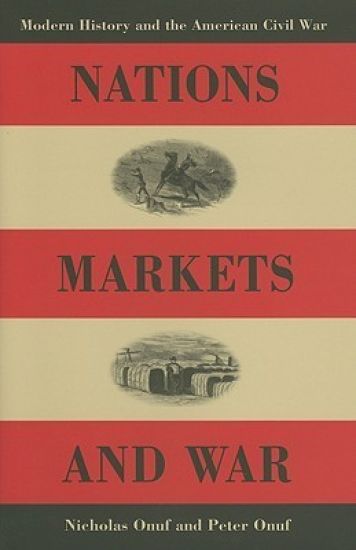
Nations, Markets, and War

Nations, Markets, and War

Nicholas Onuf; Peter S. Onuf

University of Virginia Press
2006
sidottu
In this provocative interdisciplinary study, Nicholas and Peter Onuf argue that the American Civil War was the first great war between modern nations, emerging from the wreckage of a federal union that was supposed to secure perpetual peace. Situating conceptions of nationhood and war in the broader context of modern history, the authors draw attention to overlooked aspects of liberal thought that stand in tension with the a historical individuals and markets that are so familiar to us today. The liberal conception of the autonomous, rights-bearing individual is the product, not the predicate, of what has actually been a protracted process of development. New ways of historical thinking gave rise to new ideas about the nations that collectively constituted international society; the behavior of sovereign nations in turn provided a liberal model for the reorganization of domestic societies. Changing conceptions of markets provided the impetus for nation-making, as well as for war. In the book's second part the authors show how controversy over trade policy in the early American republic led to irreconcilable ideas about the nature of the union and the relationship between home and world markets. When Southerners embraced the logic of nationhood of their known region and insisted that slavery promoted the wealth and welfare of the civilized world, Northerners held that an expanding continental republic embodied their national aspirations. In this light, the clash between Southern concerns with free markets and Northern concerns about nation-making, each classically liberal in its own way, looms especially large in the sectional tensions that led to the Civil War. The Union and Confederacy went to war as great nations determined to secure their place in the modern, civilized world because they were so much alike. Their war should not be seen as a tragic, inexplicable anomaly in American history. It was, instead, the precedent for subsequent, and even more horrific, conflicts among nations.