Kirjojen hintavertailu. Mukana 12 390 323 kirjaa ja 12 kauppaa.

Kirjailija

Nicholas P. Lovrich

Kirjat ja teokset yhdessä paikassa: 11 kirjaa, julkaisuja vuosilta 2015-2024, suosituimpien joukossa Electronic Community-Oriented Policing. Vertaile teosten hintoja ja tarkista saatavuus suomalaisista kirjakaupoista.

Mukana myös kirjoitusasut: Nicholas P Lovrich

11 kirjaa

Kirjojen julkaisuhaarukka 2015-2024.

Social Media and Criminal Justice

Social Media and Criminal Justice

Xiaochen Hu; Nicholas P. Lovrich

TAYLOR FRANCIS LTD
2024
nidottu
Discussing social media-related scholarship found in criminology, legal studies, policing, courts, corrections, victimization, and crime prevention, this book presents the current state of our knowledge on the impact of social media and the major sociological frameworks employed to study the U.S. justice system.Building a theoretical framework for the study of social media and criminal justice in each chapter, the chapters provide a systematic reflection of extant research on social media in cybercrime, operations of courts, administration of institutional and community corrections, law enforcement, and crime prevention. The book fills the gap between the contemporary state of knowledge regarding social media and criminal justice with respect to both empirical evidence and types of sociological frameworks being employed to explore and identify the societal costs and benefits of our growing dependence upon social media. In addition to providing an up-to-date overview of our current state of knowledge, this book highlights important areas of future research, wherein the benefits of social media can be expanded and the negative aspects of its broadening use can be minimized.Social Media and Criminal Justice will be of interest to students, scholars and practitioners in the areas of judicial administration, corrections management, law enforcement, and criminal justice-engaged community-based nonprofit organizations involved in court-referred treatment and/or active collaboration with local law enforcement agencies.
Social Media and Criminal Justice

Social Media and Criminal Justice

Xiaochen Hu; Nicholas P. Lovrich

TAYLOR FRANCIS LTD
2024
sidottu
Discussing social media-related scholarship found in criminology, legal studies, policing, courts, corrections, victimization, and crime prevention, this book presents the current state of our knowledge on the impact of social media and the major sociological frameworks employed to study the U.S. justice system.Building a theoretical framework for the study of social media and criminal justice in each chapter, the chapters provide a systematic reflection of extant research on social media in cybercrime, operations of courts, administration of institutional and community corrections, law enforcement, and crime prevention. The book fills the gap between the contemporary state of knowledge regarding social media and criminal justice with respect to both empirical evidence and types of sociological frameworks being employed to explore and identify the societal costs and benefits of our growing dependence upon social media. In addition to providing an up-to-date overview of our current state of knowledge, this book highlights important areas of future research, wherein the benefits of social media can be expanded and the negative aspects of its broadening use can be minimized.Social Media and Criminal Justice will be of interest to students, scholars and practitioners in the areas of judicial administration, corrections management, law enforcement, and criminal justice-engaged community-based nonprofit organizations involved in court-referred treatment and/or active collaboration with local law enforcement agencies.
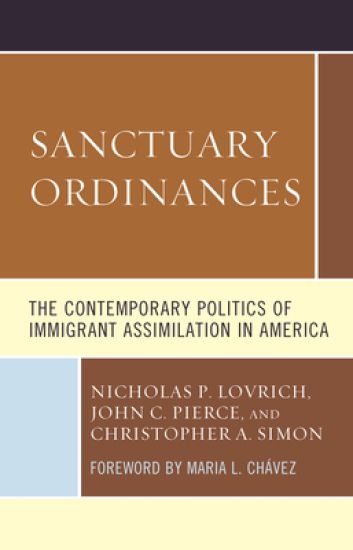
Sanctuary Ordinances

Sanctuary Ordinances

Nicholas P. Lovrich; John C. Pierce; Christopher A. Simon; Maria L. Chávez

BLOOMSBURY PUBLISHING PLC
2022
nidottu
The book examines contemporary immigration policy and immigrant assimilation with a focus on the adoption of sanctuary ordinances in US local governments in connection with Latino in-migration. It also investigates the adoption of anti-immigrant settlement local ordinances in many local governments with particular focus on local law enforcement positions taken on enforcement of federal immigration laws. The book investigates a wide range of county-level characteristics of 3,000+ U.S. counties (e.g., socio-economic and demographic traits, political culture, social capital, religious denominations present, etc.) to identify correlates of pro- and anti-immigrant settlement. The book also features the analysis of a national survey and three targeted surveys in pro-immigration (San Francisco), divided (Maricopa), and anti-immigration (Tulsa) counties to explore the individual-level factors associated with sentiments on immigration policy. Finally, the book presents findings from two case studies where active encouragement of Latino settlement (Twin Falls, ID) and active opposition (Hazleton, PA) characterize local reaction to Latino in-migration. The mixed methods study leads the authors to conclude that a funnel of causality concept, path dependency, pro-social attitudes, and the concepts of moral panic and moral dialogue collectively lead to great insight into the question of why some communities are open and accepting while others are exclusionary.
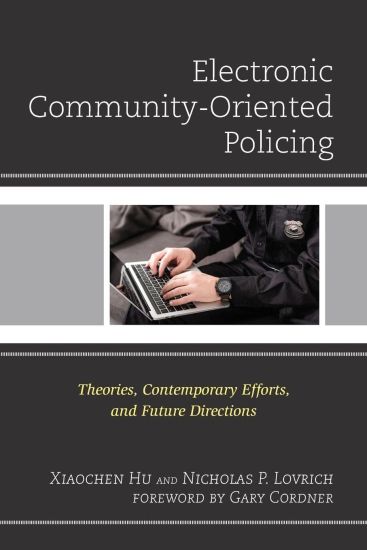
Electronic Community-Oriented Policing

Electronic Community-Oriented Policing

Xiaochen Hu; Nicholas P. Lovrich; Gary Cordner

BLOOMSBURY PUBLISHING PLC
2021
nidottu
Hu and Lovrich introduce the "electronic community-oriented policing (E-COP)," concept to explore how social media can impact police strategies on improving and maintaining police-public relation. Using empirical evidence and theoretical foundations, this book demonstrates the importance of this timely refinement to traditional community-oriented policing strategies as we move further into the twentieth century. E-COP represents a systematic approach to policing that applies knowledge derived from theories of individual behavior, social behavior, and mass communication dynamics to contemporary policing practice. This book would be of interest to policing researchers, scholars, and students as well as police practitioners wishing to improve their use of social media resources to connect to the public they serve in the digital age.
Sanctuary Ordinances

Sanctuary Ordinances

Nicholas P. Lovrich; John C. Pierce; Christopher A. Simon; Maria L. Chávez

Lexington Books
2021
sidottu
The book examines contemporary immigration policy and immigrant assimilation with a focus on the adoption of sanctuary ordinances in US local governments in connection with Latino in-migration. It also investigates the adoption of anti-immigrant settlement local ordinances in many local governments with particular focus on local law enforcement positions taken on enforcement of federal immigration laws. The book investigates a wide range of county-level characteristics of 3,000+ U.S. counties (e.g., socio-economic and demographic traits, political culture, social capital, religious denominations present, etc.) to identify correlates of pro- and anti-immigrant settlement. The book also features the analysis of a national survey and three targeted surveys in pro-immigration (San Francisco), divided (Maricopa), and anti-immigration (Tulsa) counties to explore the individual-level factors associated with sentiments on immigration policy. Finally, the book presents findings from two case studies where active encouragement of Latino settlement (Twin Falls, ID) and active opposition (Hazleton, PD) characterize local reaction to Latino in-migration. The mixed methods study leads the authors to conclude that a funnel of causality concept, path dependency, pro-social attitudes, and the concepts of moral panic and moral dialogue collectively lead to great insight into the question of why some communities are open and accepting while others are exclusionary.
Electronic Community-Oriented Policing

Electronic Community-Oriented Policing

Xiaochen Hu; Nicholas P. Lovrich; Gary Cordner

Lexington Books
2020
sidottu
Hu and Lovrich introduce the "electronic community-oriented policing (E-COP)," concept to explore how social media can impact police strategies on improving and maintaining police-public relation. Using empirical evidence and theoretical foundations, this book demonstrates the importance of this timely refinement to traditional community-oriented policing strategies as we move further into the twentieth century. E-COP represents a systematic approach to policing that applies knowledge derived from theories of individual behavior, social behavior, and mass communication dynamics to contemporary policing practice. This book would be of interest to policing researchers, scholars, and students as well as police practitioners wishing to improve their use of social media resources to connect to the public they serve in the digital age.
Policing for Sustainable Development Goals

Policing for Sustainable Development Goals

Ugljesa Ugi Zvekic; John Sellar; Nicholas P Lovrich

Scholars' Press
2019
pokkari
The main aim of this short collection is to draw the attention to some aspects of the challenges policing faces as a part of the 2030 United Nations Sustainable Development Goals (SDGs) agenda, adopted in September 2015. The goals range from poverty and hunger reduction through healthy lives, quality education, gender equality, environmental protection, affordable and sustainable energy, economic growth and employment to reduction of world's inequality and climate change. Goal 16 "Promote peaceful and inclusive societies for sustainable development, provide access to justice for all and build effective, accountable and inclusive institutions at all level" for the first time highlights prevention and control of various manifestations of crime as the very significant developmental goal. SDGs clearly require service-and human rights oriented policing, based on evidence and information, a style of policing focusing on protecting the vulnerable and emerging challenges of organized crime, corruption and wildlife trafficking.
Human Resource Management

Human Resource Management

Elizabeth D. Fredericksen; Stephanie L. Witt; W. David Patton; Nicholas P. Lovrich

Routledge
2015
sidottu
Sound HRM practices matter—they are a sine qua non of effective governance in democratic government—equally so at the local, regional, state and national levels of government. The NASPAA (Network of Schools of Public Policy, Affairs, and Administration) accreditation standards demand critical competencies for public managers that are vital to human resource managers and supervisors at all levels. These competencies include: skills to lead and manage in public governance; to participate in and contribute to the policy process; to analyze, synthesize, think critically, solve problems and make decisions; to articulate and apply a public service perspective; and to communicate and interact productively with a diverse and changing workforce and citizenry. This second edition of Human Resource Management is designed specifically with these competencies in mind to: Introduce and explore the fundamental purposes of human resource management in the public service and consider the techniques used to accomplish these purposes Provide exercises to give students practice for their skills after being introduced to the theory, foundation, and practices of public and nonprofit sector HRM Facilitate instruction of the material by introducing important topics and issues with readings drawn from the professional literature Provide information and examples demonstrating the interrelatedness of many of the topics in public sector HRM and the trends shaping public and nonprofit management, especially diversity, ethics, and technology. Demonstrate and describe differences among HRM practices in public, for-profit and nonprofit organizations, and between the levels of government. Human Resource Management is organized to provide a thorough discussion of the subject matter with extensive references to relevant literature and useful teaching tools. Thus, students will consider the issues, purposes, and techniques of HRM and conceptualize how varied their roles are, or will be, whether a personnel specialist in a centralized system or a supervisor managing in one of the increasingly common decentralized systems. Each chapter includes a thorough review of the principles and practices of HRM (including the why and the how), selected readings, important themes, diverse examples, key terms, study questions, applied exercises, case studies, and examples of forms and processes would-be managers will encounter in their roles.
Human Resource Management

Human Resource Management

Elizabeth D. Fredericksen; Stephanie L. Witt; W. David Patton; Nicholas P. Lovrich

Routledge
2015
nidottu
Sound HRM practices matter—they are a sine qua non of effective governance in democratic government—equally so at the local, regional, state and national levels of government. The NASPAA (Network of Schools of Public Policy, Affairs, and Administration) accreditation standards demand critical competencies for public managers that are vital to human resource managers and supervisors at all levels. These competencies include: skills to lead and manage in public governance; to participate in and contribute to the policy process; to analyze, synthesize, think critically, solve problems and make decisions; to articulate and apply a public service perspective; and to communicate and interact productively with a diverse and changing workforce and citizenry. This second edition of Human Resource Management is designed specifically with these competencies in mind to: Introduce and explore the fundamental purposes of human resource management in the public service and consider the techniques used to accomplish these purposes Provide exercises to give students practice for their skills after being introduced to the theory, foundation, and practices of public and nonprofit sector HRM Facilitate instruction of the material by introducing important topics and issues with readings drawn from the professional literature Provide information and examples demonstrating the interrelatedness of many of the topics in public sector HRM and the trends shaping public and nonprofit management, especially diversity, ethics, and technology. Demonstrate and describe differences among HRM practices in public, for-profit and nonprofit organizations, and between the levels of government. Human Resource Management is organized to provide a thorough discussion of the subject matter with extensive references to relevant literature and useful teaching tools. Thus, students will consider the issues, purposes, and techniques of HRM and conceptualize how varied their roles are, or will be, whether a personnel specialist in a centralized system or a supervisor managing in one of the increasingly common decentralized systems. Each chapter includes a thorough review of the principles and practices of HRM (including the why and the how), selected readings, important themes, diverse examples, key terms, study questions, applied exercises, case studies, and examples of forms and processes would-be managers will encounter in their roles.