Kirjojen hintavertailu. Mukana 12 543 047 kirjaa ja 12 kauppaa.

Kirjailija

Nickola Nelson

Kirjat ja teokset yhdessä paikassa: 14 kirjaa, julkaisuja vuosilta 2009-2021, suosituimpien joukossa Test of Integrated Language and Literacy Skills® (TILLS®) Student Language Scale. Vertaile teosten hintoja ja tarkista saatavuus suomalaisista kirjakaupoista.

14 kirjaa

Kirjojen julkaisuhaarukka 2009-2021.

Test of Integrated Language and Literacy Skills® (TILLS®) Student Language Scale

Test of Integrated Language and Literacy Skills® (TILLS®) Student Language Scale

Nickola Nelson; Elena Plante; Nancy Helm-Estabrooks; Gillian Hotz

Brookes Publishing Co
2015
irtolehti
For use with the Test of Integrated Language & Literacy Skills® (TILLS®) Examiner's Kit, the TILLS Student Rating Scale can be completed by parents, teachers, and students. It's a simple one page checklist that helps identify students' strengths and weaknesses in language and literacy skills and other non language areas (though it's not a pragmatics checklist). Sold in a pack of 50, this scale is also included in the TILLS Examiner's Kit.The TILLS Student Rating Scale is part of the Test of Integrated Language & Literacy Skills® (TILLS®) the groundbreaking assessment professionals need to test listening, speaking, reading, and writing skills in students ages 6 - 18, and to assess the role of memory in how students perform. Reliable, valid, and comprehensive, TILLS will help you streamline assessment, monitor progress, and reach your ultimate goal: improving students' communication skills so they can succeed in school.TILLS is the only test that assesses both spoken and written language and shows how these skills relate to each other. You'll get a meaningful profile of skills for each learner, so you can be sure you understand a student's strengths and needs and aren't overlooking something crucial. Unlike most other tests, TILLS also provides diagnostic accuracy in "age bands" meaningful to the development of language and literacy skills, so you'll have the evidence base you need to determine if test scores reflect typical or impaired performance. And if you're an experienced clinician, you can finish TILLS in just 90 minutes or less—which means you'll spend less time testing and more time helping students and planning interventions.Here is a link to a video introducing TILLS: https://www.youtube.com/watch?v=rJh9qtkkLQs
Test of Integrated Language and Literacy Skills® (TILLS®) Quick Start Guide

Test of Integrated Language and Literacy Skills® (TILLS®) Quick Start Guide

Nickola Nelson; Elena Plante; Nancy Helm-Estabrooks; Gillian Hotz

Brookes Publishing Co
2015
nidottu
A convenient laminated trifold that provides an overview of the test, basic instructions for test administration, summaries of the individual subtests, and scoring information. One Quick Start Guide is included in the TILLS Examiner's Kit, and additional copies are sold in packs of 5.TILLS™ is the groundbreaking assessment professionals need to test listening, speaking, reading, and writing skills in students aged 6 through 18, and to assess the role of memory in how students perform. TILLS™ is the only test that assesses both spoken and written language and shows how these skills relate to each other, developing a meaningful profile of skills for each learner, to help understand a student's strengths and needs.Reliable, valid, and comprehensive, TILLS™ will help professionals streamline assessment, monitor progress, and reach the ultimate goal of improving students' communication skills so they can succeed in school.TILLS is the only test that assesses both spoken and written language and shows how these skills relate to each other. You'll get a meaningful profile of skills for each learner, so you can be sure you understand a student's strengths and needs and aren't overlooking something crucial. Unlike most other tests, TILLS also provides diagnostic accuracy in "age bands" meaningful to the development of language and literacy skills, so you'll have the evidence base you need to determine if test scores reflect typical or impaired performance. And if you're an experienced clinician, you can finish TILLS in just 90 minutes or less—which means you'll spend less time testing and more time helping students and planning interventions.Here is a link to a video introducing TILLS: https://www.youtube.com/watch?v=rJh9qtkkLQs
Student Language Scale (SLS) User's Manual

Student Language Scale (SLS) User's Manual

Nickola Nelson; Barbara M. Howes; Michele A. Anderson

Brookes Publishing Co
2018
nidottu
For use on its own or with the Test of Integrated Language and Literacy Skills™ (TILLS™), the Student Language Scale reliably screens students from ages 6-18 years for language and literacy disorders, including dyslexia. Filled out by parents, teachers, and students in just three minutes or less, the 12-question screener is a quick, cost-effective way to see how students are performing on academic tasks as compared to their same-age peers. This concise User’s Manual shows you how to effectively use the SLS to:• Screen for language/literacy disorders by gathering teachers’ and parents’ ratings of students. When teachers or parents rate more than two areas on items 1-8 less than 5, SLS results indicate the student is at risk and needs further assessment.• Gather input about a struggling student’s strengths and needs from multiple sources—a key requirement of IDEA • Enhance home–school communication by gaining new insight into the student’s performance and the parent’s perspective, whether or not there are concernsYou’ll get reader-friendly guidance on how to administer the SLS with teachers, parents, and students; a complete guide to the technical data supporting the SLS; and three examples that show how the SLS can help you make sound decisions about followup for students who need it. Whether used with an entire classroom or with individual students, the SLS is the tool you need to quickly gather valuable information about strengths and needs—and plan next steps for students at risk for disorders.
SLS Screener for Language & Literacy Disorders

SLS Screener for Language & Literacy Disorders

Nickola Nelson; Barbara M. Howes; Michele A. Anderson

Brookes Publishing Co
2018
muu
An ideal companion to the groundbreaking TILLS test! Screen with SLS, and then follow up and diagnose with TILLS.For use on its own or with the Test of Integrated Language and Literacy Skills™ (TILLS™), the Student Language Scale (SLS) reliably screens students ages 6—18 years for language/literacy disorders, including dyslexia. Filled out by parents, teachers, and students, the screener is a quick, cost-effective way to see how students are performing on academic tasks as compared to their same-age peers. Use the SLS to:Screen for language/literacy disorders, including dyslexia, by gathering teachers' and parents' ratings of students Gather input about a struggling student's strengths and needs from multiple sourcesEnhance home—school communication by gaining new insight into the student's performance and the teacher's and the parents' and student's perspectives on it, whether or not everyone agrees and whether or not there are concerns Whether used with an entire classroom or with individual students, the SLS is the tool you need to quickly gather valuable information about strengths and needs—and plan next steps for students at risk for disorders.Why use the SLS?Expert developed: The SLS developers are highly respected for their test-building skills and evidence-based work in the field of language and literacy assessment and school social work. Fast and easy: The three-part SLS can be completed in just 3 minutes or less. Administration and scoring is simple—a pencil and paper are all you need.Strong sensitivity and specificity. Sensitivity of the SLS to risk of language/literacy disorder is .90 for teachers and .85 for parents, and specificity (correct identification of typical learners) is .90 for teachers and .83 for parents.Cost effective. The SLS helps you screen effectively at a lower cost than comparable tools on the market. Simple scoring: The 12-item rating scale section of the SLS incorporates descriptive statements that are rated on a scale of 1 to 7 from not good to very good. The first eight items on the scale ask about core language and literacy abilities that represent the 2 language levels x 4 language modalities assessed with TILLS. When teachers or parents rate more than two areas on items 1-8 as less than 5, SLS screening results indicate the student is at risk and needs further assessment. Perfect for use with TILLS!: The SLS is an ideal companion to the groundbreaking TILLS test, which assesses oral and written language skills in students ages 6—18 years. Gather teacher and parent ratings for whole classes of students with the SLS, and if results indicate that a student is at risk, follow up with TILLS assessment and other forms of language/literacy assessment. What's in this kit?: One SLS User's Manual One gummed tablet of 50 TILLS™ Student Language Scale forms One SLS Quick Start Guide with basic instructions on administering and scoring
Test of Integrated Language and Literacy TILLS Practice Kit

Test of Integrated Language and Literacy TILLS Practice Kit

Nickola Nelson; Elena Plante; Nancy Helm-Estabrooks; Gillian Hotz

Brookes Publishing Co
2016
muu
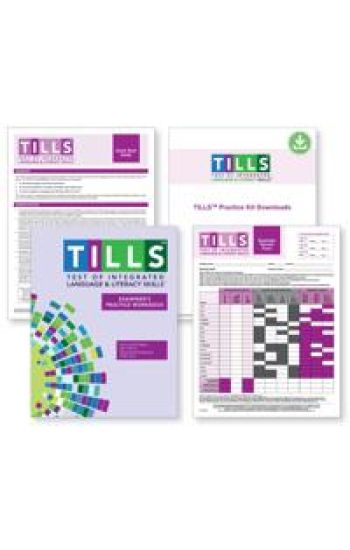
These convenient Practice Kits include the materials needed for training and practice sessions with the Test of Integrated Language & Literacy Skills (TILL), a test valid and reliable for assessing oral and written language skills in students ages 6 - 18 years. The TILLS Practice Kit gives you and your trainees access to essential materials for learning about TILLS and, in the process, about standardized testing in general. The TILLS Practice Kits are ideal for use in preservice higher education courses and inservice trainings. They can help you introduce TILLS to aspiring or experienced professionals and give them the practice they need to use TILLS and perform individualized assessment with confidence in future work settings. The TILLS Practice Kits are used to:Give trainees a complete overview of TILLS.Introduce the TILLS subtests and the three purposes of the assessment: identifying language & literacy disorders, documenting relative strengths and weaknesses, and tracking changes over time.Familiarize trainees with the 15 TILLS subtests. With the included Examiner's Practice Workbook, TILLS trainees will work through practice exercises for each subtest that prepare them for successful administration of the TILLS and other standardized tests.Provide concrete examples of standardized testing principles. Beyond testing with TILLS, the materials of the Practice Kit can be used to emphasize assessment principles in general, such as using start rules, establishing basals and ceilings, and using standardized instruction and scoring procedures with fidelity.Provide scoring practice. Using the Examiner's Practice Workbook and downloadable audio files, TILLS trainees will practice scoring and interpreting all subtests, with extra instructional material and practice examples for the Written Expression subtest.With this thorough introduction to a landmark language and literacy assessment, pre and inservice professionals will be ready to use TILLS to enhance their future work in schools, clinics, and private practice.KIT COMPONENTS: Note: Trainees each should purchase a Practice Kit for use in their coursework or TILLS training session. Instructors should have their own Practice Kit, and they may request a desk copy of the Examiner's Manual (as it is not included in the Practice Kit).Examiner's Practice Workbook: More than 100 pages of exercises on subtest administration, scoring TILLS, and interpreting results, plus a tutorial to help you master T unit division.Practice Kit Downloads: The audio files and normative data tables needed to complete the scoring of the exercises in the Examiner's Practice Workbook (downloaded with a special code that is provided to the purchaser).Examiner Record Form (pack of 3): Two forms to work through the exercises in the Workbook for students of different ages, plus an extra copy of the form for additional practice.Quick Start Guide: A laminated trifold quick reference guide to administration and scoring, perfect to take with you when using TILLS on the job and as a quick reference for trainees.Here is a link to a video introducing TILLS: https://www.youtube.com/watch?v=rJh9qtkkLQs
Test of Integrated Language and Literacy Skills® (TILLS®) Examiner's Practice Workbook

Test of Integrated Language and Literacy Skills® (TILLS®) Examiner's Practice Workbook

Nickola Nelson; Elena Plante; Nancy Helm-Estabrooks; Gillian Hotz

Brookes Publishing Co
2015
nidottu
For use with the Test of Integrated Language & Literacy Skills® (TILLS®) Examiner's Kit, The Examiner's Practice Workbook provides practice material for scoring several subtests, including the Written Expression subtest. One copy of the Practice Workbook is included in the TILLS Examiner's Kit. The TILLS Practice Workbook is part of the Test of Integrated Language & Literacy Skills® (TILLS®) the groundbreaking assessment professionals need to test listening, speaking, reading, and writing skills in students ages 6 - 18, and to assess the role of memory in how students perform. Reliable, valid, and comprehensive, TILLS will help you streamline assessment, monitor progress, and reach your ultimate goal: improving students' communication skills so they can succeed in school.TILLS is the only test that assesses both spoken and written language and shows how these skills relate to each other. You'll get a meaningful profile of skills for each learner, so you can be sure you understand a student's strengths and needs and aren't overlooking something crucial. Unlike most other tests, TILLS also provides diagnostic accuracy in "age bands" meaningful to the development of language and literacy skills, so you'll have the evidence base you need to determine if test scores reflect typical or impaired performance. And if you're an experienced clinician, you can finish TILLS in just 90 minutes or less—which means you'll spend less time testing and more time helping students and planning interventions.Here is a link to a video introducing TILLS: https://www.youtube.com/watch?v=rJh9qtkkLQs
Test of Integrated Language and Literacy Skills® (TILLS®) Student Response Form

Test of Integrated Language and Literacy Skills® (TILLS®) Student Response Form

Nickola Nelson; Elena Plante; Nancy Helm-Estabrooks; Gillian Hotz

Brookes Publishing Co
2015
nidottu
For use with the Test of Integrated Language & Literacy Skills® (TILLS®) Examiner's Kit, the Student Response Form is a booklet students use to record their responses on the following four TILLS subtests:Nonword SpellingReading ComprehensionFollowing DirectionsWritten ExpressionOne Student Response Form is required for each student who takes the TILLS. A pack of 25 forms is included in the TILLS Examiner's Kit, and additional forms can be purchased here. They're sold in a pack of 25 and come bundled with a pack of 25 TILLS Record Forms. The TILLS Student Response Form is part of the Test of Integrated Language & Literacy Skills® (TILLS®) the groundbreaking assessment professionals need to test listening, speaking, reading, and writing skills in students ages 6 - 18, and to assess the role of memory in how students perform. Reliable, valid, and comprehensive, TILLS will help you streamline assessment, monitor progress, and reach your ultimate goal: improving students' communication skills so they can succeed in school.TILLS is the only test that assesses both spoken and written language and shows how these skills relate to each other. You'll get a meaningful profile of skills for each learner, so you can be sure you understand a student's strengths and needs and aren't overlooking something crucial. Unlike most other tests, TILLS also provides diagnostic accuracy in "age bands" meaningful to the development of language and literacy skills, so you'll have the evidence base you need to determine if test scores reflect typical or impaired performance. And if you're an experienced clinician, you can finish TILLS in just 90 minutes or less—which means you'll spend less time testing and more time helping students and planning interventions.Here is a link to a video introducing TILLS: https://www.youtube.com/watch?v=rJh9qtkkLQs
Test of Integrated Language and Literacy Skills® (TILLS®) Examiner Record Form

Test of Integrated Language and Literacy Skills® (TILLS®) Examiner Record Form

Nickola Nelson; Elena Plante; Nancy Helm-Estabrooks; Gillian Hotz

Brookes Publishing Co
2015
nidottu
For use with the Test of Integrated Language & Literacy Skills® (TILLS®) Examiner's Kit, the Examiner Record Form is used to record and score student responses to all 15 TILLS subtests. This form clearly describes materials needed, start rules, basal and ceiling rules, and information about allowable prompts and repetitions.One Examiner Record Form is required for each student who takes the TILLS. A pack of 25 forms is included in the TILLS Examiner's Kit, and additional forms can be purchased here. The Record Forms are sold in a pack of 25 and come bundled with a pack of 25 TILLS Student Response Forms.The TILLS Record Forms are part of the Test of Integrated Language & Literacy Skills® (TILLS®), the groundbreaking assessment professionals need to test listening, speaking, reading, and writing skills in students ages 6 - 18, and to assess the role of memory in how students perform. Reliable, valid, and comprehensive, TILLS will help you streamline assessment, monitor progress, and reach your ultimate goal: improving students' communication skills so they can succeed in school.TILLS is the only test that assesses both spoken and written language and shows how these skills relate to each other. You'll get a meaningful profile of skills for each learner, so you can be sure you understand a student's strengths and needs and aren't overlooking something crucial. Unlike most other tests, TILLS also provides diagnostic accuracy in "age bands" meaningful to the development of language and literacy skills, so you'll have the evidence base you need to determine if test scores reflect typical or impaired performance. And if you're an experienced clinician, you can finish TILLS in just 90 minutes or less—which means you'll spend less time testing and more time helping students and planning interventions.Here is a link to a video introducing TILLS: https://www.youtube.com/watch?v=rJh9qtkkLQs
Test of Integrated Language and Literacy Skills® (TILLS®) Technical Manual

Test of Integrated Language and Literacy Skills® (TILLS®) Technical Manual

Nickola Nelson; Elena Plante; Nancy Helm-Estabrooks; Gillian Hotz

Brookes Publishing Co
2015
nidottu
For use with the Test of Integrated Language & Literacy Skills® (TILLS®) Examiner's Kit, the Technical Manual is your essential guide to the development of and data behind TILLS. It includes vital information on:test development and standardizationvalidity and reliability of TILLScontrol for biasnames and locations of test administrators who contributed data during the various phases of test developmentnames and affiliations of scientific experts, practicing clinicians, and parents of children with disabilities who contributed to the test design and formatA copy of the TILLS Technical Manual is included in the TILLS Examiner's Kit. The TILLS Technical Manual is part of the Test of Integrated Language & Literacy Skills® (TILLS®) the groundbreaking assessment professionals need to test listening, speaking, reading, and writing skills in students ages 6 - 18, and to assess the role of memory in how students perform. Reliable, valid, and comprehensive, TILLS will help you streamline assessment, monitor progress, and reach your ultimate goal: improving students' communication skills so they can succeed in school.TILLS is the only test that assesses both spoken and written language and shows how these skills relate to each other. You'll get a meaningful profile of skills for each learner, so you can be sure you understand a student's strengths and needs and aren't overlooking something crucial. Unlike most other tests, TILLS also provides diagnostic accuracy in "age bands" meaningful to the development of language and literacy skills, so you'll have the evidence base you need to determine if test scores reflect typical or impaired performance. And if you're an experienced clinician, you can finish TILLS in just 90 minutes or less—which means you'll spend less time testing and more time helping students and planning interventions.Here is a link to a video introducing TILLS: https://www.youtube.com/watch?v=rJh9qtkkLQs
Test of Integrated Language and Literacy Skills™ (TILLS™) Forms Set

Test of Integrated Language and Literacy Skills™ (TILLS™) Forms Set

Nickola Nelson; Elena Plante; Nancy Helm-Estabrooks; Gillian Hotz

Brookes Publishing Co
2015
muu
The TILLS Forms Set contains a pack of 25 Examiner Record Forms and pack of 25 Student Response Forms. One Examiner Record Form and one Student Response Form is required for each student who takes the TILLS.The Examiner Record Form is used to record and score student responses to all 15 TILLS subtests. This form clearly describes materials needed, start rules, basal and ceiling rules, and information about allowable prompts and repetitions.The Student Response Form is a booklet students use to record their responses on the following four TILLS subtests:Nonword SpellingReading ComprehensionFollowing DirectionsWritten ExpressionThe TILLS Form Set is part of the Test of Integrated Language & Literacy Skills™ (TILLS™), the groundbreaking assessment professionals need to test listening, speaking, reading, and writing skills in students ages 6 —18, and to assess the role of memory in how students perform. Reliable, valid, and comprehensive, TILLS will help you streamline assessment, monitor progress, and reach your ultimate goal: improving students' communication skills so they can succeed in school.Here is a link to a video introducing TILLS: https://www.youtube.com/watch?v=rJh9qtkkLQs
Pediatric Test of Brain Injury™ (PTBI™)

Pediatric Test of Brain Injury™ (PTBI™)

Gillian Hotz; Nancy Helm-Estabrooks; Nickola Nelson; Elena Plante

Brookes Publishing Co
2010
nidottu
This user-friendly Examiner's Manual gives clinicians the background information they need to implement PTBI™ effectively, includingan overview of the test's development, framework, and rationalegeneral guidance on optimizing the testing environment and conducting the testdetailed information on administering and scoring each of the 10 individual PTBI™ subtestscomplete technical data, including evidence for construct-identification validity, score validity, reliability, and minimization of biasa case example demonstrating successful use of the toolThis manual is part of PTBI™, a criterion-referenced, standardized test designed for use with children ages 6–16 recovering from brain injury. An effective and innovative tool that takes just 30 minutes to complete, PTBI assesses the skills children need to return to school and function in the general education curriculum.
Pediatric Test of Brain Injury

Pediatric Test of Brain Injury

Gillian Hotz; Nancy Helm-Estabrooks; Nickola Nelson; Elena Plante

Brookes Publishing Co
2010
nidottu
Designed for use with children ages 6-16 recovering from brain injury, PTBI' is the only criterion-referenced, standardized test that assesses the skills children need to return to school and function in the general education curriculum. An effective and innovative tool, PTBI helps speech-language pathologists and other clinicians determine children's neurocognitive, language, and literacy abilities so they can identify strengths and weaknesses and implement effective interventions. PTBI is also an essential tool for monitoring functional changes, tracking recovery patterns over time, and guiding decision-making related to school reintegration. Equally useful for assessing children with acquired or traumatic brain injury, PTBI is: rigorously tested using cutting-edge item response theory (IRT) analysis and traditional test development methods, yielding strong evidence of reliability and validity; focused on areas critical to school success, such as listening, speaking, reading, writing, gesturing, working memory, and problem solving; easy to complete in just 30 minutes--won't overburden children likely to be fatigued or have attention issues; field tested at trauma, rehab centers, and clinics across the country; useful anytime during the recovery process--to assess abilities in the acute phases and to monitor progress on an ongoing basis; easy to administer and score--the forms include concise, specific instructions for accurate use of PTBI. The complete PTBI includes all the components necessary for successful test administration: an Examiner's Manual with comprehensive guidelines and technical data; a Stimulus Book with all the visual stimuli needed to conduct the test; and Test Forms for recording information about the child's performance and scoring PTBI. The first and only standardized test that assesses cognitive and academic skills after brain injury, PTBI is the tool every SLP needs to develop effective supports for children and get them ready for a successful return to the classroom.
Language and Literacy Disorders

Language and Literacy Disorders

Nickola Nelson

Pearson
2009
nidottu
Organized with a clear framework and student-friendly learning supports, this textbook helps graduate and undergraduate students gain essential knowledge that can inform, and transform, their work with children who need special assistance to acquire language and literacy abilities to meet multiple communication and learning needs. Featuring content and questions that encourage deeper thinking about the nature of disordered and normal development, this text makes assessment and intervention practices relevant to contexts of home, classroom, and peer interactions. In particular, readers will learn to draw on multiple sources of input to develop an assessment picture for a child at any age and stage of development as a person with unique strengths and needs, coming from a particular cultural-linguistic background, and with concerns that may be attributed to a particular known or unknown but suspected set of etiological factors. Additionally, readers will learn to plan interventions that target developmentally appropriate outcomes in spoken and written language and to apply techniques that are informed by varied theoretical perspectives and a growing evidence base. This text is organized into three sections that are designed to promote understanding of: (1) basic concepts, taxonomies, policies, and procedures that can inform other decisions; (2) implications of common etiologies (e.g., primary language impairment/learning disability, hearing impairment, autism spectrum disorders, mental retardation/cognitive impairment; acquired neurological impairment) for modifying assessment and intervention practices; and (3) appropriate assessment and intervention procedures across developmental language and literacy ages, stages, and targets. Instructors can guide students through the sections and chapters, review and practice material, and extended exercises, so students can gain confidence they will know what to do when facing diverse populations of real children in a variety of settings. Although the book is written primarily for students in speech-language pathology, it draws on the author’s experience working in schools and classrooms with general and special education teachers and other interdisciplinary team members and can be used with (or by) members of other disciplines and by practitioners as well as students. The ultimate beneficiaries of this book should be children and adolescents who grow up with improved abilities to communicate, read, write, listen, and speak because they received services from professionals who knew what they were doing and why.