Kirjojen hintavertailu. Mukana 12 390 323 kirjaa ja 12 kauppaa.

Kirjailija

Nicolai Hartmann

Kirjat ja teokset yhdessä paikassa: 52 kirjaa, julkaisuja vuosilta 1909-2024, suosituimpien joukossa Das Wertproblem in der Philosophie der Gegenwart. Vertaile teosten hintoja ja tarkista saatavuus suomalaisista kirjakaupoista.

52 kirjaa

Kirjojen julkaisuhaarukka 1909-2024.

Die Erkenntnis im Lichte der Ontologie

Die Erkenntnis im Lichte der Ontologie

Nicolai Hartmann

BoD - Books on Demand
2024
pokkari
Die Schrift Die Erkenntnis im Lichte der Ontologie (1949) ist aus einem Vortrag hervorgegangen, den Nicolai Hartmann in der M nchner Kantgesellschaft gehalten hat. In ihr fasst Hartmann seine ontologischen berlegungen zum Erkenntnisproblem zusammen, die er bereits drei Jahrzehnte zuvor in seinem Buch Grundz ge einer Metaphysik der Erkenntnis (1921) auf breiterer Grundlage entfaltet hatte.
Ontology: Laying the Foundations

Ontology: Laying the Foundations

Nicolai Hartmann

De Gruyter
2021
isokokoinen pokkari
It is no exaggeration to say that of the early 20th century German philosophers who claimed to establish a new ontology, former neo-Kantian turned realist Nicolai Hartmann is the only one to have actually followed through. "Ontology: Laying the Foundations" deals with "what is insofar as it is," and its four parts tackle traditional ontological assumptions and prejudices and traditional categories such as substance, thing, individual, whole, object, and phenomenon; a novel redefinition of existence and essence in terms of the ontological factors Dasein and Sosein and their interrelations; an analysis of modes of "givenness" and the ontological embeddedness of cognition in affective transcendent acts; and a discussion of the status of ideal being, including mathematical being, phenomenological essences, logical laws, values, and the interconnections between the ideal and real spheres. Hartmann’s work offers rich resources for those interested in overcoming the human-centeredness of much 20th century philosophy. Hartmann’s work offers rich resources for those interested in overcoming the human-centeredness of much 20th century philosophy.
Ontology: Laying the Foundations

Ontology: Laying the Foundations

Nicolai Hartmann

De Gruyter
2019
sidottu
It is no exaggeration to say that of the early 20th century German philosophers who claimed to establish a new ontology, former neo-Kantian turned realist Nicolai Hartmann is the only one to have actually followed through. "Ontology: Laying the Foundations" deals with "what is insofar as it is," and its four parts tackle traditional ontological assumptions and prejudices and traditional categories such as substance, thing, individual, whole, object, and phenomenon; a novel redefinition of existence and essence in terms of the ontological factors Dasein and Sosein and their interrelations; an analysis of modes of "givenness" and the ontological embeddedness of cognition in affective transcendent acts; and a discussion of the status of ideal being, including mathematical being, phenomenological essences, logical laws, values, and the interconnections between the ideal and real spheres. Hartmann’s work offers rich resources for those interested in overcoming the human-centeredness of much 20th century philosophy. Hartmann’s work offers rich resources for those interested in overcoming the human-centeredness of much 20th century philosophy.
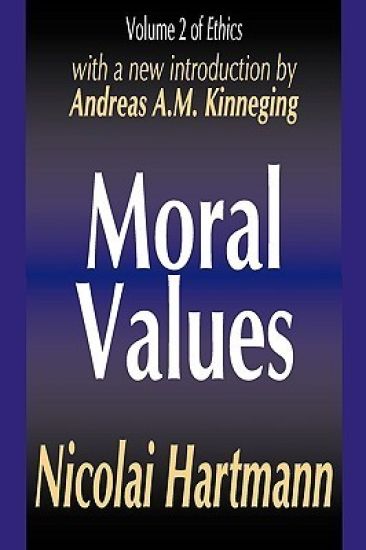
Moral Values

Moral Values

Nicolai Hartmann

Routledge
2017
sidottu
Nicolai Hartmann (1882-1950), along with Henri Bergson and Martin Heidegger, was instrumental in restoring metaphysics to the study of philosophy. Unlike his contemporaries, however, Hartmann was clearly influenced by Plato. His tour-de-force, Ethik, published in English in 1932 as Ethics, may be the most outstanding work on moral philosophy produced in the twentieth century.In the first part of Ethics (Moral Phenomena), Hartmann was concerned with the structure of ethical phenomena, and criticized utilitarianism, Kantianism, and relativism as misleading approaches. In the second part, Moral Values, the author describes all values as forming a complex and as yet imperfectly known system. The actualization of the non-moral and elementary moral values is a necessary condition for the actualization of the higher values. It is on this account that rudimentary values have a prior claim.Hartmann outlines the main features of the chief virtues, and shows that the moral disposition required in any exigency is always a specific synthesis of various and often conflicting values. Specifically describing fundamental moral values-such as goodness, nobility, and vitality-and special moral values-such as justice, wisdom, courage, self-control, trustworthiness, and modesty-Hartmann takes theoretical philosophy and brings it very much into the realm of the practical.A compelling and insightful volume, Moral Values remains an essential contribution to the moral and ethical literature of the twentieth century. Hartmann offers a self-contained system of ethics that yet offers a conservative outlook on social life.
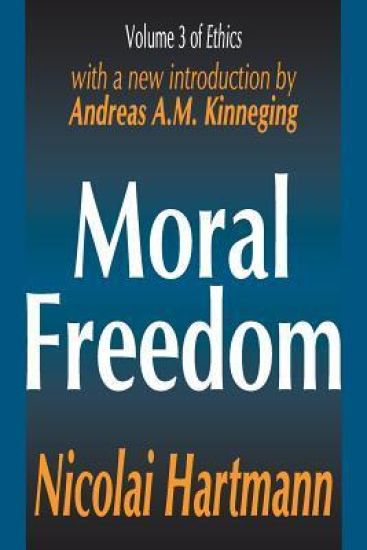
Moral Freedom

Moral Freedom

Nicolai Hartmann

Routledge
2017
sidottu
Ethics is Nicolai Hartmann's magnum opus on moral philosophy. Volume 1, Moral Phenomena, is concerned with the nature and structure of ethical phenomena. Volume 2, Moral Values, describes all values as forming a complex and imperfectly known system. The final volume, Moral Freedom, deals with one of the oldest puzzles in both philosophy and theology: the individual's freedom of the will.Freedom of the will is a necessary precondition of morality. Without it, there is no morality in the full sense of the word. In Moral Freedom Hartmann sets out to refute the determinist view that freedom of the will is impossible. Following Kant, while rejecting his transcendentalism, Hartmann first discusses the tension between causality and the freedom of the will.The tension between the determination by moral values and the freedom of the will is next examined, a crucial issue completely overlooked by Kant and virtually all other modern philosophers, but recognized by the scholastics. Why should we believe in the freedom of the will with regard to the moral values? Are there good reasons for thinking that it exists? If freedom of the will vis-a-vis the moral values does exist, how is it to be conceived? Moral Freedom concludes with the famous postscript on the antinomies between ethics and religion.Hartmann's Ethics may well be the most outstanding treatise on moral philosophy in the twentieth century. Andreas Kinneging's introduction sheds light on the volume's continuing relevance.
Aesthetics

Aesthetics

Nicolai Hartmann

De Gruyter
2017
nidottu
The book is the first English translation of Nicolai Hartmann's final book, published in 1953. It will be of value to graduate students in philosophy, scholars concerned with 20th century Continental philosophy, students of aesthetics and art history and criticism, and persons in and out of academic philosophy who wish to develop their aesthetic understanding and responsiveness to art and music. Aesthetics, Hartmann believes, centers on the phenomenon of beauty, and art “objectivates” beauty, but beauty exists only for a prepared observer. Part One explores the act of aesthetic appreciation and its relation to the aesthetic object. It discovers phenomenologically determinable levels of apprehension.Beauty appears when an observer peers through the physical foreground of the work into the strata upon which form has been bestowed by an artist in the process of expressing some theme. The theory of the stratification of aesthetic objects is perhaps Hartmann's most original and fundamental contribution to aesthetics. He makes useful and perceptive distinctions between the levels in which beauty is given to perception by nature, in the performing and the plastic arts, and in literature of all kinds. Part Two develops the phenomenology of beauty in each of the fine arts. Then Hartmann explores some traditional categories of European aesthetics, most centrally those of unity of value and of truth in art. Part Three discusses the forms of aesthetic values. Hartmann contrasts aesthetic values with moral values, and this exploration culminates in an extensive phenomenological exhibition of three specific aesthetic values, the sublime, the charming, and the comic. A brief appendix, never completed by the author, contains some reflections upon the ontological implications of aesthetics. Engaged in constant dialogue with thinkers of the past, especially with Aristotle, Kant and Hegel, Hartmann corrects and develops their insights by reference to familiar phenomena of art, especially with Shakespeare, Rembrandt and Greek sculpture and architecture. In the course of his analysis, he considers truth in art (the true-to-life and the essential truth), the value of art, and the relation of art and morality. The workstands with other great 20th century contributors to art theory and philosophical aesthetics: Heidegger, Sartre, Croce, Adorno, Ingarden, and Benjamin, among others.
Ethics

Ethics

Nicolai Hartmann

Routledge
2015
nidottu
This volume is devoted to the thesis that morality is possible only in a world determined throughout, mentally as well as physically, by the law of cause and effect. But as organic life, although deupon mechanical laws, cannot be explained by them, so moral life cannot be explained by physiological and psychological processes. Responsibility, imputability, and the sense of guilt imply that man is free to do otherwise than he actually does. If man is not free in this sense, then his consciousness of responsibility and of guilt is a delusion. He is in fact determined neither by the moral law nor by the laws of nature, but is self-determined.
Ethics

Ethics

Nicolai Hartmann

Routledge
2015
nidottu
Volume 1: After pointing out the errors involved in ethical naturalism, the author proceeds to refute Kant's teaching that the moral law, because discerned a priori, issues from Reason and is a self-legislation of the rational will. Against this view Plato's position is upheld, that all values and the Ought constitute an objective, absolute realm of essences which man discovers a priori, but which no more emanate from Reason than do the principles of mathematics and logic.
Aesthetics

Aesthetics

Nicolai Hartmann

De Gruyter
2014
sidottu
The book is the first English translation of Nicolai Hartmann's final book, published in 1953. It will be of value to graduate students in philosophy, scholars concerned with 20th century Continental philosophy, students of aesthetics and art history and criticism, and persons in and out of academic philosophy who wish to develop their aesthetic understanding and responsiveness to art and music. Aesthetics, Hartmann believes, centers on the phenomenon of beauty, and art “objectivates” beauty, but beauty exists only for a prepared observer. Part One explores the act of aesthetic appreciation and its relation to the aesthetic object. It discovers phenomenologically determinable levels of apprehension. Beauty appears when an observer peers through the physical foreground of the work into the strata upon which form has been bestowed by an artist in the process of expressing some theme. The theory of the stratification of aesthetic objects is perhaps Hartmann's most original and fundamental contribution to aesthetics. He makes useful and perceptive distinctions between the levels in which beauty is given to perception by nature, in the performing and the plastic arts, and in literature of all kinds. Part Two develops the phenomenology of beauty in each of the fine arts. Then Hartmann explores some traditional categories of European aesthetics, most centrally those of unity of value and of truth in art. Part Three discusses the forms of aesthetic values. Hartmann contrasts aesthetic values with moral values, and this exploration culminates in an extensive phenomenological exhibition of three specific aesthetic values, the sublime, the charming, and the comic. A brief appendix, never completed by the author, contains some reflections upon the ontological implications of aesthetics. Engaged in constant dialogue with thinkers of the past, especially with Aristotle, Kant and Hegel, Hartmann corrects and develops their insights by reference to familiar phenomena of art, especially with Shakespeare, Rembrandt and Greek sculpture and architecture. In the course of his analysis, he considers truth in art (the true-to-life and the essential truth), the value of art, and the relation of art and morality. The work stands with other great 20th century contributors to art theory and philosophical aesthetics: Heidegger, Sartre, Croce, Adorno, Ingarden, and Benjamin, among others.

Studien zur Neuen Ontologie und Anthropologie
This textbook includes important texts by Hartmann, some of them virtually inaccessible before, with a concise introduction to the central themes in Hartmann’s thought. There has been a recent renaissance of interest in his “new ontology”both as systematic theory and in philosophical anthropology. This text serves as an ideal introduction to Hartmann and as a supplement in courses on metaphysics, anthropology, and 20th century philosophy.
Possibility and Actuality

Possibility and Actuality

Nicolai Hartmann

De Gruyter
2013
sidottu
Nicolai Hartmann's Possibility and Actuality is the second volume of a four-part investigation of ontology. It deals with such questions as: How do we know that something is really possible? Is the possible only the actual? Is the actual only the possible? What is the difference between ideal and real possibility? This groundbreaking work of modal analysis describes the logical relations between possibility, actuality, and necessity, and it provides insight into the relations between modes of knowledge and modes of being. Hartmann reviews the history of philosophical concepts of possibility and necessity, from ancient Megarian philosophy to Aristotle, to Medieval Scholasticism, to Leibniz, Kant, and Hegel. He explains the importance of modal analysis as a basic investigative tool, and he proposes an approach to understanding the nature of human existence that unifies the fields of ontology, modal logic, metaphysics, and epistemology. This brilliant and fascinating work is relevant to many topics of debate in contemporary philosophy, including the ontology of possible worlds, the metaphysics of modality, the logic of counterfactual conditionals, and modal epistemology. It illuminates the nature of real, ideal, logical, and epistemic possibility.
Moral Freedom

Moral Freedom

Nicolai Hartmann

Transaction Publishers
2004
nidottu
Ethics is Nicolai Hartmann's magnum opus on moral philosophy. Volume 1, Moral Phenomena, is concerned with the nature and structure of ethical phenomena. Volume 2, Moral Values, describes all values as forming a complex and imperfectly known system. The final volume, Moral Freedom, deals with one of the oldest puzzles in both philosophy and theology: the individual's freedom of the will.Freedom of the will is a necessary precondition of morality. Without it, there is no morality in the full sense of the word. In Moral Freedom Hartmann sets out to refute the determinist view that freedom of the will is impossible. Following Kant, while rejecting his transcendentalism, Hartmann first discusses the tension between causality and the freedom of the will.The tension between the determination by moral values and the freedom of the will is next examined, a crucial issue completely overlooked by Kant and virtually all other modern philosophers, but recognized by the scholastics. Why should we believe in the freedom of the will with regard to the moral values? Are there good reasons for thinking that it exists? If freedom of the will vis-a-vis the moral values does exist, how is it to be conceived? Moral Freedom concludes with the famous postscript on the antinomies between ethics and religion.Hartmann's Ethics may well be the most outstanding treatise on moral philosophy in the twentieth century. Andreas Kinneging's introduction sheds light on the volume's continuing relevance.
Moral Values

Moral Values

Nicolai Hartmann

Transaction Publishers
2002
nidottu
Nicolai Hartmann (1882-1950), along with Henri Bergson and Martin Heidegger, was instrumental in restoring metaphysics to the study of philosophy. Unlike his contemporaries, however, Hartmann was clearly influenced by Plato. His tour-de-force, Ethik, published in English in 1932 as Ethics, may be the most outstanding work on moral philosophy produced in the twentieth century.In the first part of Ethics (Moral Phenomena), Hartmann was concerned with the structure of ethical phenomena, and criticized utilitarianism, Kantianism, and relativism as misleading approaches. In the second part, Moral Values, the author describes all values as forming a complex and as yet imperfectly known system. The actualization of the non-moral and elementary moral values is a necessary condition for the actualization of the higher values. It is on this account that rudimentary values have a prior claim.Hartmann outlines the main features of the chief virtues, and shows that the moral disposition required in any exigency is always a specific synthesis of various and often conflicting values. Specifically describing fundamental moral values-such as goodness, nobility, and vitality-and special moral values-such as justice, wisdom, courage, self-control, trustworthiness, and modesty-Hartmann takes theoretical philosophy and brings it very much into the realm of the practical.A compelling and insightful volume, Moral Values remains an essential contribution to the moral and ethical literature of the twentieth century. Hartmann offers a self-contained system of ethics that yet offers a conservative outlook on social life.
Ethics

Ethics

Nicolai Hartmann

Routledge
2002
sidottu
This volume is devoted to the thesis that morality is possible only in a world determined throughout, mentally as well as physically, by the law of cause and effect. But as organic life, although deupon mechanical laws, cannot be explained by them, so moral life cannot be explained by physiological and psychological processes. Responsibility, imputability, and the sense of guilt imply that man is free to do otherwise than he actually does. If man is not free in this sense, then his consciousness of responsibility and of guilt is a delusion. He is in fact determined neither by the moral law nor by the laws of nature, but is self-determined.
Ethics

Ethics

Nicolai Hartmann

Routledge
2002
sidottu
Volume 1: After pointing out the errors involved in ethical naturalism, the author proceeds to refute Kant's teaching that the moral law, because discerned a priori, issues from Reason and is a self-legislation of the rational will. Against this view Plato's position is upheld, that all values and the Ought constitute an objective, absolute realm of essences which man discovers a priori, but which no more emanate from Reason than do the principles of mathematics and logic.