Kirjailija
Nicolas Malebranche
Kirjat ja teokset yhdessä paikassa: 37 kirjaa, julkaisuja vuosilta 1968-2025, suosituimpien joukossa Oeuvres de Malebranche. Vertaile teosten hintoja ja tarkista saatavuus suomalaisista kirjakaupoista.
Mukana myös kirjoitusasut: Nicolas. Malebranche, Nicolás Malebranche
37 kirjaa
Kirjojen julkaisuhaarukka 1968-2025.
Trait De Morale De Malebranche is a seminal work by Nicolas Malebranche, the renowned 17th-century French philosopher. This treatise delves into the intricacies of moral philosophy, exploring fundamental questions about human nature, ethics, and the pursuit of virtue. Malebranche's unique perspective, influenced by both Cartesian philosophy and Augustinian theology, offers a profound exploration of the relationship between reason, passion, and divine will. In this work, Malebranche articulates his vision of morality as grounded in the love of God and the rational understanding of the natural order. He provides insights into the nature of good and evil, the role of grace in moral development, and the path to achieving true happiness. A cornerstone of early modern philosophy, Trait De Morale De Malebranche continues to be studied for its historical significance and enduring philosophical insights. This work has been selected by scholars as being culturally important, and is part of the knowledge base of civilization as we know it. This work was reproduced from the original artifact, and remains as true to the original work as possible. Therefore, you will see the original copyright references, library stamps (as most of these works have been housed in our most important libraries around the world), and other notations in the work. This work is in the public domain in the United States of America, and possibly other nations. Within the United States, you may freely copy and distribute this work, as no entity (individual or corporate) has a copyright on the body of the work. As a reproduction of a historical artifact, this work may contain missing or blurred pages, poor pictures, errant marks, etc. Scholars believe, and we concur, that this work is important enough to be preserved, reproduced, and made generally available to the public. We appreciate your support of the preservation process, and thank you for being an important part of keeping this knowledge alive and relevant.



R impression inchang e de l' dition originale de 1882.

R impression inchang e de l' dition originale de 1882.


The Meditations chretiennes et metaphysiques represent a renewed attempt to delve into the theoretical themes of the Recherche de la verite and the Conversations chretiennes. Their strategy consists in making God himself speak, the eternal Word, who teaches and enlightens all minds.
Traité De L'infini Créé: Avec L'explication De La Possibilite De La Transsubstantiation: Traité De La Confession & De La Communion
Nicolas Malebranche
Creative Media Partners, LLC
2018
sidottu

Entretiens Sur La Metaphysique Et Sur La Religion
Nicolas Malebranche
Librarie Philosophique J. Vrin
2017
nidottu
Les Entretiens sur la metaphysique et sur la religion (1688) sont de tous les ouvrages de Malebranche le plus acheve. Veritable oeuvre litteraire, temoignant d'une maitrise magnifique de l'art du dialogue, ces quatorze entretiens sont un modele de pedagogie: l'homme n'instruit pas l'homme, dit l'oratorien qui se presente non comme un maitre, mais en tant que simple moniteur. Veritable somme philosophique, aussi, qui depasse la querelle avec Arnauld et porte le lecteur de la connaissance de l'esprit de l'homme a la connaissance de Dieu, lui offrant ainsi une synthese metaphysique qui est en meme temps une montee vers Dieu. Le texte est etabli a partir de la derniere edition parue du vivant de Malebranche en 1711. L'orthographe et la ponctuation sont modernisees, les citations latines traduites.
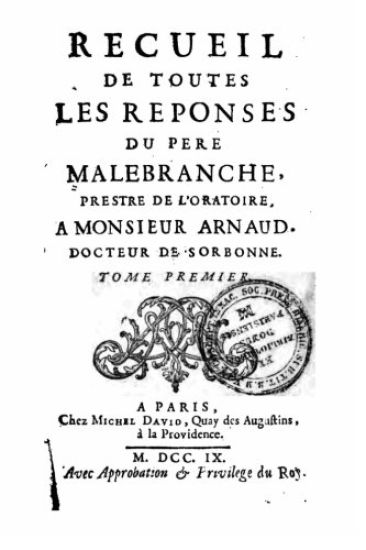
Recueil de toutes les réponses du père Malebranche - Tome I
Nicolas Malebranche
Createspace Independent Publishing Platform
2016
nidottu
Recueil de toutes les r ponses du p re Malebranche - Tome I by Nicolas Malebranche. This book is a reproduction of the original book published in 1709 and may have some imperfections such as marks or hand-written notes.
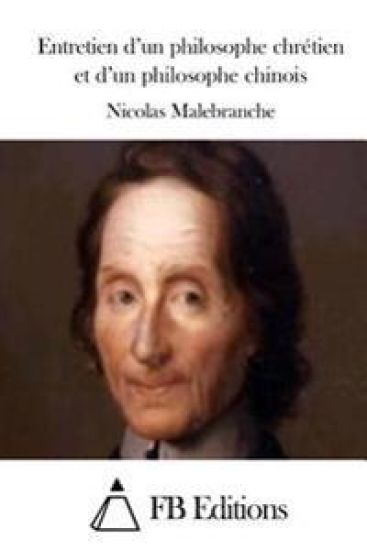
Entretien d'un philosophe chrétien et d'un philosophe chinois
Nicolas Malebranche
Createspace Independent Publishing Platform
2015
nidottu
"Entretien d'un philosophe chr tien et d'un philosophe chinois" de Nicolas Malebranche. Philosophe, pr tre oratorien et th ologien fran ais (1638-1715).
First published in 2002. This is Volume XI of seventeen in the Library of Philosophy series on Metaphysics. Written in 1923, this study of Malebranche’s philosophical system, translated from ‘Entretiens sur la Metaphysique’, dialogues on metaphysics and religion.
De La Recherche De La Vérité... - Primary Source Edition
Nicolás Malebranche
Nabu Press
2013
pokkari
explanation might be understood in relationship to our mental, moral, and spiritual life, leapt to his attention and was to occupy it from that day until his death. II. MALEBRANCHE'S THEORY OF BEING His fIrst work, The Search After Truth, appeared from 1674-76, some fourteen to sixteen years after his dramatic encounter with Descartes' work; to this day it is the only work unfailingly associated with his name, though it was the first of nine studies and several volumes of responses in which he went on to explore and develop his thought. Malebranche criticizes the prevailing theories of sense perception, imagination, memory and cognition, and fIrst proposes his own theory of how we acquire and evaluate ideas - from mathematical to physical, and moral to self-reflective. Underlying this theory is his rejection of Scholastic Aristotelian metaphysics, in which particular beings are said to have powers or forms that act on our minds to inform us. Malebranche - here in company with other critics . of that metaphysics from Montaigne to Bacon and Hobbes - argues that the prevailing view of beings endowed with powers by which they act unilaterally, as "causes" in the full sense of that word, makes no sense and cannot be confirmed by experience. For Malebranche, on the other hand, power can be predicated univocally only of God. Created beings have only that limited power given by God under the conditions of creation.