Kirjojen hintavertailu. Mukana 12 390 323 kirjaa ja 12 kauppaa.

Kirjailija

Nicolas Spulber

Kirjat ja teokset yhdessä paikassa: 11 kirjaa, julkaisuja vuosilta 1976-2012, suosituimpien joukossa The American Economy. Vertaile teosten hintoja ja tarkista saatavuus suomalaisista kirjakaupoista.

11 kirjaa

Kirjojen julkaisuhaarukka 1976-2012.

Russia's Economic Transitions

Russia's Economic Transitions

Nicolas Spulber

Cambridge University Press
2003
sidottu
Russia's Economic Transitions examines the three major transformations that the country underwent from the early 1860s to 2000. The first transition, under Tsarism, involved the partial break-up of the feudal framework of land ownership and the move toward capitalist relations. The second, following the Communist revolution of 1917, brought to power a system of state ownership and administration - a sui generis type of war-economy state capitalism - subjecting the economy's development to central commands. The third, started in the early 1990s and still unfolding, is aiming at reshaping the inherited economic fabric on the basis of private ownership. The three transitions originated within different settings, but with a similar primary goal, namely the changing of the economy's ownership pattern in the hopes of providing a better basis for subsequent development. The treatment's originality, impartiality and historical breadth have cogent economic, social and political relevance.

Redefining the State

Redefining the State

Nicolas Spulber

Cambridge University Press
1997
sidottu
Redefining the State examines in historical perspective the changes of the role of the state with regard to public ownership and the scope of welfare in the main industrial and transitional economies. These changes have given rise to illuminating debates on the state's size, range, and function, and have involved important transformations concerning the boundaries between the public and private sector, the forms and extent of privatization, and the nature and content of public welfare. These debates and transformations are of critical importance to understanding the actual and potential scope of the state in any economy.
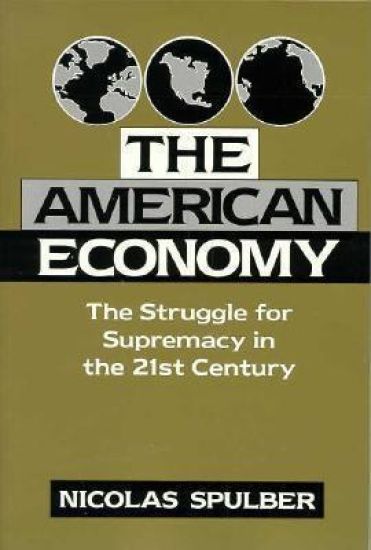
The American Economy

The American Economy

Nicolas Spulber

Cambridge University Press
1997
pokkari
This work focuses on the economic challenges the American economy has faced during the post-World War II era, and on the new challenges - represented notably by the competing economies of Japan, Germany, and of the entire European Union - which confront it as the twenty-first century approaches. Professor Spulber presents a detailed critique of the thesis alleging that the American economy has experienced some kind of decline, and also argues that the economy will continue to move forward energetically and successfully if growth and change are primarily left to emerge from the impulses and incentives of the private economy.
Economics of Water Resources: From Regulation to Privatization
The appearance of this Second Edition has been encouraged by the favorable reception of the first. This has offered us the opportunity to update the materials and to expand the exposition ofour central theses concerning (1) the integration of water quantity-quality issues and the treatment of water as a multi-product commodity, with the market playing a major role in determining water quality-discriminant pricing; (2) the drawbacks of public controls, regulation and enforcement, and the need to expand privatization of water supply and of water and wastewater treatment facilities to ensure their appropriate development and modernization through increased reliance on private capital; (3) the unification and centralization of water management on the river basin level in order to handle effectively the expanding pressures for water availability, for the elimination of waterborne disease, for extensive and effective pollution abatement as well as coping with the related issues of soil erosion, siltation in streams, channels, and reservoirs, protection against distress from drought and floods, and with the myriad problems relating to the environment, recreation, and navigation. We have maintained the division ofthe book into four major parts and 12 chapters.
Organizational Alternatives in Soviet-Type Economies

Organizational Alternatives in Soviet-Type Economies

Nicolas Spulber

Cambridge University Press
2011
pokkari
In this volume, which was originally published in 1979, an essay of analysis prefaces a collection of translated papers from Eastern Europe. The juxtaposition of analysis and original documents from Eastern European authorities (both revered there and disgraced) enables the reader to join in the experience of interpretation. The essay (Part I) provides an analysis of the mechanisms of Soviet-type economies. It concentrates on four issues: decision-making processes; the limits upon the choices made; practical implementation of the choices; and the objectives implied by them. This ends with an explanation of the relatively scant application of economic principles to the operation of this type of economic system. Part II is a reader consisting of appropriately chosen original texts from Eastern European sources grouped into sections on administration, resource allocation, planning and incentives. The issues are examined in relation to the special conditions which brought them to a head.
Russia's Economic Transitions

Russia's Economic Transitions

Nicolas Spulber

Cambridge University Press
2006
pokkari
Russia's Economic Transitions examines the three major transformations that the country underwent from the early 1860s to 2000. The first transition, under Tsarism, involved the partial break-up of the feudal framework of land ownership and the move toward capitalist relations. The second, following the Communist revolution of 1917, brought to power a system of state ownership and administration - a sui generis type of war-economy state capitalism - subjecting the economy's development to central commands. The third, started in the early 1990s and still unfolding, is aiming at reshaping the inherited economic fabric on the basis of private ownership. The three transitions originated within different settings, but with a similar primary goal, namely the changing of the economy's ownership pattern in the hopes of providing a better basis for subsequent development. The treatment's originality, impartiality and historical breadth have cogent economic, social and political relevance.
Redefining the State

Redefining the State

Nicolas Spulber

Cambridge University Press
2006
pokkari
Redefining the State examines in historical perspective the changes of the role of the state with regard to public ownership and the scope of welfare in the main industrial and transitional economies. These changes have given rise to illuminating debates on the state's size, range, and function, and have involved important transformations concerning the boundaries between the public and private sector, the forms and extent of privatization, and the nature and content of public welfare. These debates and transformations are of critical importance to understanding the actual and potential scope of the state in any economy.
Economics of Water Resources: From Regulation to Privatization
The appearance of this Second Edition has been encouraged by the favorable reception of the first. This has offered us the opportunity to update the materials and to expand the exposition ofour central theses concerning (1) the integration of water quantity-quality issues and the treatment of water as a multi-product commodity, with the market playing a major role in determining water quality-discriminant pricing; (2) the drawbacks of public controls, regulation and enforcement, and the need to expand privatization of water supply and of water and wastewater treatment facilities to ensure their appropriate development and modernization through increased reliance on private capital; (3) the unification and centralization of water management on the river basin level in order to handle effectively the expanding pressures for water availability, for the elimination of waterborne disease, for extensive and effective pollution abatement as well as coping with the related issues of soil erosion, siltation in streams, channels, and reservoirs, protection against distress from drought and floods, and with the myriad problems relating to the environment, recreation, and navigation. We have maintained the division ofthe book into four major parts and 12 chapters.
The American Economy

The American Economy

Nicolas Spulber

Cambridge University Press
1995
sidottu
This work focuses on the economic challenges the American economy has faced during the post-World War II era, and on the new challenges - represented notably by the competing economies of Japan, Germany, and of the entire European Union - which confront it as the twenty-first century approaches. Professor Spulber presents a detailed critique of the thesis alleging that the American economy has experienced some kind of decline, and also argues that the economy will continue to move forward energetically and successfully if growth and change are primarily left to emerge from the impulses and incentives of the private economy.