

Kirjailija
Nigel Davies
Kirjat ja teokset yhdessä paikassa: 28 kirjaa, julkaisuja vuosilta 2002-2025, suosituimpien joukossa Starting Out: The Modern. Vertaile teosten hintoja ja tarkista saatavuus suomalaisista kirjakaupoista.
28 kirjaa
Kirjojen julkaisuhaarukka 2002-2025.

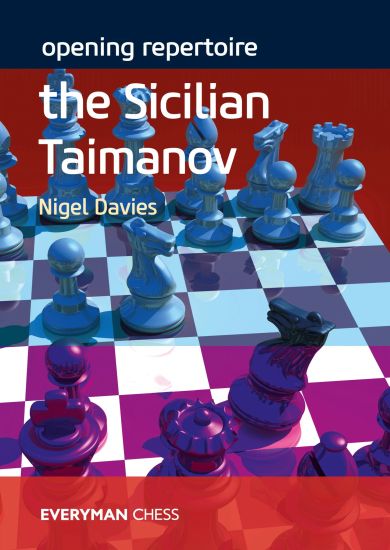
The Sicilian Taimanov (1 e4 c5 2 Nf3 e6 3 d4 cxd4 4 Nxd4 Nc6) is a very flexible Black system in the Sicilian Defence developed by Mark Taimanov. It is characterised by the development of the g8-knight on e7, often along with a quick ...b7-b5. The Taimanov often leads to tense, dynamic position which are ripe in counterattacking possibilities. In Opening Repertoire: The Sicilian Taimanov, highly experienced chess author and coach Nigel Davies guides the reader through the complexities of the Taimanov and carves out a repertoire for Black. He examines all aspects of this highly complex opening and provides the reader with well-researched, fresh, and innovative analysis. Each annotated game has valuable lessons on how to play the opening and contains instructive commentary on typical middlegame plans. There are also suggestions for countering White’s “anti-Sicilian” tries thus creating an entire repertoire to meet 1 e4. * A complete repertoire for Black against 1 e4. * A question and answer approach provides an excellent study method. * All key variations analysed in detail.
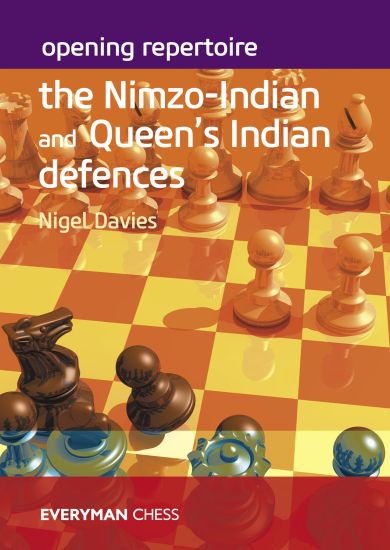
Opening Repertoire: The Nimzo-Indian and Queen's Indian Defences
Nigel Davies
Everyman Chess
2021
nidottu
The Nimzo-Indian Defence (1 d4 Nf6 2 c4 e6 3 Nc3 Bb4) and the Queen's Indian Defence (1 d4 Nf6 2 c4 e6 3 Nf3 b6) are two classic systems for Black to meet 1 d4. They are popular at all levels and have been played by virtually every world champion. They enable Black to gain a firm foothold in the centre at an early stage and White is not permitted the easy space advantage that occurs with many other defences to 1 d4. Black does not seek to engage White in immediate battle but postpones conflict for the middlegame when an understanding of themes and plans will be paramount. In Opening Repertoire: The Nimzo-Indian and Queen's Indian Defences, highly experienced chess author and coach Nigel Davies guides the reader through the complexities of these two lines and carves out a repertoire for Black. He examines all aspects of these complex systems and provides the reader with well-researched, fresh, and innovative analysis. Each annotated game has valuable lessons on how to play the opening and contains instructive commentary on typical middlegame plans. * A complete repertoire for Black against 1 d4. * A question and answer approach provides an excellent study method.

The Grünfeld Defence is is a combative reply to 1 d4 which has been favoured by many world champions including those two legends of the game, Bobby Fischer and Garry Kasparov. It is an opening in the hypermodern style, in that Black generally allows White to build a strong centre early on in the expectation of being able to undermine it in the middlegame play. Opening Repetoire: The Grünfeld Defence book cuts through the dense theory that surrounds this opening and establishes a straightforward repertoire is based around consistent strategies and concepts. It has all the information necessary to enable the reader to begin playing the Grünfeld with confidence. There are also “Grünfeld-type” suggestions to counter White systems based on the English and Réti openings. In Opening Repertoire: The Grünfeld Defence, Nigel Davies guides the reader through the complexities of the Grünfeld and carves out a repertoire for Black. He examines all aspects of this highly complex opening and provides the reader with well-researched, fresh, and innovative analysis. Each annotated game has valuable lessons on how to play the opening and contains instructive commentary on typical middlegame plans. * A complete repertoire for Black against 1 d4. * A question and answer approach provides an excellent study method.
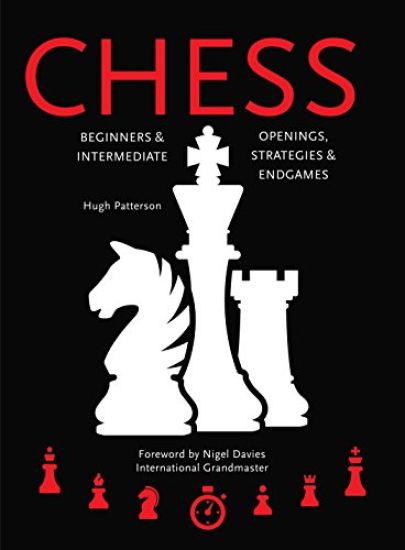
Chess is a popular and fascinating game, it’s good for the mind, and satisfying to play with others, in clubs, or alone, in travel, against a computer, or an app. This new book will take you quickly through the movement of the pieces to good opening strategies, middle game techniques, and how to either finish off or defend against your opponent.
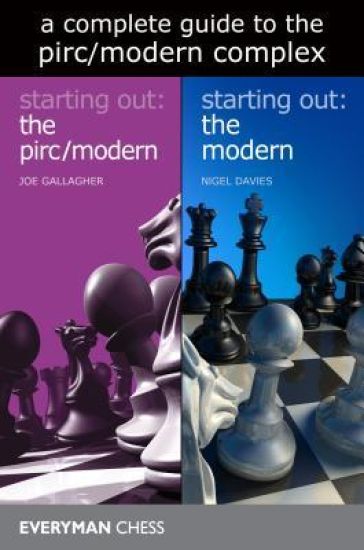
Everyman Chess's Starting Out series has firmly established itself as the leading guide to studying openings for up-and-coming players. These books are distinguished by their easy-to-read layout, the lucid explanations of the fundamentals, and the abundance of notes, tips and warnings to help the reader absorb vital ideas. Now brought together in one volume are...Starting Out: The Pirc/Modern by Joe Gallagher.

Two winning books in one volume. 10 Great Ways get better at Chess by Nigel Davies How can you improve at chess? This is the eternal question asked by players of all levels. Which part of the game should you focus on? How often should you play? Should you change your opening repertoire? What's the best way to learn from your defeats? So many questions ... and yet direct answers are hard to find. In this book Grandmaster Nigel Davies provides that direction. He examines the methods used by a number of players who were looking to improve their game, and how they went about achieving their goal. He has drawn heavily on the games and thoughts of players who have been his students over the years and experienced a clear improvement in their play. Break the Rules!: A Modern Look at Chess Strategy by Neil McDonald In this instructive book, Grandmaster Neil McDonald studies in depth the key components of successful rule-breaking in chess. As we progress as chess players we quickly learn a set of guidelines which help us to formulate plans, develop typical strategies and recognize key tactics. However, chess is not an easy game, with fixed 'rules' that can be applied to every single position. In fact, blindly following such rules proves to be counterproductive and prevents a player from moving on to the next level, whereas knowing when to 'break' these rules is precisely the skill which separates the best from the rest.
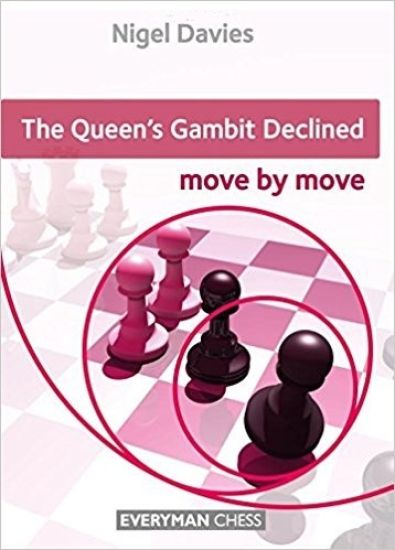
The Queen's Gambit Declined is one of the central pillars of chess opening theory. Virtually every world champion has played the opening with both the white and black pieces and it is a great favourite at all levels in chess. The reason for its enduring popularity is that it is rich in the classic strategic themes. Either side can end up with an isolated d-pawn, White can pursue a queenside initiative while Black counters on the other wing or White can attempt to build a powerful centre that Black hopes to undermine. ----- The Move by Move series provides an ideal format for the keen chessplayer to improve their game. While reading you are continually challenged to answer probing questions - a method that greatly encourages the learning and practising of vital skills just as much as the traditional assimilation of chess knowledge. Carefully selected questions and answers are designed to keep you actively involved and allow you to monitor your progress as you learn. This is an excellent way to study chess while providing the best possible chance to retain what has been learnt. ----- * Everything you need to know about the Queen's Gambit Declined . --- * The Q and A approach emphasizes plans and strategies. --- * Written by an expert on the opening.

* Are you fearless in your approach to chess openings? --- * Do you like to attack your opponents from the very beginning?--- * Are you happy to take calculated risks? --- * Do you loathe trivial positional chess? --- * Do you feel the need to sacrifice pawns early in the game? --- * Are you a Gambiteer? ----- If the answer to these questions is 'Yes'! then these are the books for you. ----- In this two volume book, published together for the first time, opening expert Nigel Davies produces a complete repertoire which is certainly not for the fainted-hearted: uncompromising and wild attacking ideas for both colours. The first volume deals with a gambit style approach for White; the second volume concentrates on an ambitious Black repertoire. All of the opening lines Davies advocates in Volume 1 lead to positions of open warfare, where sharp, tactical play completely dominates dreary positional sacrifices. In Volume 2, Davies produces an ambitious and uncompromising repertoire for Black. His two main choices are the Albin Counter Gambit and the Schlieman Gambit, the pick of the crop having been tried and tested by some of the World's most inventive players.

This series provides an ideal platform to study chess openings. By continually challenging the reader to answer probing questions throughout the book, the Move by Move format greatly encourages the learning and practicing of vital skills just as much as the traditional assimilation of opening knowledge. Carefully selected questions and answers are designed to keep you actively involved and allow you to monitor your progress as you learn. This is an excellent way to study any chess opening and at the same time improve your general chess skills and knowledge. The Pirc Defense is a dynamic counter-attacking option for Black. The initial strategy is to allow White to construct an impressive-looking pawn center, but the plan is to attack this center later on with both pieces and pawns, with the ultimate aim of destroying it completely. This ambitious and provocative approach by Black carries some risk but it can often lead to rich rewards, and the Pirc has always been popular among players who are aiming for more than just dry equality. In this book, Grandmaster Nigel Davies invites you to join him in a study of the Pirc Defense and its many variations. He shares his experience and knowledge with the opening, provides repertoire options for Black, offers answers to all the key questions and tells you everything you need to know about playing the Pirc Defense. *Essential guidance and training in the Pirc *Written by a renowned Pirc expert *Utilizes an ideal approach to chess study

Pervasive Displays
Nigel Davies; Sarah Clinch; Florian Alt
Springer International Publishing AG
2014
nidottu
Fueled by falling display hardware costs and rising demand, digital signage and pervasive displays are becoming ever more ubiquitous. Such systems have traditionally been used for advertising and information dissemination, with digital signage commonplace in shopping malls, airports and public spaces. While advertising and broadcasting announcements remain important applications, developments in sensing and interaction technologies are enabling entirely new classes of display applications that tailor content to the situation and audience of the display. As a result, signage systems are beginning to transition from simple broadcast systems to rich platforms for communication and interaction. In this lecture, we provide an introduction to this emerging field for researchers and practitioners interested in creating state-of-the-art pervasive display systems. We begin by describing the history of pervasive display research, providing illustrations of key systems, from pioneering work on supporting collaboration to contemporary systems designed for personalized information delivery. We then consider what the near future might hold for display networks -- describing a series of compelling applications that are being postulated for future display networks. Creating such systems raises a wide range of challenges and requires designers to make a series of important trade-offs. We dedicate four chapters to key aspects of pervasive display design: audience engagement, display interaction, system software, and system evaluation. These chapters provide an overview of current thinking in each area. Finally, we present a series of case studies of display systems and our concluding remarks.
How can you improve at chess? This is the eternal question asked by players of all levels. Which part of the game should you focus on? How often should you play? Should you change your opening repertoire? What's the best way to learn from your defeats? So many questions ...and yet direct answers are hard to find. It's no wonder aspiring players are left bewildered and in need of direction. In this book grandmaster Nigel Davies provides that direction. He examines the methods used by a number of players who were looking to improve their game, and how they went about achieving their goal. He has drawn heavily on the games and thoughts of players who have been his students over the years and experienced a clear improvement in their play. Finding the path towards improvement can prove difficult without the right guidance. This book will demonstrate the route to take. *A major study of chess improvement *Written by a renowned chess trainer *Tackles all areas of the game
The Rules of Winning Chess provides you with the key fundamentals of the game, principles that you can easily learn and remember, and that will help you to achieve both greater understanding and enjoyment of chess.
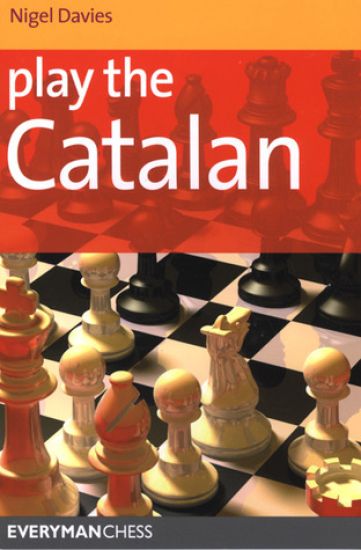
The Catalan is a sophisticated and wide-ranging opening system which is popular at all levels of chess. In recent years it has been catapulted into the limelight by Vladimir Kramnik, who has revitalized it with many new ideas and has utilized it with great success against the world's strongest players - on occasion making it look like a forced win for White! In this book, Grandmaster Nigel Davies presents a major study of this important opening. Drawing upon his wealth of personal experience with the Catalan, Davies provides a reliable and dynamic repertoire for White, covers the keys plans for both sides, and tackles crucial modern day issues such as move orders.


Grandmaster Nigel Davies revisits the fundamentals of the Modern Defence, studying in depth the crucial early moves and plans for both sides. This book is ideal for up-and-coming players.

The DRCOG (Diploma) is an examination for doctors who wish to offer obstetrics, gynaecology and other aspects of women's health care in a primary care setting (GP surgeries, walk-in centres and family planning clinics). This book provides a comprehensive guide to the new style DRCOG examination which was introduced in October 2007. It includes: an overview of the curriculum and syllabus a guide to the format of the DRCOG examination sample questions for each of the question formats: extended matching questions (EMQs), single best answer questions (SBAs) and multiple choice questions (MCQs) six sample papers answers to all of the sample questions and papers tips for candidates."
Sie haben Schwarz und sind auf der Suche nach einer Art Generalschl ssel, der auf nahezu alle Er ffnungsz ge passt? Gl ckwunsch: Sie haben ihn schon in der Hand Die Moderne Verteidigung ist eine universelle und dynamische Antwort auf praktisch jedes wei e System. Ganz provokant erlauben Sie Wei ein imposantes Bauernzentrum, um es sp ter mit einem gezielten Gegenschlag zu zerst ren. Danach sammeln Sie einfach die berreste ein. Aber Vorsicht - Risiko: Wei kann hoffen, Sie mit seinem Raumvorteil zu erdr cken, und mit einem direkten Angriff Erfolg haben. All dies f hrt zu faszinierenden K mpfen. F r beide Seiten gilt: Schon ein einziger Fehlgriff kann fatal sein. Damit dies nicht passiert, lassen Sie sich vom international renommierten Schachgro meister Nigel Davies in die Geheimnisse der Modernen Verteidigung einweihen. Die Er ffnungsreihe STARTING OUT ist die deutschsprachige Ausgabe der international bekannten englischen STARTING OUT-Serie von Everyman Chess und erscheint in Zusammenarbeit mit der EuroChess Zentrale in K nigswinter. Mit STARTING OUT erlernen Sie spielerisch und schnell ein Er ffnungsrepertoire, mit dem Sie viel Spielfreude in der Partie haben k nnen. Die zahlreichen Tipps, Hinweise und Warnungen bei STARTING OUT sind freundliche Helfer, um Ideen, taktische Tricks und Schl sselprinzipien besser zu verstehen.
Are you fearless in your approach to chess openings? Do you like to attack your opponents from the very beginning? Are you happy to take calculated risks? Do you loathe trivial positional chess? Do you feel the need to sacrifice pawns early in the game? Are you a Gambiteer? If the answer to these questions is 'yes!' then this is the book for you! In his two-volume Gambiteer series, opening expert Nigel Davies produces a complete opening repertoire which is certainly not for the faint-hearted: uncompromising and wild attacking ideas for both colours. Whilst the first volume dealt with a gambit-style approach for White, this second book concentrates on an ambitious Black repertoire. All of the opening lines Davies advocates lead to positions of open warfare, where sharp, tactical play completely dominates dreary, positional subtleties. Are you ready for the battle? Then cry havoc and let slip the dogs of war! *A complete opening repertoire for Black *A feast of blood-thirsty chess *Ideal for the attack-minded player