Kirjailija
NIGEL GILBERT
Kirjat ja teokset yhdessä paikassa: 14 kirjaa, julkaisuja vuosilta 1997-2024, suosituimpien joukossa Analyzing Tabular Data. Vertaile teosten hintoja ja tarkista saatavuus suomalaisista kirjakaupoista.
14 kirjaa
Kirjojen julkaisuhaarukka 1997-2024.
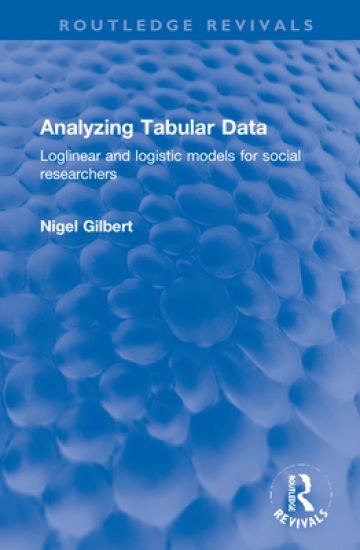
First published in 1993, Analyzing Tabular Data is an accessible text introducing a powerful range of analytical methods. Empirical social research almost invariably requires the presentation and analysis of tables, and this book is for those who have little prior knowledge of quantitative analysis or statistics, but who have a practical need to extract the most from their data. The book begins with an introduction to the process of data analysis and the basic structure of cross-tabulations. At the core of the methods described in the text is the loglinear model. This and the logistic model, are explained and their application to causal modelling, to event history analysis, and to social mobility research are described in detail. Each chapter concludes with sample programs to show how analysis on typical datasets can be carried out using either the popular computer packages, SPSS, or the statistical programme, GLIM. The book is packed with examples which apply the methods to social science research.Sociologists, geographers, psychologists, economists, market researchers and those involved in survey research in the fields of planning, evaluation and policy will find the book to be a clear and thorough exposition of methods for the analysis of tabular data.
Agent-based simulation has become increasingly popular as a modeling approach in the social sciences because it enables researchers to build models where individual entities and their interactions are directly represented. The Second Edition of Nigel Gilbert's Agent-Based Models introduces this technique; considers a range of methodological and theoretical issues; shows how to design an agent-based model, with a simple example; offers some practical advice about developing, verifying and validating agent-based models; and finally discusses how to plan an agent-based modelling project, publish the results and apply agent-based modeling to formulate and evaluate social and economic policies.
Agent-based modelling in economics Lynne Hamill and Nigel Gilbert, Centre for Research in Social Simulation (CRESS), University of Surrey, UK New methods of economic modelling have been sought as a result of the global economic downturn in 2008.This unique book highlights the benefits of an agent-based modelling (ABM) approach. It demonstrates how ABM can easily handle complexity: heterogeneous people, households and firms interacting dynamically. Unlike traditional methods, ABM does not require people or firms to optimise or economic systems to reach equilibrium. ABM offers a way to link micro foundations directly to the macro situation. Key features: Introduces the concept of agent-based modelling and shows how it differs from existing approaches.Provides a theoretical and methodological rationale for using ABM in economics, along with practical advice on how to design and create the models.Each chapter starts with a short summary of the relevant economic theory and then shows how to apply ABM.Explores both topics covered in basic economics textbooks and current important policy themes; unemployment, exchange rates, banking and environmental issues.Describes the models in pseudocode, enabling the reader to develop programs in their chosen language.Supported by a website featuring the NetLogo models described in the book. Agent-based Modelling in Economics provides students and researchers with the skills to design, implement, and analyze agent-based models. Third year undergraduate, master and doctoral students, faculty and professional economists will find this book an invaluable resource.
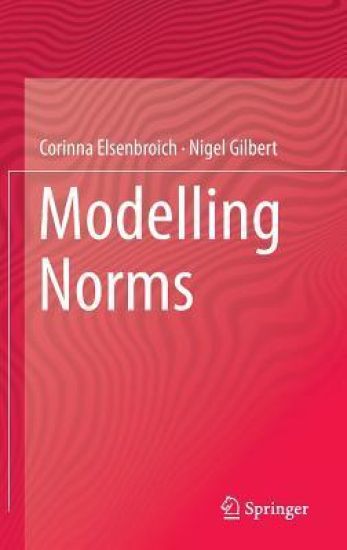
The book focusses on questions of individual and collective action, the emergence and dynamics of social norms and the feedback between individual behaviour and social phenomena. It discusses traditional modelling approaches to social norms and shows the usefulness of agent-based modelling for the study of these micro-macro interactions. Existing agent-based models of social norms are discussed and it is shown that so far too much priority has been given to parsimonious models and questions of the emergence of norms, with many aspects of social norms, such as norm-change, not being modelled. Juvenile delinquency, group radicalisation and moral decision making are used as case studies for agent-based models of collective action extending existing models by providing an embedding into social networks, social influence via argumentation and a causal action theory of moral decision making. The major contribution of the book is to highlight the multifaceted nature of the dynamics of social norms, consisting not only of emergence, and the importance of embedding of agent-based models into existing theory.
This book brings together computer models and simulation approaches that allow the investigation of a wide range of innovation related issues, and hence will be of interest for academics and researchers from a variety of innovation related disciplines.'- Mercedes Bleda, Journal of Artificial Societies and Social SimulationChristopher Watts and Nigel Gilbert explore the generation, diffusion and impact of innovations, which can now be studied using computer simulations.Agent-based simulation models can be used to explain the innovation that emerges from interactions among complex, adaptive, diverse networks of firms, people, technologies, practices and resources. This book provides a critical review of recent advances in agent-based modeling and other forms of the simulation of innovation. Elements explored include: diffusion of innovations, social networks, organizational learning, science models, adopting and adapting, and technological evolution and innovation networks. Many of the models featured in the book can be downloaded from the book's accompanying website.Bringing together simulation models from several innovation-related fields, this book will prove a fascinating read for academics and researchers in a wide range of disciplines, including: innovation studies, evolutionary economics, complexity science, organization studies, social networks, and science and technology studies. Scholars and researchers in the areas of computer science, operational research and management science will also be interested in the uses of simulation models to improve the understanding of organization.
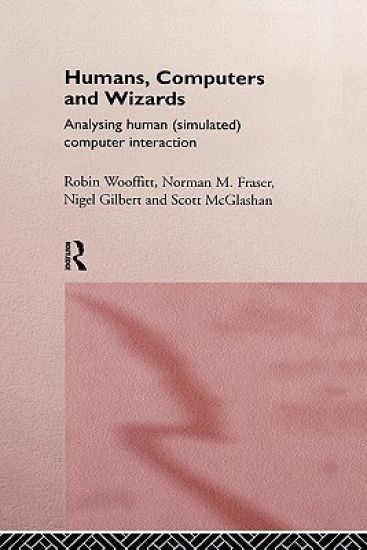
Humans, Computers and Wizards
Norman Fraser; Nigel Gilbert; Scott McGlashan; Robin Wooffitt
Routledge
2014
nidottu
Using data taken from a major European Union funded project on speech understanding, the SunDial project, this book considers current perspectives on human computer interaction and argues for the value of an approach taken from sociology which is based on conversation analysis.
This book brings together computer models and simulation approaches that allow the investigation of a wide range of innovation related issues, and hence will be of interest for academics and researchers from a variety of innovation related disciplines.'- Mercedes Bleda, Journal of Artificial Societies and Social SimulationChristopher Watts and Nigel Gilbert explore the generation, diffusion and impact of innovations, which can now be studied using computer simulations.Agent-based simulation models can be used to explain the innovation that emerges from interactions among complex, adaptive, diverse networks of firms, people, technologies, practices and resources. This book provides a critical review of recent advances in agent-based modeling and other forms of the simulation of innovation. Elements explored include: diffusion of innovations, social networks, organizational learning, science models, adopting and adapting, and technological evolution and innovation networks. Many of the models featured in the book can be downloaded from the book's accompanying website.Bringing together simulation models from several innovation-related fields, this book will prove a fascinating read for academics and researchers in a wide range of disciplines, including: innovation studies, evolutionary economics, complexity science, organization studies, social networks, and science and technology studies. Scholars and researchers in the areas of computer science, operational research and management science will also be interested in the uses of simulation models to improve the understanding of organization.
The book focusses on questions of individual and collective action, the emergence and dynamics of social norms and the feedback between individual behaviour and social phenomena. It discusses traditional modelling approaches to social norms and shows the usefulness of agent-based modelling for the study of these micro-macro interactions. Existing agent-based models of social norms are discussed and it is shown that so far too much priority has been given to parsimonious models and questions of the emergence of norms, with many aspects of social norms, such as norm-change, not being modelled. Juvenile delinquency, group radicalisation and moral decision making are used as case studies for agent-based models of collective action extending existing models by providing an embedding into social networks, social influence via argumentation and a causal action theory of moral decision making. The major contribution of the book is to highlight the multifaceted nature of the dynamics of social norms, consisting not only of emergence, and the importance of embedding of agent-based models into existing theory.
Kidderminster has had a colourful history, of struggle, conflict and change yet, surprisingly, this is the first complete account to have been published for over a century and the first ever chronological history of the town, wherein the author shows how one thing led to another. The medieval manor was large and extended across the Severn, incorporating what was to become Bewdley. It was a place of considerable importance from the eighth century, when a monastery was almost certainly established there, and the author discusses its transformation into a significant medieval town.In exploring the long history of its cloth industry, from the Middle Ages to the 19th century, the author fully assesses the contribution of religion to industrial growth; in particular that of the non-conformists and the legacy of the preacher, Richard Baxter, probably Kidderminster's most influential citizen. The town's story continues with the rise of the carpet industry, which made Kidderminster world famous for more than two centuries.Its progress was not easy, with a ruinous five-month strike in 1828 and the exploitation of child and female labour. Among the other social issues discussed are the unsanitary conditions of the 19th century and the attempts to solve the housing shortages in the 20th century. The detailed story of the hospital is also told, from its roots as a Victorian infirmary to the political uproar which led to the election of Dr Richard Taylor as an independent Member of Parliament.A social as well as a local historian, the author pays as much attention to the lives, work and recreations of ordinary Kidderminster folk as to the movers and shakers of local society. He also documents in detail the demolition and destruction of the ancient town centre. Fortunately many of the lost buildings are preserved in his fine collection of photographs, which add greatly to the irresistible appeal of this entertaining new book to all who live in, or near, or visit the old town.
`This book is highly recommended for libraries and departments to adopt. If I had to teach a statistics class for sociology students this would be a book I would surely choose. The book achieves two very important goals: it teaches students a software package and trains them in the statistical analysis of sociological data' - Journal of Applied Statistics This fully revised, expanded and updated Second Edition of the best-selling textbook by Jane Fielding and Nigel Gilbert provides a comprehensive yet accessible guide to quantitative data analysis. Designed to help take the fear out of the use of numbers in social research, this textbook introduces students to statistics as a powerful means of revealing patterns in human behaviour. The textbook covers everything typically included in an introductory course on social statistics for students in the social sciences and the authors have taken the opportunity of this Second Edition to bring the data sources as current as possible. The book is full of up-to-date examples and useful and clear illustrations using the latest SPSS software. While maintaining the student-friendly elements of the first, such as chapter summaries, exercises at the end of each chapter, and a glossary of key terms, new features to this edition include: - Updated examples and references SPSS coverage and screen-shots now incorporate the current version 14.0 and are used to demonstrate the latest social statistics datasets; - Additions to content include a brand new section on developing a coding frame and an additional discussion of weighting counts as a means of analyzing published statistics; - Enhanced design aids navigation which is further simplified by the addition of core objectives for each chapter and bullet-pointed chapter summaries; - The updated Website at http:/www.soc.surrey.ac.uk/uss/index.html reflects changes made to the text and provides updated datasets; A valuable and practical guide for students dealing with the large amounts of data that are typically collected in social surveys, the Second Edition of Understanding Social Statistics is an essential textbook for courses on statistics and quantitative research across the social sciences.
Simulation for the Social Scientist
Nigel Gilbert; Klaus Troitzsch
Open University Press
2005
nidottu
What can computer simulation contribute to the social sciences?Which of the many approaches to simulation would be best for my social science project?How do I design, carry out and analyse the results from a computer simulation?Interest in social simulation has been growing rapidly worldwide as a result of increasingly powerful hardware and software and also a rising interest in the application of ideas of complexity, evolution, adaptation and chaos in the social sciences. Simulation for the Social Scientist is a practical textbook on the techniques of building computer simulations to assist understanding of social and economic issues and problems. This authoritative book details all the common approaches to social simulation, to provide social scientists with an appreciation of the literature and allow those with some programming skills to create their own simulations. New for this edition:A new chapter on designing multi-agent systems, to support the fact that multi-agent modelling has become the most common approach to simulationNew examples and guides to current softwareUpdated throughout to take new approaches into accountThe book is an essential tool for social scientists in a wide range of fields, particularly sociology, economics, anthropology, geography, organizational theory, political science, social policy, cognitive psychology and cognitive science. It will also appeal to computer scientists interested in distributed artificial intelligence, multi-agent systems and agent technologies.
Humans, Computers and Wizards
Norman Fraser; Nigel Gilbert; Scott McGlashan; Robin Wooffitt
Routledge
1997
sidottu
Using data taken from a major European Union funded project on speech understanding, the SunDial project, this book considers current perspectives on human computer interaction and argues for the value of an approach taken from sociology which is based on conversation analysis.