Kirjojen hintavertailu. Mukana 12 390 323 kirjaa ja 12 kauppaa.

Kirjailija

Nigel Thomas

Kirjat ja teokset yhdessä paikassa: 40 kirjaa, julkaisuja vuosilta 1982-2025, suosituimpien joukossa Disability, Sport and Society. Vertaile teosten hintoja ja tarkista saatavuus suomalaisista kirjakaupoista.

40 kirjaa

Kirjojen julkaisuhaarukka 1982-2025.

The Royal Hungarian Army in World War II

The Royal Hungarian Army in World War II

Nigel Thomas; Laszlo Szabo

Osprey Publishing
2008
nidottu
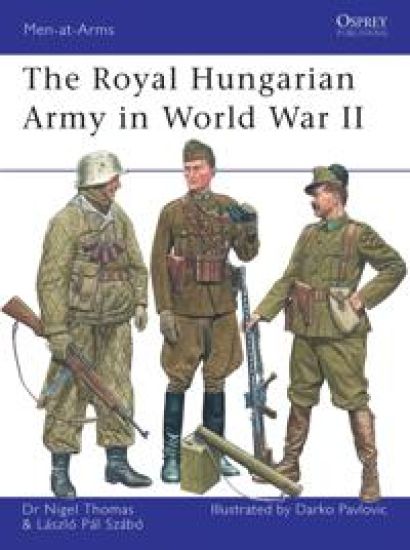
The Royal Hungarian Army was Germany's largest ally on the Eastern Front, but information about the Hungarian Army in English is rare.Deployed in Ukraine at the beginning of the war, the Hungarian Army was involved in a number of brutal encounters with the Red Army, including stubborn resistance in Transylvania in the summer of 1944, and the brave defense of Budapest in the face of overwhelming odds.The Hungarian Army was a varied and colourful force, ranging from mountain troops and tank units to horse cavalry and specialist infantry. All of these are illustrated in full-colour artwork, with full details about the Hungarian Army's own, quite distinct uniforms and insignia as well as many of its own weapons and tanks.This is an essential starter resource for wargamers, modelers, re-enactors and military historians.
The Yugoslav Wars (2)

The Yugoslav Wars (2)

Nigel Thomas; K Mikulan

Osprey Publishing
2006
nidottu
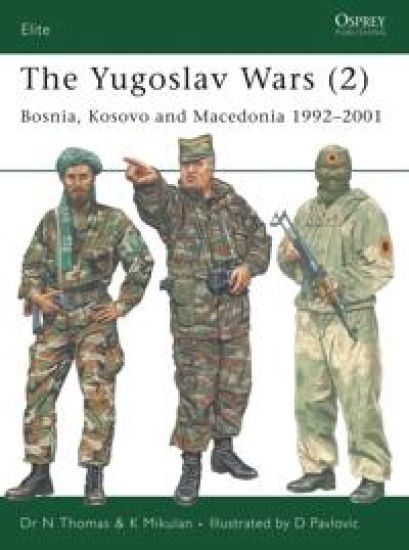
Following the death of the Yugoslavian strongman President Tito in 1980, the several semi-autonomous republics and provinces that he had welded into a nation in 1945 moved inexorably towards separation. As the world watched a series of wars ripped through this modern European state. In this second of two volumes, experts on the Balkan region give a clear and concise explanation of the armies of the Croatian War of Independence 1991-92 and the Bosnian Civil War 1992-95. This includes the regular and militia forces which fought in these campaigns and which ultimately resulted in the UN/NATO policing of Croatia and Bosnia that continues to this day. The book details this fascinating conflict and is illustrated with rare photos and an extraordinary range of colour uniform plates.
The Yugoslav Wars (1)

The Yugoslav Wars (1)

K Mikulan; Nigel Thomas

Osprey Publishing
2006
nidottu
The breakup of Yugoslavia in the 1990s was the bloodiest conflict in Europe since World War II, costing thousands of lives. Nigel Thomas and K Mikulan provide the first detailed account of the struggle that focuses on the numerous combatant armies. Including extensive research through official documents and local sources, they examine the political background and the military campaigns, supplementing their text with detailed maps, orders of battles, rank insignia plates and colour photographs and illustrations. This book, the first in a two-part series, is the only concise, authoritative and illustrated guide to the regular and militia forces of the campaigns in the former Yugoslavia.
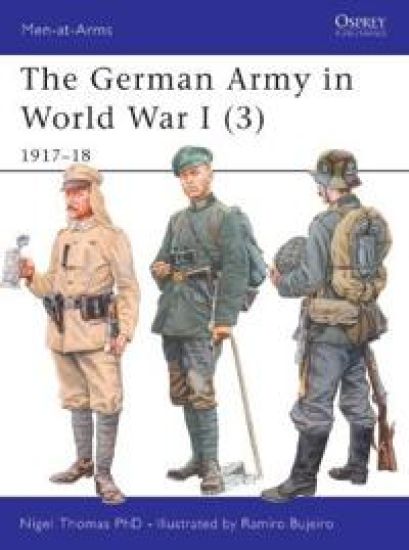
The German Army in World War I (3)

The German Army in World War I (3)

Nigel Thomas

Osprey Publishing
2004
nidottu
This third volume of a mini-series covering the German forces in World War I examines the troops that fought during the climax of the war on all fronts: the last great battles of attrition in the West (Arras, Messines, 3rd Ypres - Passchendaele/Langemarck - and Cambrai, 1917) and the collapse of Russia in the East. The 'Kaiserschlacht' campaign is covered, as are the German operations in Italy, the Balkans, and in support of Turkey in the Middle East. Uniform changes during this period reflected the introduction of new tactics and weapons and new types of troops, such as tanks and assault battalions.
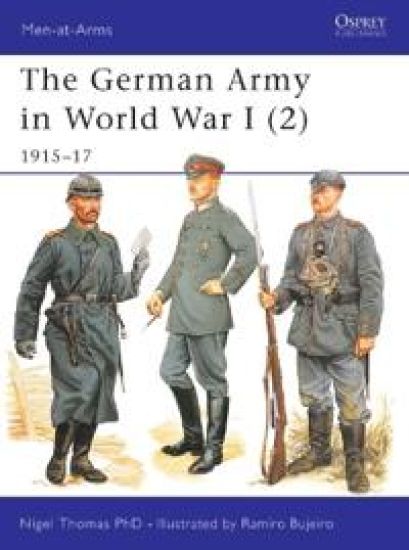
The German Army in World War I (2)

The German Army in World War I (2)

Nigel Thomas

Osprey Publishing
2004
nidottu
The years 1915-17 saw the Imperial German Army, like the other Great War combatants, forced to adapt to the new realities of static trench warfare. Prewar uniforms and equipment had to be modified, for reasons of both utility and economy; on battlefields ruled by machine guns and artillery the steel helmet reappeared, and masks to protect against the terrifying new weapon of poison gas. The fashionable cavalry regiments became irrelevant on the Western Front; many were dismounted to join the infantry, while new types of unit usurped their prestige - assault battalions, and the air corps. This second volume in a three-part sequence offers a mass of detail on organization, uniforms and insignia, illustrated with rare photographs and meticulous colour artwork.
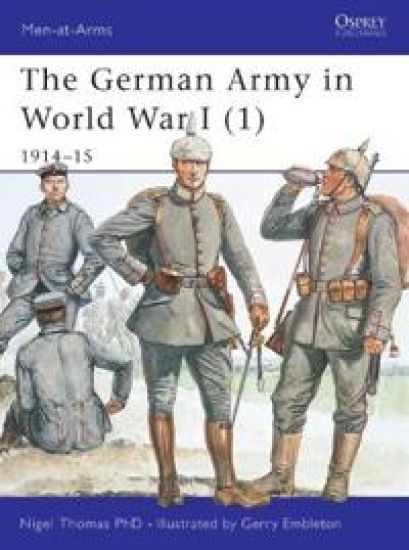
The German Army in World War I (1)

The German Army in World War I (1)

Nigel Thomas

Osprey Publishing
2003
nidottu
This is the first of three books that study the German Army of World War I in great detail. They give a comprehensive study of the organisation, uniforms, insignia and equipment of the Imperial German army - in practice the combined armies of Prussia, Bavaria, Saxony and Wurttemberg. This first volume covers the troops who fought at Mons, Arras, and 1st Ypres in 1914; in winter 1914; at Neuve Chappelle, 2nd Ypres, Artois and the Argonne, 1915; and in East Prussia and Poland, 1914-15. It reflects the impact of the first period of trench warfare on the uniforms worn at the outbreak of war.
Children, family and the state

Children, family and the state

Nigel Thomas

Policy Press
2002
nidottu
What part should children take in decisions about their lives? Does their need to be involved in decisions conflict with adult responsibility for their welfare? In its search for answers to these questions, Children, family and the state examines different theories of childhood, children's rights and the relationship between children, parents and the state. Focusing on children who are looked after by the state, it reviews the changing objectives of the care system and the extent to which children have been involved in decisions about their care.
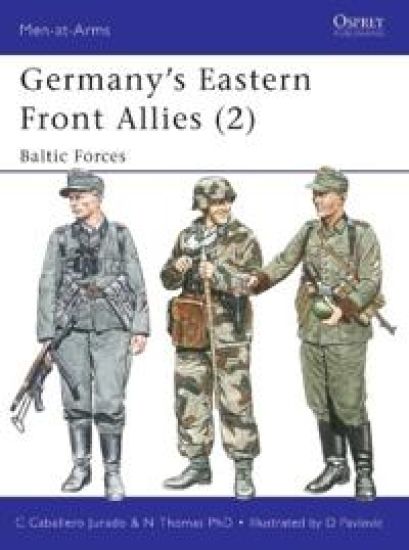
Germany's Eastern Front Allies (2)

Germany's Eastern Front Allies (2)

Nigel Thomas; Carlos Caballero Jurado

Osprey Publishing
2002
nidottu
The Baltic region of Latvia, Lithuania and Estonia saw some of the most prolonged and savage fighting of any on Germany's Eastern Front during World War II. The coastal nations were invaded by the USSR in 1940; captured by the Wehrmacht in 1941; provided major recruitment for the German Army and Waffen-SS in 1941-44; were retaken by the Red Army in 1944-45 despite stubborn resistance; yet still sustained a guerrilla movement which was not wiped out by the Russian occupiers until 1952. The tragic period covered in this book saw many combat and local security units raised by both sides, offering a most interesting range of uniforms and insignia.
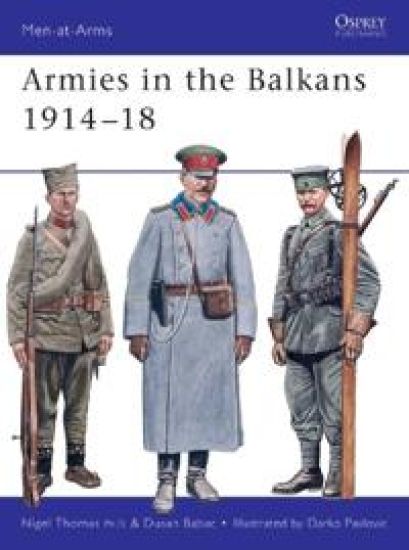
Armies in the Balkans 1914–18

Armies in the Balkans 1914–18

Nigel Thomas; Dusan Babac

Osprey Publishing
2001
nidottu
It was the Balkan flashpoint which set off World War I, yet the fighting there is curiously neglected, although it was an inportant 'second front' cutting the Central Powers in two and preventing direct German/Turkish co-operation. The campaigns in the Balkans in 1915-18 involved the British, French, Russian and Italian armies, together with the local Serbian, Montenegrin, Greek and Rumanian forces, fighting German, Austrian and Bulgarian troops. This concise but comprehensive account identifies, describes and illustrates all these forces. The text is illustrated with rare photographs never before seen in the West, and with full orders-of-battle and insignia charts.
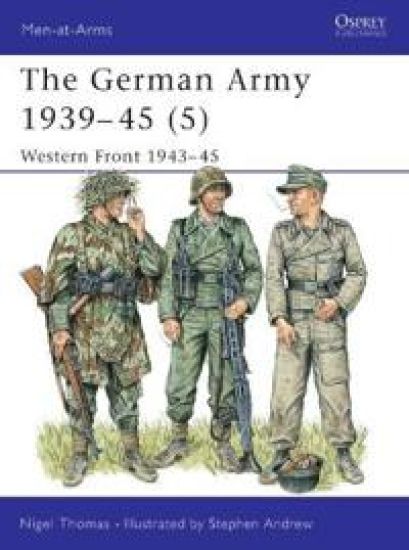
The German Army 1939–45 (5)

The German Army 1939–45 (5)

Nigel Thomas

Osprey Publishing
2000
nidottu
Despite the huge pressure of fighting on three fronts, ever-worsening shortages of manpower and equipment, and Allied command of the skies, Germany's decimated divisions fought on with impressive skill and determination.This period also saw a fascinating mixture of obsolescent, newly designed, and field-made combat clothing which gave the German soldier a radically different appearance from his predecessor of just five years before.Featuring illustrations throughout, this book covers the high command, the developments in unit organisation, the campaigns and the uniforms and equipment of the German Army in the last two years of the war in North-West Europe and Italy.
The German Army 1939–45 (4)

The German Army 1939–45 (4)

Nigel Thomas

Osprey Publishing
1999
nidottu
In early 1943 the annihilation of the 6th Army at Stalingrad marked the irreversible turning-point of the war in the East.Despite occasional local successes gained in the face of great odds – testimony to the Wehrmacht's extraordinary resilience – from now on Germany was on the defensive. Despite Hitler's damaging interference the quality of German field leadership, and of new weapons, remained high; but each new Soviet offensive pushed the front line closer to – and finally, across – the borders of the Reich.In this fourth title of their sequence, Nigel Thomas and Stephen Andrew describe and illustrate the developments in unit organization, uniforms and equipment during 1943–45, including information on European and Eastern volunteer units; text and illustrations are supported by detailed tables.
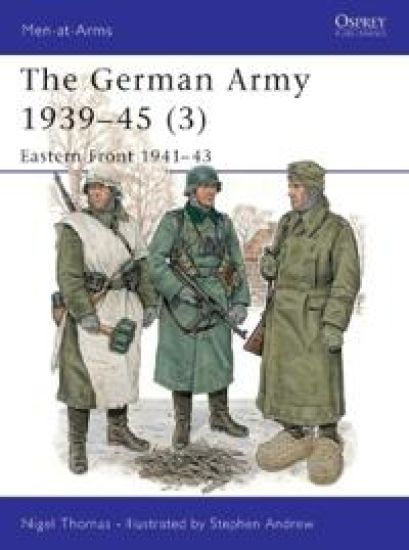
The German Army 1939–45 (3)

The German Army 1939–45 (3)

Nigel Thomas

Osprey Publishing
1999
nidottu
Operation Barbarossa, the attack on the Soviet Union, commenced on 22 June 1941.It became the biggest conflict in military history, with some three million German troops and about 900,000 allies facing almost 4.7 million Soviet troops. The effects would colour postwar European history for the next 50 years.This title examines the history of the conflict, and the organisation, uniforms and insignia of the German Army on the Eastern Front from 1941-43. The book contains numerous illustrations and photographs throughout, including eight fine full-page colour plates by Stephen Andrew.
The German Army 1939–45 (2)

The German Army 1939–45 (2)

Nigel Thomas

Osprey Publishing
1998
nidottu
Hitler first considered an invasion of Great Britain in autumn 1940, then scheduled Operation Barbarossa, the conquest of the European part of the Soviet Union, for May 1941.Anxious to emulate Hitler's successes, the Italian dictator Mussolini embarked upon unnecessary military adventures in North Africa and the Balkans, which forced Hitler's intervention, diverting and depleting precious German resources, and a six-week postponement of Barbarossa.In this second of four volumes (Men-at-Arms 311, 316, 326 & 330) on the German Army of the Second World War, Nigel Thomas examines the uniforms and insignia of the forces involved in North Africa and the Balkans.
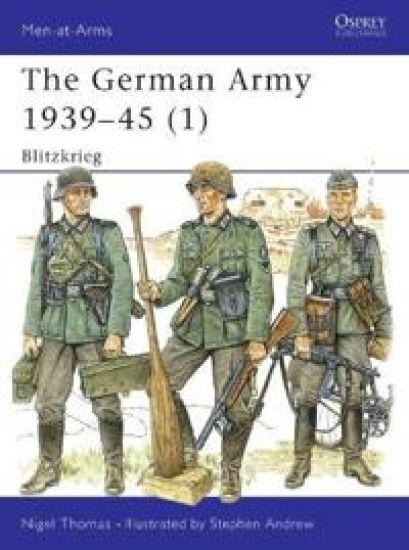
The German Army 1939–45 (1)

The German Army 1939–45 (1)

Nigel Thomas

Osprey Publishing
1997
nidottu
The first of a series of five books on the German army of World War II. This volume focuses on their achievements from 1935 to 1940, and how the military traditions of Germany were used by Hitler to dominate Europe. Nigel Thomas examines the ways in which this army was trained and organized to allow them to dominate large areas of Europe so successfully. He looks at the campaigns and uniforms during the Polish, Danish, Norwegian, Belgian, Dutch and French campaigns between September 1939 and June 1940, and also considers the pre-war campaigns in Rhineland, Spain, Austria and Czechoslovakia from between 1936 and 1939.
Axis Forces in Yugoslavia 1941–45

Axis Forces in Yugoslavia 1941–45

Nigel Thomas

Osprey Publishing
1995
nidottu
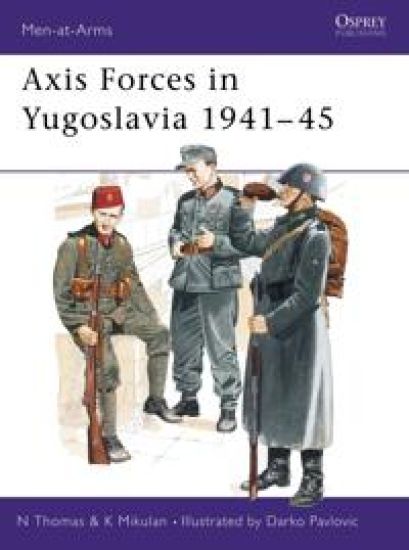
On 6 April, the German 2nd and 12th Armies, Italian 2nd and 9th Armies, and the Hungarian 4th, 5th and Mobile Corps invaded Yugoslavia from Italy, Germany, Rumania, Bulgaria and Albania. Few of the Royal Yugoslav Army's 30 divisions actively resisted, and after 11 days the Yugoslav High Command surrendered. In Croatia, a puppet state was installed. Axis forces quickly occupied the principal towns and patrolled the main road and rail links, but in the villages, countryside and mountains a vicious and complex guerrilla war was brewing. This title takes a close look at the German, Italian, Croatian, Serbian, Montenegrin, Bulgarian, Macedonian, and Slovenian units that fought for the Axis powers in Yugoslavia.
Wehrmacht Auxiliary Forces

Wehrmacht Auxiliary Forces

Nigel Thomas

Osprey Publishing
1992
nidottu
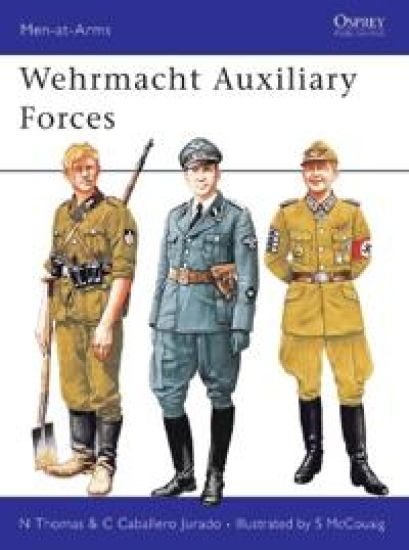
In 1938 Adolf Hitler directed two paramilitary labour organizations - the Reicharbeitsdienst consisting of recruits undergoing pre-military training, and the Organisation Todt that comprised a mobilized force of private construction firms - to assist the military forces. Later the NSKK was organized to assist with supply and transport with the Transportkorps Speer added in 1944. That same year as defeat loomed, all manpower with any military potential was drafted into the Deutscher Volkssturm. The history, equipment and uniforms of these auxillary organizations are detailed in this volume.
Central American Wars 1959–89

Central American Wars 1959–89

Carlos Caballero Jurado; Nigel Thomas

Osprey Publishing
1990
nidottu
Once predicted to be 'the Middle East of the Year 2000', Central America and the Caribbean have long been a powder keg of revolutionary activity and guerilla warfare. The United States, with important strategic and economic interests in the region, has traditionally opted for a military solution toward the political upheaval, developing a range of responses, from direct military intervention to the training of tens of thousands of Latin-American soldiers in anti-guerilla warfare techniques. This text, enhanced by colour plates and numerous photographs, examines the history of the Central American Wars by country, detailing the organization and uniforms of the combatants.
The Korean War 1950–53

The Korean War 1950–53

Nigel Thomas; Peter Abbott

Osprey Publishing
1986
nidottu
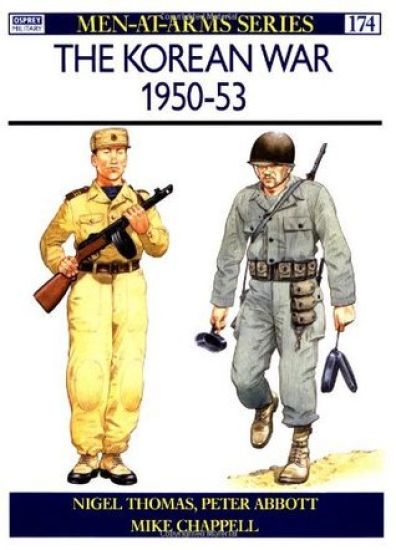
A concise illustrated study of the first military conflict of the Cold War. At 4am on Sunday 25 June 1950, powerful North Korean forces invaded South Korea, advancing down the Uijongbu Corridor towards the Southern Capital of Seoul. South Korean troops resisted bravely, but were crushed by overwhelming Northern superiority. Later that day, the United Nations Security Council condemned the aggression, and on 7 July appointed US General of the Army Douglas MacArthur to command UN forces which would be sent to save South Korea. Nigel Thomas and Peter Abbott explore the history of this conflict, which pitted UN forces against the People's Republic of China in a struggle that resulted in hundreds of thousands of casualties. The text is accompanied by black and white photographs, maps and diagrams, along with colour plates from artist Mike Chappell depicting uniforms and equipment of soldiers of North and South Korea, People's Republic of China, the United States and other UN forces.
Partisan Warfare 1941–45

Partisan Warfare 1941–45

Nigel Thomas; Peter Abbott

Osprey Publishing
1983
nidottu
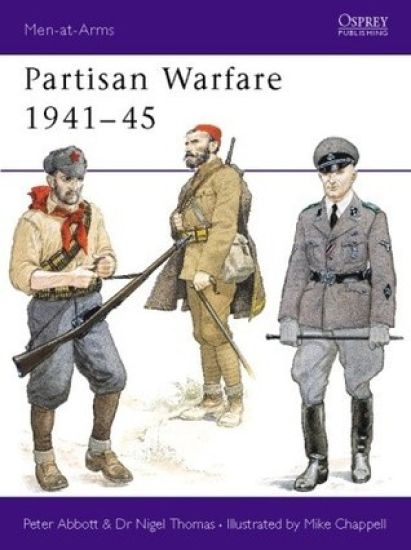
A compact volume on the history, organisation, uniforms and equipment of the Communist-led and non-Communist resistance groups resisting German occupation.During 1941 the Germans occupied first Greece and the former Yugoslavia, then enormous areas of European Russia. Once the front line troops had moved on the struggle continued as bands of resistance fighters waged war against the occupation forces until their final withdrawal. The term 'partisan' is associated with Communist-led bands and they were often the most fanatical defenders of the Soviet realm. However, there were also non-Communist resistance groups which were nationalist and broadly constitutionalist and as a result a complicated three-way war developed.This book details the guerrilla war which was waged in the various regions and the uniforms and equipment of the combatants.
Germany's Eastern Front Allies 1941–45

Germany's Eastern Front Allies 1941–45

Peter Abbott; Nigel Thomas

Osprey Publishing
1982
nidottu
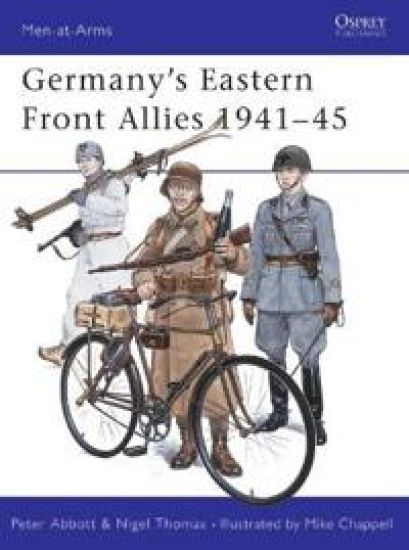
The 1930s were a time of growing tension for the smaller states of Eastern Europe. Since the end of the First World War they had enjoyed an independence which most of them had not known for centuries, but this was now threatened by the growing power of Nazi Germany and Soviet Russia. Instead of combining for self defence, they were bitterly divided. The Munich crisis showed how little reliance could be placed on the Western democracies, whose power to intervene militarily in Eastern Europe was negligible. In effect this left the smaller East European states with little alternative but to become clients of either Germany or Russia.