Kirjojen hintavertailu. Mukana 12 595 353 kirjaa ja 12 kauppaa.

Kirjailija

Nikil D. Dutt

Kirjat ja teokset yhdessä paikassa: 10 kirjaa, julkaisuja vuosilta 1992-2014, suosituimpien joukossa High — Level Synthesis. Vertaile teosten hintoja ja tarkista saatavuus suomalaisista kirjakaupoista.

10 kirjaa

Kirjojen julkaisuhaarukka 1992-2014.

Functional Verification of Programmable Embedded Architectures

Functional Verification of Programmable Embedded Architectures

Prabhat Mishra; Nikil D. Dutt

Springer-Verlag New York Inc.
2014
nidottu
It is widely acknowledged that the cost of validation and testing comprises a s- nificant percentage of the overall development costs for electronic systems today, and is expected to escalate sharply in the future. Many studies have shown that up to 70% of the design development time and resources are spent on functional verification. Functional errors manifest themselves very early in the design flow, and unless they are detected up front, they can result in severe consequence- both financially and from a safety viewpoint. Indeed, several recent instances of high-profile functional errors (e. g. , the Pentium FDIV bug) have resulted in - creased attention paid to verifying the functional correctness of designs. Recent efforts have proposed augmenting the traditional RTL simulation-based validation methodology with formal techniques in an attempt to uncover hard-to-find c- ner cases, with the goal of trying to reach RTL functional verification closure. However, what is often not highlighted is the fact that in spite of the tremendous time and effort put into such efforts at the RTL and lower levels of abstraction, the complexity of contemporary embedded systems makes it difficult to guarantee functional correctness at the system level under all possible operational scenarios. The problem is exacerbated in current System-on-Chip (SOC) design meth- ologies that employ Intellectual Property (IP) blocks composed of processor cores, coprocessors, and memory subsystems. Functional verification becomes one of the major bottlenecks in the design of such systems.
SPARK: A Parallelizing Approach to the High-Level Synthesis of Digital Circuits

SPARK: A Parallelizing Approach to the High-Level Synthesis of Digital Circuits

Sumit Gupta; Rajesh Gupta; Nikil D. Dutt; Alexandru Nicolau

Springer-Verlag New York Inc.
2013
nidottu
Rapid advances in microelectronic integration and the advent of Systems-on-Chip have fueled the need for high-level synthesis, i.e., an automated approach to the synthesis of hardware from behavioral descriptions. SPARK: A Parallelizing Approach to the High - Level Synthesis of Digital Circuits presents a novel approach to the high-level synthesis of digital circuits -- that of parallelizing high-level synthesis (PHLS). This approach uses aggressive code parallelizing and code motion techniques to discover circuit optimization opportunities beyond what is possible with traditional high-level synthesis. This PHLS approach addresses the problems of the poor quality of synthesis results and the lack of controllability over the transformations applied during the high-level synthesis of system descriptions with complex control flows, that is, with nested conditionals and loops. Also described are speculative code motion techniques and dynamic compiler transformations that optimize the circuit quality in terms of cycle time, circuit size and interconnect costs. We describe the SPARK parallelizing high-level synthesis framework in which we have implemented these techniques and demonstrate the utility of SPARK's PHLS approach using designs derived from multimedia and image processing applications. We also present a case study of an instruction length decoder derived from the Intel Pentium-class of microprocessors. This case study serves as an example of a typical microprocessor functional block with complex control flow and demonstrates how our techniques are useful for such designs. SPARK: A Parallelizing Approach to the High - Level Synthesis of Digital Circuits is targeted mainly to embedded system designers and researchers. This includes people working on design and design automation. The book is useful for researchers and design automation engineers who wish to understand how the main problems hindering the adoption of high-level synthesis among designers.
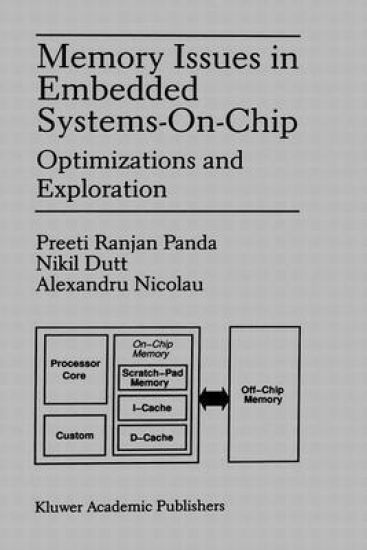
Memory Issues in Embedded Systems-on-Chip

Memory Issues in Embedded Systems-on-Chip

Preeti Ranjan Panda; Nikil D. Dutt; Alexandru Nicolau

Springer-Verlag New York Inc.
2012
nidottu
Memory Issues in Embedded Systems-On-Chip: Optimizations and Explorations is designed for different groups in the embedded systems-on-chip arena. First, it is designed for researchers and graduate students who wish to understand the research issues involved in memory system optimization and exploration for embedded systems-on-chip. Second, it is intended for designers of embedded systems who are migrating from a traditional micro-controllers centered, board-based design methodology to newer design methodologies using IP blocks for processor-core-based embedded systems-on-chip. Also, since Memory Issues in Embedded Systems-on-Chip: Optimization and Explorations illustrates a methodology for optimizing and exploring the memory configuration of embedded systems-on-chip, it is intended for managers and system designers who may be interested in the emerging capabilities of embedded systems-on-chip design methodologies for memory-intensive applications.
High — Level Synthesis

High — Level Synthesis

Daniel D. Gajski; Nikil D. Dutt; Allen C-H Wu; Steve Y-L Lin

Springer-Verlag New York Inc.
2012
nidottu
Research on high-level synthesis started over twenty years ago, but lower-level tools were not available to seriously support the insertion of high-level synthesis into the mainstream design methodology. Since then, substantial progress has been made in formulating and understanding the basic concepts in high-level synthesis. Although many open problems remain, high-level synthesis has matured. High-Level Synthesis: Introduction to Chip and System Design presents a summary of the basic concepts and results and defines the remaining open problems. This is the first textbook on high-level synthesis and includes the basic concepts, the main algorithms used in high-level synthesis and a discussion of the requirements and essential issues for high-level synthesis systems and environments. A reference text like this will allow the high-level synthesis community to grow and prosper in the future.
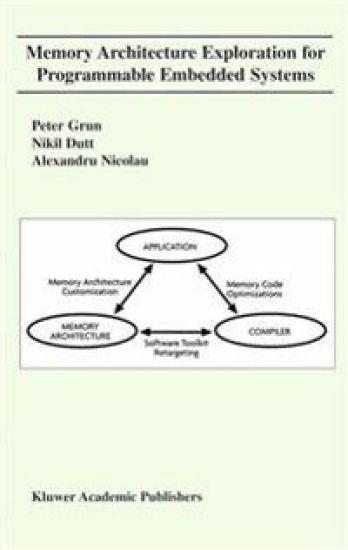
Memory Architecture Exploration for Programmable Embedded Systems

Memory Architecture Exploration for Programmable Embedded Systems

Peter Grun; Nikil D. Dutt; Alexandru Nicolau

Springer-Verlag New York Inc.
2010
nidottu
Memory Architecture Exploration for Programmable Embedded Systems addresses efficient exploration of alternative memory architectures, assisted by a "compiler-in-the-loop" that allows effective matching of the target application to the processor-memory architecture. This new approach for memory architecture exploration replaces the traditional black-box view of the memory system and allows for aggressive co-optimization of the programmable processor together with a customized memory system. The book concludes with a set of experiments demonstrating the utility of this exploration approach. The authors perform architecture and compiler exploration for a set of large, real-life benchmarks, uncovering promising memory configurations from different perspectives, such as cost, performance and power.
Functional Verification of Programmable Embedded Architectures

Functional Verification of Programmable Embedded Architectures

Prabhat Mishra; Nikil D. Dutt

Springer-Verlag New York Inc.
2005
sidottu
It is widely acknowledged that the cost of validation and testing comprises a s- nificant percentage of the overall development costs for electronic systems today, and is expected to escalate sharply in the future. Many studies have shown that up to 70% of the design development time and resources are spent on functional verification. Functional errors manifest themselves very early in the design flow, and unless they are detected up front, they can result in severe consequence- both financially and from a safety viewpoint. Indeed, several recent instances of high-profile functional errors (e. g. , the Pentium FDIV bug) have resulted in - creased attention paid to verifying the functional correctness of designs. Recent efforts have proposed augmenting the traditional RTL simulation-based validation methodology with formal techniques in an attempt to uncover hard-to-find c- ner cases, with the goal of trying to reach RTL functional verification closure. However, what is often not highlighted is the fact that in spite of the tremendous time and effort put into such efforts at the RTL and lower levels of abstraction, the complexity of contemporary embedded systems makes it difficult to guarantee functional correctness at the system level under all possible operational scenarios. The problem is exacerbated in current System-on-Chip (SOC) design meth- ologies that employ Intellectual Property (IP) blocks composed of processor cores, coprocessors, and memory subsystems. Functional verification becomes one of the major bottlenecks in the design of such systems.
SPARK: A Parallelizing Approach to the High-Level Synthesis of Digital Circuits

SPARK: A Parallelizing Approach to the High-Level Synthesis of Digital Circuits

Sumit Gupta; Rajesh Gupta; Nikil D. Dutt; Alexandru Nicolau

Springer-Verlag New York Inc.
2004
sidottu
Rapid advances in microelectronic integration and the advent of Systems-on-Chip have fueled the need for high-level synthesis, i.e., an automated approach to the synthesis of hardware from behavioral descriptions. SPARK: A Parallelizing Approach to the High - Level Synthesis of Digital Circuits presents a novel approach to the high-level synthesis of digital circuits -- that of parallelizing high-level synthesis (PHLS). This approach uses aggressive code parallelizing and code motion techniques to discover circuit optimization opportunities beyond what is possible with traditional high-level synthesis. This PHLS approach addresses the problems of the poor quality of synthesis results and the lack of controllability over the transformations applied during the high-level synthesis of system descriptions with complex control flows, that is, with nested conditionals and loops. Also described are speculative code motion techniques and dynamic compiler transformations that optimize the circuit quality in terms of cycle time, circuit size and interconnect costs. We describe the SPARK parallelizing high-level synthesis framework in which we have implemented these techniques and demonstrate the utility of SPARK's PHLS approach using designs derived from multimedia and image processing applications. We also present a case study of an instruction length decoder derived from the Intel Pentium-class of microprocessors. This case study serves as an example of a typical microprocessor functional block with complex control flow and demonstrates how our techniques are useful for such designs. SPARK: A Parallelizing Approach to the High - Level Synthesis of Digital Circuits is targeted mainly to embedded system designers and researchers. This includes people working on design and design automation. The book is useful for researchers and design automation engineers who wish to understand how the main problems hindering the adoption of high-level synthesis among designers.
Memory Architecture Exploration for Programmable Embedded Systems

Memory Architecture Exploration for Programmable Embedded Systems

Peter Grun; Nikil D. Dutt; Alexandru Nicolau

Springer-Verlag New York Inc.
2002
sidottu
Memory Architecture Exploration for Programmable Embedded Systems addresses efficient exploration of alternative memory architectures, assisted by a "compiler-in-the-loop" that allows effective matching of the target application to the processor-memory architecture. This new approach for memory architecture exploration replaces the traditional black-box view of the memory system and allows for aggressive co-optimization of the programmable processor together with a customized memory system. The book concludes with a set of experiments demonstrating the utility of this exploration approach. The authors perform architecture and compiler exploration for a set of large, real-life benchmarks, uncovering promising memory configurations from different perspectives, such as cost, performance and power.
Memory Issues in Embedded Systems-on-Chip

Memory Issues in Embedded Systems-on-Chip

Preeti Ranjan Panda; Nikil D. Dutt; Alexandru Nicolau

Springer
1998
sidottu
Memory Issues in Embedded Systems-On-Chip: Optimizations and Explorations is designed for different groups in the embedded systems-on-chip arena. First, it is designed for researchers and graduate students who wish to understand the research issues involved in memory system optimization and exploration for embedded systems-on-chip. Second, it is intended for designers of embedded systems who are migrating from a traditional micro-controllers centered, board-based design methodology to newer design methodologies using IP blocks for processor-core-based embedded systems-on-chip. Also, since Memory Issues in Embedded Systems-on-Chip: Optimization and Explorations illustrates a methodology for optimizing and exploring the memory configuration of embedded systems-on-chip, it is intended for managers and system designers who may be interested in the emerging capabilities of embedded systems-on-chip design methodologies for memory-intensive applications.
High — Level Synthesis

High — Level Synthesis

Daniel D. Gajski; Nikil D. Dutt; Allen C-H Wu; Steve Y-L Lin

Springer
1992
sidottu
Research on high-level synthesis started over twenty years ago, but lower-level tools were not available to seriously support the insertion of high-level synthesis into the mainstream design methodology. Since then, substantial progress has been made in formulating and understanding the basic concepts in high-level synthesis. Although many open problems remain, high-level synthesis has matured. High-Level Synthesis: Introduction to Chip and System Design presents a summary of the basic concepts and results and defines the remaining open problems. This is the first textbook on high-level synthesis and includes the basic concepts, the main algorithms used in high-level synthesis and a discussion of the requirements and essential issues for high-level synthesis systems and environments. A reference text like this will allow the high-level synthesis community to grow and prosper in the future.