Kirjojen hintavertailu. Mukana 12 320 454 kirjaa ja 12 kauppaa.

Kirjailija

Niklas Luhmann

Kirjat ja teokset yhdessä paikassa: 99 kirjaa, julkaisuja vuosilta 1978-2026, suosituimpien joukossa Die Grenzen der Verwaltung. Vertaile teosten hintoja ja tarkista saatavuus suomalaisista kirjakaupoista.

99 kirjaa

Kirjojen julkaisuhaarukka 1978-2026.

A Sociological Theory of Law

A Sociological Theory of Law

Niklas Luhmann

Routledge
2013
sidottu
Niklas Luhmann is recognised as a major social theorist, and his treatise on the sociology of law is a classic text. For Luhmann, law provides the framework of the state, lawyers are the main human resource for the state, and legal theory provides the most suitable base from which to theorize on the nature of society. He explores the concept of law in the light of a general theory of social systems, showing the important part law plays in resolving fundamental problems a society may face. He then goes on to discuss in detail how modern 'positive' – as opposed to ‘natural’ – law comes to fulfil this function. The work as a whole is not only a contribution to legal sociology, but a major work in social theory. With a revised translation, and a new introduction by Martin Albrow.
Theory of Society, Volume 2

Theory of Society, Volume 2

Niklas Luhmann

Stanford University Press
2013
sidottu
This second volume of Niklas Luhmann's two-part final work was first published in German in 1997. The culmination of his thirty-year theoretical project to reconceptualize sociology, it offers a comprehensive description of modern society. Beginning with an account of the fluidity of meaning and the accordingly high improbability of successful communication, Luhmann analyzes a range of communicative media, including language, writing, the printing press, and electronic media, as well as "success media," such as money, power, truth, and love, all of which structure this fluidity and make communication possible. The book asks what gives rise to functionally differentiated social systems, how they evolve, and how social movements, organizations, and patterns of interaction emerge. The advent of the computer and its networks, which triggered potentially far-reaching processes of restructuring, receives particular attention. A concluding chapter on the semantics of modern society's self-description bids farewell to the outdated theoretical approaches of "old Europe"—that is, to ontological, holistic, ethical, and critical interpretations of society—and argues that concepts such as "the nation," "the subject," and "postmodernity" are vastly overrated. In their stead, "society"—long considered a suspicious term by sociologists, one open to all kinds of reification—is defined in purely operational terms. It is the always uncertain answer to the question of what comes next in all areas of communication.
Theory of Society, Volume 2

Theory of Society, Volume 2

Niklas Luhmann

Stanford University Press
2013
pokkari
This second volume of Niklas Luhmann's two-part final work was first published in German in 1997. The culmination of his thirty-year theoretical project to reconceptualize sociology, it offers a comprehensive description of modern society. Beginning with an account of the fluidity of meaning and the accordingly high improbability of successful communication, Luhmann analyzes a range of communicative media, including language, writing, the printing press, and electronic media, as well as "success media," such as money, power, truth, and love, all of which structure this fluidity and make communication possible. The book asks what gives rise to functionally differentiated social systems, how they evolve, and how social movements, organizations, and patterns of interaction emerge. The advent of the computer and its networks, which triggered potentially far-reaching processes of restructuring, receives particular attention. A concluding chapter on the semantics of modern society's self-description bids farewell to the outdated theoretical approaches of "old Europe"—that is, to ontological, holistic, ethical, and critical interpretations of society—and argues that concepts such as "the nation," "the subject," and "postmodernity" are vastly overrated. In their stead, "society"—long considered a suspicious term by sociologists, one open to all kinds of reification—is defined in purely operational terms. It is the always uncertain answer to the question of what comes next in all areas of communication.

A Systems Theory of Religion

A Systems Theory of Religion

Niklas Luhmann

Stanford University Press
2013
sidottu
A Systems Theory of Religion, still unfinished at Niklas Luhmann's death in 1998, was first published in German two years later thanks to the editorial work of André Kieserling. One of Luhmann's most important projects, it exemplifies his later work while redefining the subject matter of the sociology of religion. Religion, for Luhmann, is one of the many functionally differentiated social systems that make up modern society. All such subsystems consist entirely of communications and all are "autopoietic," which is to say, self-organizing and self-generating. Here, Luhmann explains how religion provides a code for coping with the complexity, opacity, and uncontrollability of our world. Religion functions to make definite the indefinite, to reconcile the immanent and the transcendent. Synthesizing approaches as disparate as the philosophy of language, historical linguistics, deconstruction, and formal systems theory/cybernetics, A Systems Theory of Religion takes on important topics that range from religion's meaning and evolution to secularization, turning decades of sociological assumptions on their head. It provides us with a fresh vocabulary and a fresh philosophical and sociological approach to one of society's most fundamental phenomena.
A Systems Theory of Religion

A Systems Theory of Religion

Niklas Luhmann

Stanford University Press
2013
pokkari
A Systems Theory of Religion, still unfinished at Niklas Luhmann's death in 1998, was first published in German two years later thanks to the editorial work of André Kieserling. One of Luhmann's most important projects, it exemplifies his later work while redefining the subject matter of the sociology of religion. Religion, for Luhmann, is one of the many functionally differentiated social systems that make up modern society. All such subsystems consist entirely of communications and all are "autopoietic," which is to say, self-organizing and self-generating. Here, Luhmann explains how religion provides a code for coping with the complexity, opacity, and uncontrollability of our world. Religion functions to make definite the indefinite, to reconcile the immanent and the transcendent. Synthesizing approaches as disparate as the philosophy of language, historical linguistics, deconstruction, and formal systems theory/cybernetics, A Systems Theory of Religion takes on important topics that range from religion's meaning and evolution to secularization, turning decades of sociological assumptions on their head. It provides us with a fresh vocabulary and a fresh philosophical and sociological approach to one of society's most fundamental phenomena.
Introduction to Systems Theory

Introduction to Systems Theory

Niklas Luhmann

Polity Press
2012
nidottu
Niklas Luhmann ranks as one of the most important sociologists and social theorists of the twentieth century. Through his many books he developed a highly original form of systems theory that has been hugely influential in a wide variety of disciplines. In Introduction to Systems Theory, Luhmann explains the key ideas of general and sociological systems theory and supplies a wealth of examples to illustrate his approach. The book offers a wide range of concepts and theorems that can be applied to politics and the economy, religion and science, art and education, organization and the family. Moreover, Luhmann’s ideas address important contemporary issues in such diverse fields as cognitive science, ecology, and the study of social movements. This book provides all the necessary resources for readers to work through the foundations of systems theory – no other work by Luhmann is as clear and accessible as this. There is also much here that will be of great interest to more advanced scholars and practitioners in sociology and the social sciences.
Introduction to Systems Theory

Introduction to Systems Theory

Niklas Luhmann

Polity Press
2012
sidottu
Niklas Luhmann ranks as one of the most important sociologists and social theorists of the twentieth century. Through his many books he developed a highly original form of systems theory that has been hugely influential in a wide variety of disciplines. In Introduction to Systems Theory, Luhmann explains the key ideas of general and sociological systems theory and supplies a wealth of examples to illustrate his approach. The book offers a wide range of concepts and theorems that can be applied to politics and the economy, religion and science, art and education, organization and the family. Moreover, Luhmann’s ideas address important contemporary issues in such diverse fields as cognitive science, ecology, and the study of social movements. This book provides all the necessary resources for readers to work through the foundations of systems theory – no other work by Luhmann is as clear and accessible as this. There is also much here that will be of great interest to more advanced scholars and practitioners in sociology and the social sciences.
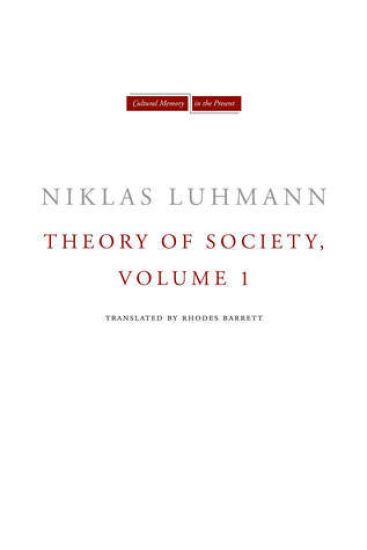
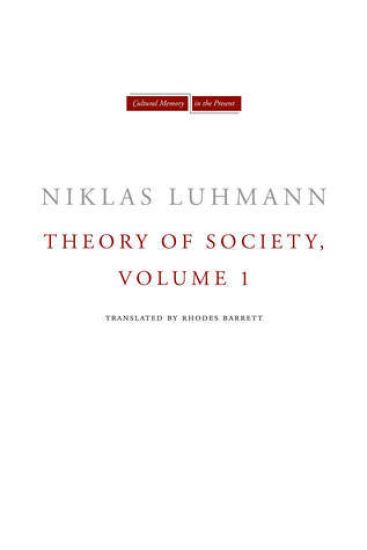
Theory of Society, Volume 1

Theory of Society, Volume 1

Niklas Luhmann

Stanford University Press
2012
pokkari
This first volume of Niklas Luhmann's two-part final work was initially published in German in 1997. The culmination of his thirty-year theoretical project to reconceptualize sociology, it offers a comprehensive description of modern society on a scale not attempted since Talcott Parsons. Beginning with an account of the fluidity of meaning and the accordingly high improbability of successful communication, Luhmann analyzes a range of communicative media, including language, writing, the printing press, and electronic media as well as "success media," such as money, power, truth, and love, all of which structure this fluidity and make communication possible. An investigation into the ways in which social systems produce and reproduce themselves, the book asks what gives rise to functionally differentiated social systems, how they evolve, and how social movements, organizations, and patterns of interaction emerge. The advent of the computer and its networks, which trigger potentially far-reaching processes of restructuring, receive particular attention. A concluding chapter on the semantics of modern society's self-description bids farewell to the outdated theoretical approaches of "old Europe," that is, to ontological, holistic, ethical, and critical interpretations of society, and argues that concepts such as "the nation," "the subject," and "postmodernity" are vastly overrated. In their stead, "society"—long considered a suspicious term by sociologists, one open to all kinds of reification—is defined in purely operational terms. It is the always uncertain answer to the question of what comes next in all areas of communication.
Theory of Society, Volume 1

Theory of Society, Volume 1

Niklas Luhmann

Stanford University Press
2012
sidottu
This first volume of Niklas Luhmann's two-part final work was initially published in German in 1997. The culmination of his thirty-year theoretical project to reconceptualize sociology, it offers a comprehensive description of modern society on a scale not attempted since Talcott Parsons. Beginning with an account of the fluidity of meaning and the accordingly high improbability of successful communication, Luhmann analyzes a range of communicative media, including language, writing, the printing press, and electronic media as well as "success media," such as money, power, truth, and love, all of which structure this fluidity and make communication possible. An investigation into the ways in which social systems produce and reproduce themselves, the book asks what gives rise to functionally differentiated social systems, how they evolve, and how social movements, organizations, and patterns of interaction emerge. The advent of the computer and its networks, which trigger potentially far-reaching processes of restructuring, receive particular attention. A concluding chapter on the semantics of modern society's self-description bids farewell to the outdated theoretical approaches of "old Europe," that is, to ontological, holistic, ethical, and critical interpretations of society, and argues that concepts such as "the nation," "the subject," and "postmodernity" are vastly overrated. In their stead, "society"—long considered a suspicious term by sociologists, one open to all kinds of reification—is defined in purely operational terms. It is the always uncertain answer to the question of what comes next in all areas of communication.
Love as Passion

Love as Passion

Niklas Luhmann

Polity Press
2012
nidottu
In this important book Niklas Luhmann - one of the leading social thinkers of the late 20th century - analyses the emergence of ‘love' as the basis of personal relationships in modern societies. He argues that, while family systems remained intact in the transition from traditional to modern societies, a semantics for love developed to accommodate extra-marital relationships; this semantics was then transferred back into marriage and eventually transformed marriage itself. Drawing on a diverse range of historical and literary sources, Luhmann retraces the emergence and evolution of the special semantics of passionate love that has come to form the basis of modern forms of intimacy and personal relationships. This classic book by Luhmann has been widely recognized as a work of major importance. It is an outstanding contribution to social theory and it provides an original and illuminating perspective on the nature of modern marriage and sexuality.
Organisation und Entscheidung

Organisation und Entscheidung

Niklas Luhmann

Vs Verlag Fur Sozialwissenschaften
2011
sidottu
Organisationsbildung setzt eine Erkennungsregel voraus, die erlaubt festzustellen, welche Handlungen und unter welchen Aspekten sie als Entscheidungen der Organisation zu gelten haben. Diese Erkenntnisregel ist zunächst und vor allem eine Mitgliedschaftsregel. Sie legt fest, wer als Mitglied des Systems angesehen wird und in welchen Rollen diese Mitgliedschaft ausgeübt werden kann. Durch Personalauswahl und Rollendefinition wird die Organisation gegen das sie umgebende sonstige Soziale abgegrenzt und ausdifferenziert.
Love

Love

Niklas Luhmann

Polity Press
2010
nidottu
Love seems like the most personal experience, one that touches each of us in a unique way that is more personal than social, and hence it is not surprising that it has been largely neglected by sociologists and social theorists. While it has long been a central preoccupation of writers and novelists, love has rarely attracted anything more than the most cursory attention of social scientists. This short text, originally written in 1969 by the eminent German social theorist Niklas Luhmann, goes a long way to redressing this neglect. Rather than seeing love as a unique and ineffable personal experience, Luhmann treats love as a solution to a problem that depends on a wider range of social structures and forms. Human beings are faced with a world of enormous complexity and they have to find ways to order and make sense of this world. In other words, they need certain facilities for action Ð what Luhmann calls ‘media of communication’ Ð that enable them to select from a host of alternatives in ways that will be understood as meaningful by others. Love is one of these media; truth, power, money and art are others. With the development of modern societies, greater demands are made on this medium of love, altering the relationship between love and sexuality and giving rise to the distinctive difficulties we associate with love today. This short text by one of the most brilliant social theorists of the 20th century will be of great interest to students and scholars throughout the social sciences and humanities. It is a concise and pithy statement of what is still the only sociological theory of love we have.
Love

Love

Niklas Luhmann

Polity Press
2010
sidottu
Love seems like the most personal experience, one that touches each of us in a unique way that is more personal than social, and hence it is not surprising that it has been largely neglected by sociologists and social theorists. While it has long been a central preoccupation of writers and novelists, love has rarely attracted anything more than the most cursory attention of social scientists. This short text, originally written in 1969 by the eminent German social theorist Niklas Luhmann, goes a long way to redressing this neglect. Rather than seeing love as a unique and ineffable personal experience, Luhmann treats love as a solution to a problem that depends on a wider range of social structures and forms. Human beings are faced with a world of enormous complexity and they have to find ways to order and make sense of this world. In other words, they need certain facilities for action Ð what Luhmann calls ‘media of communication’ Ð that enable them to select from a host of alternatives in ways that will be understood as meaningful by others. Love is one of these media; truth, power, money and art are others. With the development of modern societies, greater demands are made on this medium of love, altering the relationship between love and sexuality and giving rise to the distinctive difficulties we associate with love today. This short text by one of the most brilliant social theorists of the 20th century will be of great interest to students and scholars throughout the social sciences and humanities. It is a concise and pithy statement of what is still the only sociological theory of love we have.