Kirjojen hintavertailu. Mukana 12 595 353 kirjaa ja 12 kauppaa.

Kirjailija

Nitin Indurkhya

Kirjat ja teokset yhdessä paikassa: 5 kirjaa, julkaisuja vuosilta 2004-2016, suosituimpien joukossa Text Mining. Vertaile teosten hintoja ja tarkista saatavuus suomalaisista kirjakaupoista.

5 kirjaa

Kirjojen julkaisuhaarukka 2004-2016.

Fundamentals of Predictive Text Mining

Fundamentals of Predictive Text Mining

Sholom M. Weiss; Nitin Indurkhya; Tong Zhang

Springer London Ltd
2016
nidottu
This successful textbook on predictive text mining offers a unified perspective on a rapidly evolving field, integrating topics spanning the varied disciplines of data science, machine learning, databases, and computational linguistics. Serving also as a practical guide, this unique book provides helpful advice illustrated by examples and case studies. This highly anticipated second edition has been thoroughly revised and expanded with new material on deep learning, graph models, mining social media, errors and pitfalls in big data evaluation, Twitter sentiment analysis, and dependency parsing discussion. The fully updated content also features in-depth discussions on issues of document classification, information retrieval, clustering and organizing documents, information extraction, web-based data-sourcing, and prediction and evaluation. Features: includes chapter summaries and exercises; explores the application of each method; provides several case studies; contains links to free text-mining software.
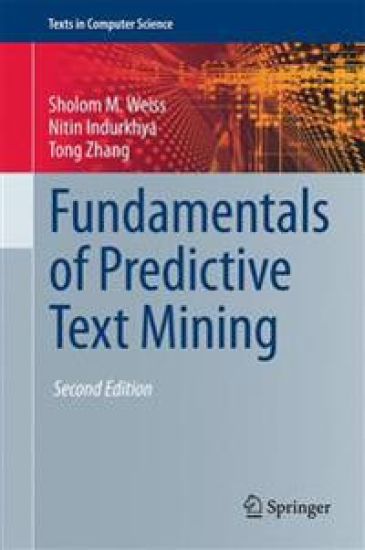
Fundamentals of Predictive Text Mining

Fundamentals of Predictive Text Mining

Sholom M. Weiss; Nitin Indurkhya; Tong Zhang

Springer London Ltd
2015
sidottu
This successful textbook on predictive text mining offers a unified perspective on a rapidly evolving field, integrating topics spanning the varied disciplines of data science, machine learning, databases, and computational linguistics. Serving also as a practical guide, this unique book provides helpful advice illustrated by examples and case studies. This highly anticipated second edition has been thoroughly revised and expanded with new material on deep learning, graph models, mining social media, errors and pitfalls in big data evaluation, Twitter sentiment analysis, and dependency parsing discussion. The fully updated content also features in-depth discussions on issues of document classification, information retrieval, clustering and organizing documents, information extraction, web-based data-sourcing, and prediction and evaluation. Features: includes chapter summaries and exercises; explores the application of each method; provides several case studies; contains links to free text-mining software.
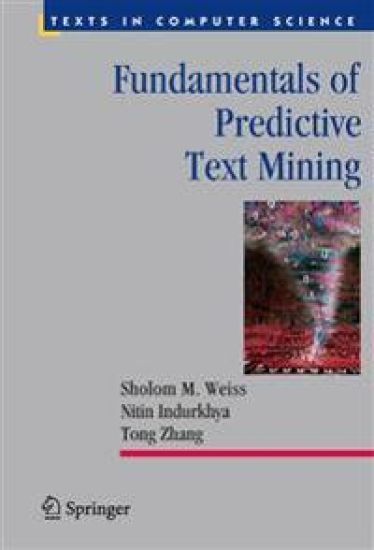
Fundamentals of Predictive Text Mining

Fundamentals of Predictive Text Mining

Sholom M. Weiss; Nitin Indurkhya; Tong Zhang

Springer London Ltd
2012
nidottu
One consequence of the pervasive use of computers is that most documents originate in digital form. Widespread use of the Internet makes them readily available. Text mining – the process of analyzing unstructured natural-language text – is concerned with how to extract information from these documents. Developed from the authors’ highly successful Springer reference on text mining, Fundamentals of Predictive Text Mining is an introductory textbook and guide to this rapidly evolving field. Integrating topics spanning the varied disciplines of data mining, machine learning, databases, and computational linguistics, this uniquely useful book also provides practical advice for text mining. In-depth discussions are presented on issues of document classification, information retrieval, clustering and organizing documents, information extraction, web-based data-sourcing, and prediction and evaluation. Background on data mining is beneficial, but not essential. Where advanced concepts are discussed that require mathematical maturity for a proper understanding, intuitive explanations are also provided for less advanced readers. Topics and features: presents a comprehensive, practical and easy-to-read introduction to text mining; includes chapter summaries, useful historical and bibliographic remarks, and classroom-tested exercises for each chapter; explores the application and utility of each method, as well as the optimum techniques for specific scenarios; provides several descriptive case studies that take readers from problem description to systems deployment in the real world; includes access to industrial-strength text-mining software that runs on any computer; describes methods that rely on basic statistical techniques, thus allowing for relevance to all languages (not just English); contains links to free downloadable software and other supplementary instruction material. Fundamentals of Predictive Text Mining is an essential resource for IT professionalsand managers, as well as a key text for advanced undergraduate computer science students and beginning graduate students. Dr. Sholom M. Weiss is a Research Staff Member with the IBM Predictive Modeling group, in Yorktown Heights, New York, and Professor Emeritus of Computer Science at Rutgers University. Dr. Nitin Indurkhya is Professor at the School of Computer Science and Engineering, University of New South Wales, Australia, as well as founder and president of data-mining consulting company Data-Miner Pty Ltd. Dr. Tong Zhang is Associate Professor at the Department of Statistics and Biostatistics at Rutgers University, New Jersey.
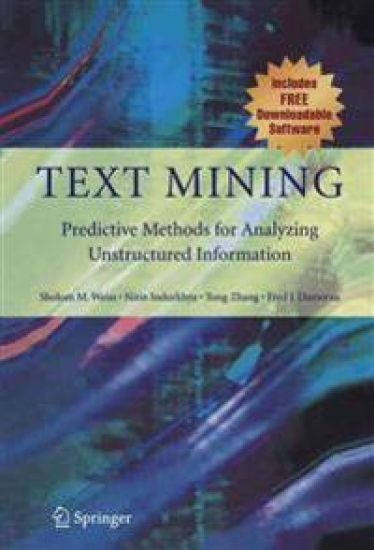
Text Mining

Text Mining

Sholom M. Weiss; Nitin Indurkhya; Tong Zhang; Fred Damerau

Springer-Verlag New York Inc.
2010
nidottu
Data mining is a mature technology. The prediction problem, looking for predictive patterns in data, has been widely studied. Strong me- ods are available to the practitioner. These methods process structured numerical information, where uniform measurements are taken over a sample of data. Text is often described as unstructured information. So, it would seem, text and numerical data are different, requiring different methods. Or are they? In our view, a prediction problem can be solved by the same methods, whether the data are structured - merical measurements or unstructured text. Text and documents can be transformed into measured values, such as the presence or absence of words, and the same methods that have proven successful for pred- tive data mining can be applied to text. Yet, there are key differences. Evaluation techniques must be adapted to the chronological order of publication and to alternative measures of error. Because the data are documents, more specialized analytical methods may be preferred for text. Moreover, the methods must be modi?ed to accommodate very high dimensions: tens of thousands of words and documents. Still, the central themes are similar.
Text Mining

Text Mining

Sholom M. Weiss; Nitin Indurkhya; Tong Zhang; Fred Damerau

Springer-Verlag New York Inc.
2004
sidottu
Data mining is a mature technology. The prediction problem, looking for predictive patterns in data, has been widely studied. Strong me- ods are available to the practitioner. These methods process structured numerical information, where uniform measurements are taken over a sample of data. Text is often described as unstructured information. So, it would seem, text and numerical data are different, requiring different methods. Or are they? In our view, a prediction problem can be solved by the same methods, whether the data are structured - merical measurements or unstructured text. Text and documents can be transformed into measured values, such as the presence or absence of words, and the same methods that have proven successful for pred- tive data mining can be applied to text. Yet, there are key differences. Evaluation techniques must be adapted to the chronological order of publication and to alternative measures of error. Because the data are documents, more specialized analytical methods may be preferred for text. Moreover, the methods must be modi?ed to accommodate very high dimensions: tens of thousands of words and documents. Still, the central themes are similar.