Kirjojen hintavertailu. Mukana 12 390 323 kirjaa ja 12 kauppaa.

Kirjailija

Norann Voll

Kirjat ja teokset yhdessä paikassa: 6 kirjaa, julkaisuja vuosilta 2020-2025, suosituimpien joukossa Plough Quarterly No. 39 - The Riddle of Nature. Vertaile teosten hintoja ja tarkista saatavuus suomalaisista kirjakaupoista.

6 kirjaa

Kirjojen julkaisuhaarukka 2020-2025.

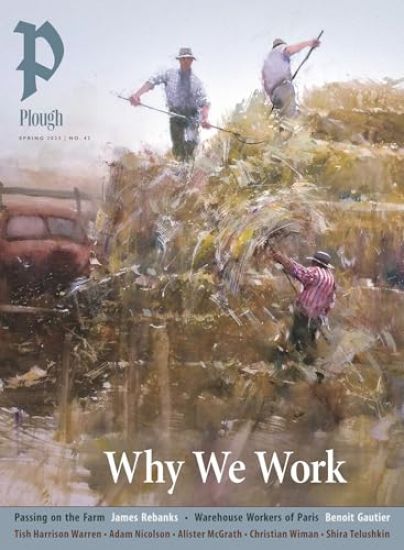
Plough Quarterly No. 43 – Why We Work

Plough Quarterly No. 43 – Why We Work

James Rebanks; Benoit Gautier; Tish Harrison Warren; Adam Nicolson; Alister McGrath; Cristian Wiman; Shira Telushkin; Alastiar Roberts; Norann Voll; Bobbie Jamieson; Brian D. Miller; Ben Wray; William P. Hyland

PLOUGH PUBLISHING HOUSE
2025
nidottu
Is our work merely a way to put food on the table, or does it have inherent value? Should our work define us? Does it play too large a role in our lives? Does it make us feel more human, or less so? This issue explores the realities of work for people with various jobs, but also probes the reasons people work and what they hope to gain from their labor. From warehouse workers to poets, food delivery specialists to cloistered nuns, farmers to police officers, this issue considers personal, spiritual, and social aspects of one of the most basic human activities. On this theme: James Rebanks prepares to pass on the farm to his children. Benoit Gautier rides a shuttlebus with dislocated French warehouse workers. Shira Telushkin asks why young women today are becoming cloistered nuns. Ben Wray talks to food-delivery riders in three countries about their attempts to organize. John Clair, a police chief, wants policing to be about relationships, not statistics. Norann Voll tells how her father taught her to embrace her blue-collar roots. Maureen Swinger honors the unpaid and unheralded work of caring for an aging loved one. Alastair Roberts recommends the divine rhythm of work and Sabbath rest God established in Genesis. Also in this issue: Adam Nicolson finds a different sort of freedom sailing a sixteen-foot wooden boat. Alister McGrath explores the connection between detective fiction and the spiritual quest. Tish Harrison Warren introduces Stanley Hauerwas to new audiences. Christian Wiman shares a new poem about a glass-eyed monk. Plough Quarterly features stories, ideas, and culture for people eager to apply their faith to the challenges we face. Each issue includes in-depth articles, interviews, poetry, book reviews, and art.
Plough Quarterly No. 39 – The Riddle of Nature

Plough Quarterly No. 39 – The Riddle of Nature

William Thomas Okie; Angel Adams Parham; Joy Marie Clarkson; Erik Varden; Lore Ferguson Wilbert; Clare Coffey; Daniel J. D. Stulac; Greta Gaffin; Rhys Laverty; Casey Kleczek; Norann Voll; David McBride; Caroline Moore; Timothy J. Keiderling; Robert W. Crawford

PLOUGH PUBLISHING HOUSE
2024
nidottu
What is our place in nature?Since the Industrial Revolution, humans have has exercised unprecedented dominance over nature, with consequences that are now catching up with us. Many have pointed to Christianity as a culprit. Yet Christianity actually teaches that our relationship to nature should not be one of contempt or disassociation. Rather, according to ancient church tradition, nature is a book to be read, revealing truths about its creator and ours. At a time when many moderns are unsure of what difference, if any, marks us out from other living beings on our planet, and of what our place in the natural world ought to be, what might nature itself tell us about how to live within it? On this theme:Peter Mommsen asks if humans should live by nature’s laws.Colin Boller interviews farmers successfully shifting to regenerative agriculture.Caroline Moore introduces some of Britain’s amazing moths.Daniel Stulac wonders what the Promised Land means in Saskatchewan.Clare Coffey defends dandelions in lawns.Rhys Laverty reports on man’s battle with the sea at the Alderney breakwater.William Thomas Okie explores the old idea that plants reveal their uses.Greta Gaffin looks at our relationship to wolves, and Saint Francis’s.Norann Voll remembers lambing with her father.Tim Maendel finds peace by hunting.Erik Varden asks if the Christian teaching on chastity is unnatural.David McBride translates “The Leper of Abercuawg,” an old Welsh poem.Maureen Swinger watches meteor showers.Plough Quarterly features stories, ideas, and culture for people eager to apply their faith to the challenges we face. Each issue includes in-depth articles, interviews, poetry, book reviews, and art.
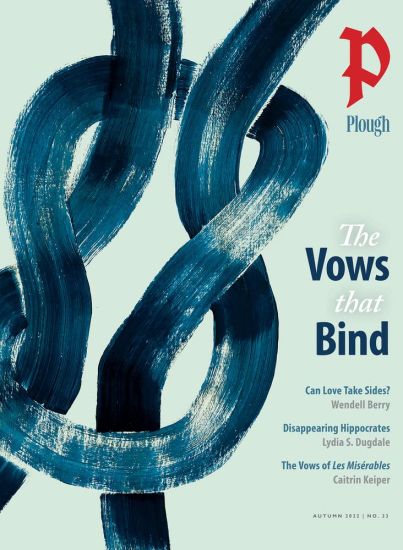
Plough Quarterly No. 33 – The Vows That Bind

Plough Quarterly No. 33 – The Vows That Bind

Wendell Berry; Lydia S. Dugdale; Phil Christman; Kelsey Osgood; King-Ho Leung; Andreas Knapp; Starlette Thomas; G. K. Chesterton; Norann Voll

PLOUGH PUBLISHING HOUSE
2022
pokkari
In a culture that prizes keeping one’s options open, making commitments offers something more valuable. The consumerism and instant gratification of “liquid modernity” feed a general reluctance to make commitments, a refusal to be pinned down for the long term. Consider the decline of three forms of commitment that involve giving up options: marriage, military service, and monastic life. Yet increasing numbers of people question whether unprecedented freedom might be leading to less flourishing, not more. They are dissatisfied with an atomized way of life that offers endless choices of goods, services, and experiences but undermines ties of solidarity and mutuality. They yearn for more heroic virtues, more sacrificial commitments, more comprehensive visions of the individual and common good. It turns out that the American Founders were right: the Creator did endow us with an unalienable right of liberty. But he has endowed us with something else as well, a gift that is equally unalienable: desire for unreserved commitment of all we have and are. Our liberty is given us so that we in turn can freely dedicate ourselves to something greater. Ultimately, to take a leap of commitment, even without knowing where one will land, is the way to a happiness worth everything. On this theme: - Lydia S. Dugdale asks what happened to the Hippocratic Oath in modern medicine. - Caitrin Keiper looks at competing vows in Victor Hugo’s Les Misérables. - Kelsey Osgood, an Orthodox Jew, asks why lifestyle discipline is admired in sports but not religion. - Wendell Berry says being on the side of love does not allow one to have enemies. - Phil Christman spoofs the New York Times Vows column. - Andreas Knapp tells why he chose poverty. - Norann Voll recounts the places a vow of obedience took her. - Carino Hodder says chastity is for everyone, not just nuns. - Dori Moody revisits her grandparents’ broken but faithful marriage. - Randall Gauger, a Bruderhof pastor, finds that lifelong vows make faithfulness possible. - King-Ho Leung looks at vows, oaths, promises, and covenants in the Bible. Also in the issue: - A young Black pastor reads Clarence Jordan today. - Activists discuss the pro-life movement after Roe and Dobbs. - Children learn from King Arthur, Robin Hood, and the occasional cowboy. - Original poetry by Ned Balbo - Reviews of Montgomery and Biklé’s What Your Food Ate, Mohsin Hamid’s The Last White Man, and Bonnie Kristian’s Untrustworthy - A profile of Sadhu Sundar Singh Plough Quarterly features stories, ideas, and culture for people eager to apply their faith to the challenges we face. Each issue includes in-depth articles, interviews, poetry, book reviews, and art.
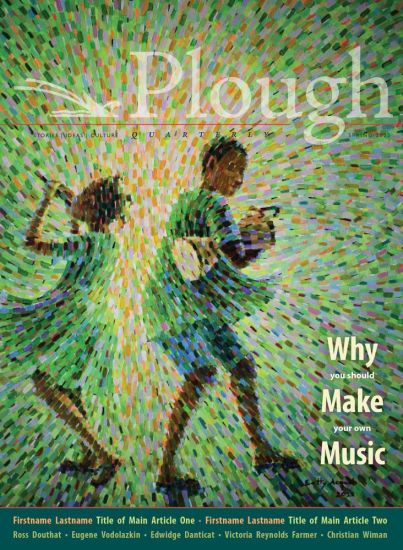
Plough Quarterly No. 31 – Why We Make Music

Plough Quarterly No. 31 – Why We Make Music

Christopher Tin; Stephen Michael Newby; Mary Townsend; Maureen Swinger; Joseph Julián González; Phil Christman; Eugene Vodolazkin; Esther Maria Magnis; Ben Crosby; Nathan Schram; Brittany Petruzzi; Norann Voll

PLOUGH PUBLISHING HOUSE
2022
pokkari
Communal music has the power to shape a soul and a society.In many places today, a culture of singing and making music remains robust, despite pressure from the commercial music industry. Or it was until the Covid pandemic hit and we glimpsed what a world without communal music-making could be like. According to Plato, virtuous music is vital for building a virtuous community. Jewish and Christian traditions take this insight even further: good communal music shapes and builds up the people of God. So how can we choose good music and avoid the bad? The sheer ubiquity of music available for consumption – its presence as a near-constant soundtrack to our daily lives – poses a hazard. Digital music on tap is a temptation to chronic distraction of the soul, to a habit of superficiality and non-attention. Fortunately, the remedy is straightforward: spend less time consuming prepackaged tunes and more time making music. This will be doubly rewarding if done with others – singing with one’s family, singing in church, playing in a string quartet, starting a regular jam session. If personal media players tend to cut us off from the physical presence of others, sharing in good music together breaks the spell of isolation and disembodiment. It builds friendship and community.On this theme:- Maureen Swinger’s amateur choir sings Bach’s Saint Matthew Passion.- Stephen Michael Newby says Black spirituals aren’t just for Black people. - Mary Townsend finds Dolly Parton magnificent, but would Aristotle? - Phil Christman finds catharsis in the YouTube comments of eighties songs. - Ben Crosby says congregational singing should be unabashedly weird to visitors.- Joseph Julián González draws on ancient Nahua poets in his music.- Christopher Tin explains why he weaves so many historical influences into his music. - Seven musicians talk about making your own music in schools, churches, prisons, backyards, or children’s bedrooms: Nathan Schram, Esther Keiderling, Norann Voll, Chaka Watch Ngwenya, Eileen Maendel, Adora Wong, and Brittany Petruzzi.Also in the issue: Exclusive excerpts from forthcoming books by Eugene Vodolazkin and Esther Maria Magnis- Thoughts on music from Augustine, Gregory of Nyssa, Hildegard of Bingen, Martin Luther, and Eberhard Arnold- Catholics and Anabaptists unite to commemorate the Radical Reformation- New poems by Jacqueline Saphra- A profile of Argentinian singer Mercedes Sosa.- Reviews of Kate Clifford Larson’s Walk with Me, Rowan Williams’s Shakeshafte, and Sam Quinones’s The Least of UsPlough Quarterly features stories, ideas, and culture for people eager to apply their faith to the challenges we face. Each issue includes in-depth articles, interviews, poetry, book reviews, and art.
Plough Quarterly No. 26 – What Are Families For?

Plough Quarterly No. 26 – What Are Families For?

Ross Douthat; Edwidge Danticat; Sarah C. Williams; Rabbi Jonathan Sacks; Cardinal Christoph Schönborn; Leah Libresco Sargeant; Gina Dalfonzo; Zito Madu; Norann Voll; Noah Van Niel

Plough Publishing House
2020
pokkari
What is a family and what is it good for? Story 1: Families are in crisis, and the cause is moral breakdown. We urgently need a deep renewal of our family culture, supported by public policies that strengthen traditional marriage and encourage childbearing. Story 2: Families are in crisis, and the cause is capitalism. We need structural changes in society so that all families can flourish: parental leave, guaranteed healthcare, flexible work hours for parents, restorative justice. What if both these stories are true? This issue of Plough reflects on what a family is and what it is for, so that the transformations needed to solve the crisis of the family start from a firm basis, not a nostalgic ideal or progressive theorizing. As always, we take as a starting point the teachings of Jesus. It turns out his idea of family values might not be what people think. He calls us to extend our natural love for our biological family to a vast new throng of siblings – a family of many ethnicities and cultures that includes the widowed, the unmarried, the outsider, and the stranger. In this issue: - Ross Douthat asks what is stopping people from having the one more child they desire. - Edwidge Danticat says families are not nuclear. - Gina Dalfonzo reveals what singles know best about the church as family. - Norann Voll remembers a Jewish woman who escaped the Holocaust and married a German. - W. Bradford Wilcox and Alysse ElHage report on how the Covid pandemic has impacted the family. - Noah Van Niel asks whether masculinity is OK anymore. - Cardinal Christoph Schönborn reflects the burden of family history, celibacy, and monument toppling. - Sarah C. Williams pinpoints the source of feminist pioneer Josephine Butler’s daring. - Rabbi Jonathan Sacks begins the story of marriage 385 million years ago in a lake in Scotland. - Zito Madu recalls how his father’s amazing storytelling saved the past from oblivion. You’ll also find: - M. M. Townsend on what Louisa May Alcott and Simone de Beauvoir had in common - A special announcement about Plough’s new poetry contest: the Rhina Espaillat Poetry Award - A reading from G. K. Chesterton - Two new poems by Rachel Hadas - Reviews of Eric Edstrom’s Un-American, Maya Schenwar and Victoria Law’s Prison by Any Other Name, Brian Doyle’s One Long River of Song, and Martín Caparrós’s Hunger Plough Quarterly features stories, ideas, and culture for people eager to put their faith into action. Each issue brings you in-depth articles, interviews, poetry, book reviews, and art to help you put Jesus’ message into practice and find common cause with others.