Kirjojen hintavertailu. Mukana 12 142 324 kirjaa ja 12 kauppaa.

Kirjailija

Norbert Wiener

Kirjat ja teokset yhdessä paikassa: 26 kirjaa, julkaisuja vuosilta 1966-2025, suosituimpien joukossa Mensch Und Menschmaschine. Vertaile teosten hintoja ja tarkista saatavuus suomalaisista kirjakaupoista.

26 kirjaa

Kirjojen julkaisuhaarukka 1966-2025.

The Human Use of Human Beings

The Human Use of Human Beings

Norbert Wiener

HARPERCOLLINS PUBLISHERS INC
2025
nidottu
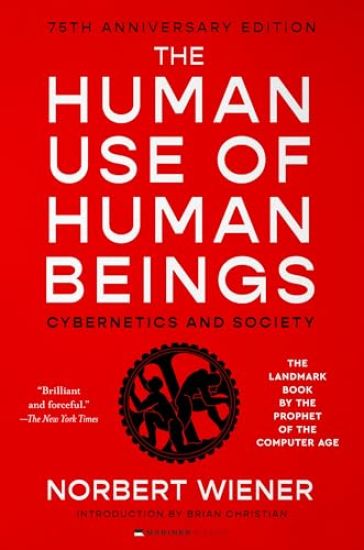
For the 75th anniversary, a new edition of The Human Use of Human Beings—the landmark book that delves into the relationship between humans and computers, and presciently anticipates many contemporary dilemmas surrounding AI technology. With a new introduction by Brian Christian, author of the bestselling Algorithms to Live By and The Alignment Problem.In 1950, mathematician-philosopher Norbert Wiener ended this classic book on the place of machines in society with a warning: “We shall never receive the right answers to our questions unless we ask the right questions.... The hour is very late, and the choice of good and evil knocks at our door.”Wiener, the founder of the science of cybernetics—the study of the relationship between computers and the human nervous system—was widely mislabeled as an advocate for the automation of human life. As The Human Use for Human Beings reveals, his vision was much more complex and interesting, and is more relevant in today’s world of AI than anyone could have anticipated.In his new introduction, Brian Christian aptly calls Wiener the “progenitor of contemporary AI-safety discourse.” Wiener hoped that machines would release people from relentless and repetitive drudgery to achieve more creative pursuits, yet he anticipated the danger of dehumanizing and displacement. His pioneering views on the human-machine relationship as a “communicative process” are only more crucial now, as we carry in our pockets AI devices that we can literally speak to. His prescient warnings illuminate our contemporary relationships with language, art, and even social media.The Human Use of Human Beings examines the implications of cybernetics for education, law, language, science, technology, as Wiener anticipates the enormous impact—in effect, a third industrial revolution—that the computer has had on our lives.
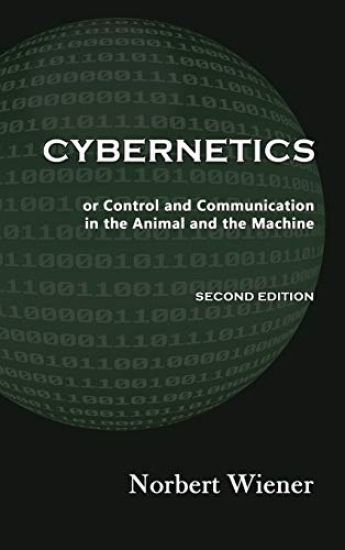
Cybernetics, Second Edition: or Control and Communication in the Animal and the Machine
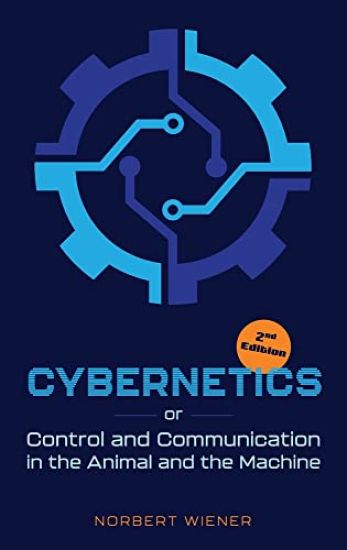
Cybernetics or Control and Communication in the Animal and the Machine (Reprint of 1961 Second Edition) by Norbert Wiener is a seminal work that had long-ranging implications for the fields of computers, automation, electrical engineering, neuroscience, and communications.Author Norbert Wiener (b. 1894, d. 1964) was a mathematician and philosopher, as well as a long-term professor of mathematics at the Massachusetts Institute of Technology (MIT). A child prodigy, Wiener graduated from high school at just 11 years old, and completed his BA in mathematics from Tufts University at the age of 14. By age 19, he had received his Ph.D from Harvard for a dissertation on mathematical logic.While he was later a pacifist, Wiener contributed to the war efforts in both world wars, working on ballistics during World War I and anti-aircraft guns during World War II. By the late 1940s, he had grown concerned with the militarization of science, and stopped contributing to any military projects or taking government funding. Wiener taught philosophy at Harvard during his early career, but was unable to secure a permanent teaching position-a fact he attributed to anti-Semitism, as the son of Jewish immigrants. After World War I, he was hired at MIT, where he would teach for the rest of his career.In addition to teaching, Wiener conducted research in cognitive science and developed theories in cybernetics, computing, and automation. He also wrote many books and articles on these topics, as well as two autobiographical works.Cybernetics or Control and Communication in the Animal and the Machine is one of Wiener's best-known works. Cybernetics refers to the science of control systems and communications in both machines and living beings. This book demonstrates the first public use of the term and describes the way self-regulating mechanisms (including the human brain) function through the receipt, processing, and use of external feedback.This interdisciplinary work is the result of years of discussions with medical scientists, physicians, mathematicians, and physicists, giving it a wide range of influences both on the book's concepts and on the fields that it impacted. The book has been foundational for research into computing, electronic engineering, automation, telecommunications, and neuroscience.At the core of cybernetics are feedback loops, the inflow of information and subsequent response. Both philosophical and technical, the book presents "noise" as the ultimate force that prevents equilibrium. And for the human being, mass media is the greatest source of that noise. Prescient, for a book written decades before personal computers, the internet, and smartphones.A surprise bestseller, Cybernetics was read far beyond its intended technical audience. The book's popularity led Wiener to write a follow-up work further exploring the social and psychological implications of cybernetics called The Human Use of Human Beings.Cybernetics also inspired a whole field of later writing, including the well-known self-development book Psycho-Cybernetics by Maxwell Maltz. This book draws heavily on Wiener's earlier work, and has been cited by self-help experts including Zig Ziglar and Tony Robbins as being a major influence on their techniques.
Cybernetics, Second Edition: or Control and Communication in the Animal and the Machine
Cybernetics or Control and Communication in the Animal and the Machine (Reprint of 1961 Second Edition) by Norbert Wiener is a seminal work that had long-ranging implications for the fields of computers, automation, electrical engineering, neuroscience, and communications.Author Norbert Wiener (b. 1894, d. 1964) was a mathematician and philosopher, as well as a long-term professor of mathematics at the Massachusetts Institute of Technology (MIT). A child prodigy, Wiener graduated from high school at just 11 years old, and completed his BA in mathematics from Tufts University at the age of 14. By age 19, he had received his Ph.D from Harvard for a dissertation on mathematical logic.While he was later a pacifist, Wiener contributed to the war efforts in both world wars, working on ballistics during World War I and anti-aircraft guns during World War II. By the late 1940s, he had grown concerned with the militarization of science, and stopped contributing to any military projects or taking government funding.Wiener taught philosophy at Harvard during his early career, but was unable to secure a permanent teaching position-a fact he attributed to anti-Semitism, as the son of Jewish immigrants. After World War I, he was hired at MIT, where he would teach for the rest of his career.In addition to teaching, Wiener conducted research in cognitive science and developed theories in cybernetics, computing, and automation. He also wrote many books and articles on these topics, as well as two autobiographical works.Cybernetics or Control and Communication in the Animal and the Machine is one of Wiener's best-known works. Cybernetics refers to the science of control systems and communications in both machines and living beings. This book demonstrates the first public use of the term and describes the way self-regulating mechanisms (including the human brain) function through the receipt, processing, and use of external feedback.This interdisciplinary work is the result of years of discussions with medical scientists, physicians, mathematicians, and physicists, giving it a wide range of influences both on the book's concepts and on the fields that it impacted. The book has been foundational for research into computing, electronic engineering, automation, telecommunications, and neuroscience.At the core of cybernetics are feedback loops, the inflow of information and subsequent response. Both philosophical and technical, the book presents "noise" as the ultimate force that prevents equilibrium. And for the human being, mass media is the greatest source of that noise. Prescient, for a book written decades before personal computers, the internet, and smartphones.A surprise bestseller, Cybernetics was read far beyond its intended technical audience. The book's popularity led Wiener to write a follow-up work further exploring the social and psychological implications of cybernetics called The Human Use of Human Beings.Cybernetics also inspired a whole field of later writing, including the well-known self-development book Psycho-Cybernetics by Maxwell Maltz. This book draws heavily on Wiener's earlier work, and has been cited by self-help experts including Zig Ziglar and Tony Robbins as being a major influence on their techniques.
Mensch Und Menschmaschine

Mensch Und Menschmaschine

Norbert Wiener

Verlag Vittorio Klostermann
2022
nidottu
Das Buch "Mensch und Menschmaschine" des amerikanischen Mathematikers und Philosophen Norbert Wiener (1894-1964) ist eine zuganglich geschriebene Einleitung in die Organisationsidee der modernen Gesellschaft. Als bekanntester Pionier der Kybernetik, der Wissenschaft und Technik der Steuerung von Regelkreislaufen, warnt Wiener vor den Moglichkeiten eines solchen Wissens. Im Zentrum seiner Uberlegungen steht eine maschinenhafte Regierungstechnologie, in welcher der Mensch nur eine Ruckkopplungs-Information, ein Signal von Zustimmung oder Ablehnung geworden ist. Der moderne Mensch wird zu einem Individuum, dessen Individualitat die wesentliche Eigenschaft hat, von Sozial-Ingenieuren gesteuert werden zu konnen. In dieser komfortablen, weil geregelten Sozial-Maschine kann der Mensch nicht anders als bestatigen, was die Gesellschaft fur notwendig und fortschrittlich erachtet.
Cybernetics or Control and Communication in the Animal and the Machine

Cybernetics or Control and Communication in the Animal and the Machine

Norbert Wiener; Doug Hill; Sanjoy Mitter

MIT Press
2019
pokkari
A classic and influential work that laid the theoretical foundations for information theory and a timely text for contemporary informations theorists and practitioners.With the influential book Cybernetics, first published in 1948, Norbert Wiener laid the theoretical foundations for the multidisciplinary field of cybernetics, the study of controlling the flow of information in systems with feedback loops, be they biological, mechanical, cognitive, or social. At the core of Wiener's theory is the message (information), sent and responded to (feedback); the functionality of a machine, organism, or society depends on the quality of messages. Information corrupted by noise prevents homeostasis, or equilibrium. And yet Cybernetics is as philosophical as it is technical, with the first chapter devoted to Newtonian and Bergsonian time and the philosophical mixed with the technical throughout. This book brings the 1961 second edition back into print, with new forewords by Doug Hill and Sanjoy Mitter. Contemporary readers of Cybernetics will marvel at Wiener's prescience-his warnings against "noise," his disdain for "hucksters" and "gadget worshipers," and his view of the mass media as the single greatest anti-homeostatic force in society. This edition of Cybernetics gives a new generation access to a classic text.
Norbert Wiener—A Life in Cybernetics

Norbert Wiener—A Life in Cybernetics

Norbert Wiener; Ronald R. Kline

MIT Press
2018
pokkari
Norbert Wiener's celebrated autobiography, available for the first time in one volume.Norbert Wiener-A Life in Cybernetics combines for the first time the two volumes of Norbert Wiener's celebrated autobiography. Published at the height of public enthusiasm for cybernetics-when it was taken up by scientists, engineers, science fiction writers, artists, and musicians-Ex-Prodigy (1953) and I Am a Mathematician (1956) received attention from both scholarly and mainstream publications, garnering reviews and publicity in outlets that ranged from the New York Times and New York Post to the Virginia Quarterly Review. Norbert Wiener was a mathematician with extraordinarily broad interests. The son of a Harvard professor of Slavic languages, Wiener was reading Dante and Darwin at seven, graduated from Tufts at fourteen, and received a PhD from Harvard at eighteen. He joined MIT's Department of Mathematics in 1919, where he remained until his death in 1964 at sixty-nine. In Ex-Prodigy, Wiener offers an emotionally raw account of being raised as a child prodigy by an overbearing father. In I Am a Mathematician, Wiener describes his research at MIT and how he established the foundations for the multidisciplinary field of cybernetics and the theory of feedback systems. This volume makes available the essence of Wiener's life and thought to a new generation of readers.
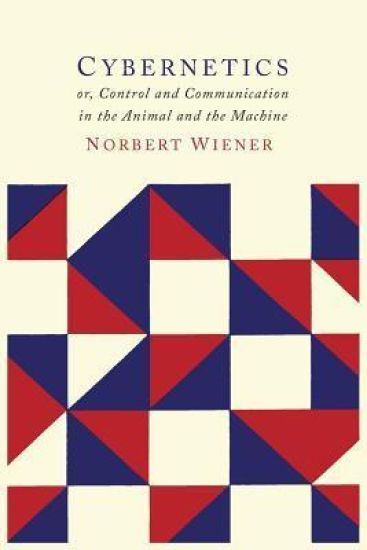
Cybernetics: Or, Control and Communication in the Animal and the Machine
Cybernetics: Or, Control And Communication In The Animal And The Machine is a groundbreaking book by Norbert Wiener that explores the fundamental principles of cybernetics, the study of control and communication in both living organisms and machines. Originally published in 1948, this book is considered a classic in the field of cybernetics and has had a profound impact on a wide range of disciplines, including engineering, computer science, biology, psychology, and philosophy.Wiener's central thesis is that all systems, whether biological or mechanical, can be understood as information-processing systems that rely on feedback mechanisms to maintain stability and adapt to changing environments. He argues that this insight has profound implications for our understanding of the nature of intelligence, consciousness, and agency, and that it opens up new possibilities for designing more efficient and adaptive machines.Throughout the book, Wiener draws on examples from biology, engineering, and other fields to illustrate his ideas, and he engages in a wide-ranging discussion of topics such as communication theory, information theory, feedback control systems, and the relationship between mind and machine. He also explores the ethical and social implications of cybernetics, including the potential for machines to replace human labor and the need for responsible stewardship of technological progress.Overall, Cybernetics: Or, Control And Communication In The Animal And The Machine is a seminal work that continues to influence our understanding of the relationship between living organisms and machines, and of the role of information and communication in shaping the world around us.This is a new release of the original 1949 edition.This scarce antiquarian book is a facsimile reprint of the old original and may contain some imperfections such as library marks and notations. Because we believe this work is culturally important, we have made it available as part of our commitment for protecting, preserving, and promoting the world's literature in affordable, high quality, modern editions, that are true to their original work.
Fourier Integral and Certain of Its Applications

Fourier Integral and Certain of Its Applications

Norbert Wiener

Literary Licensing, LLC
2013
sidottu
""Fourier Integral And Certain Of Its Applications"" is a mathematical text written by Norbert Wiener. The book explores the Fourier integral, a mathematical concept that allows for the representation of a function as a sum of sine and cosine waves. The author delves into the theory behind the Fourier integral and its applications in various fields, including physics, engineering, and signal processing. The text is written for advanced mathematicians and students with a strong background in calculus and mathematical analysis. The book is considered a classic in the field of mathematical analysis and is still widely referenced and studied today.This scarce antiquarian book is a facsimile reprint of the old original and may contain some imperfections such as library marks and notations. Because we believe this work is culturally important, we have made it available as part of our commitment for protecting, preserving, and promoting the world's literature in affordable, high quality, modern editions, that are true to their original work.
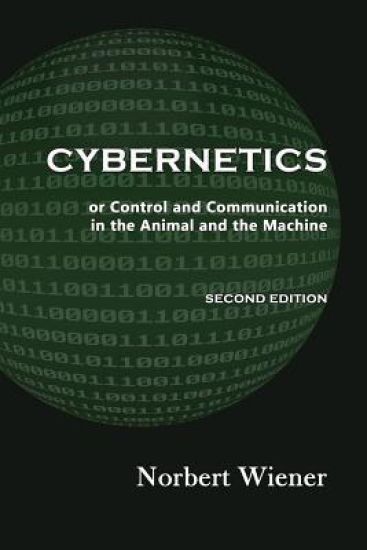
Cybernetics, Second Edition: or Control and Communication in the Animal and the Machine
CYBERNETICS, in its authoritative and final Second Edition, and available in a modern and highly legible presentation - not a "facsimile edition" (photocopy) of the printing as are cheap recreations. Instead, the Quid Pro Books edition allows the reader to experience the best version of the work in a contemporary but affordable printing, not just as a facsimile or reprint. NOTE: Only the Quid Pro edition offers these features, even if this description erroneously appears under other press's versions or older, used copies of the work.] A quality, affordable ebook version of this classic work is also available from Quid Pro Books. CYBERNETICS is on virtually everyone's short list of the most important and influential nonfiction books of the last century. First published by MIT mathematics professor Norbert Wiener in 1948, and later in its Second Edition in 1961, this groundbreaking account of systems, thought processes, AI, and the use of "feedback" foreshadowed intelligent and replicating machines, complex organizational organisms, and the physiology and failure of the human nervous system. Its 1961 Second Edition is the same version republished in many printed paperback editions since (such as the 1965 printing by MIT Press), and represents the culmination of the author's work on this project. No small wonder this has been widely read by scientists and lay readers alike, to understand the origins and future of computers, wider communication pathways, the use of feedback to refine actions and thought processes, and the logic and math behind non-linear systems. Educated readers know the term "cybernetics"; this book coined the term and created an entire field of interdisciplinary study that resonates today, and led to the "cyber"-everything that we know. Norbert Wiener, known as the "Father of Cybernetics," has influenced such fields of study as game theory, system theory, sociology, psychology and neuroscience, modern philosophy, organizational theory, and even architecture.
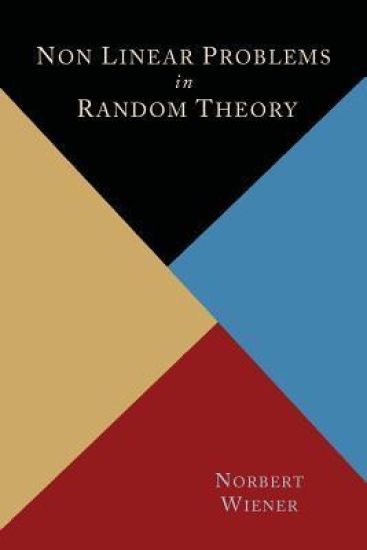
Nonlinear Problems in Random Theory

Nonlinear Problems in Random Theory

Norbert Wiener; J. A. Stratton

Literary Licensing, LLC
2013
sidottu
Nonlinear Problems in Random Theory is a book written by Norbert Wiener, a renowned mathematician and one of the pioneers of cybernetics. The book deals with the application of probability theory and stochastic processes to the study of nonlinear systems. It explores the behavior of systems that exhibit randomness and nonlinearity, and how these two factors interact to produce complex and unpredictable outcomes.The book is divided into three parts. The first part introduces the basic concepts of probability theory and stochastic processes, and discusses their application to the study of nonlinear systems. The second part focuses on specific examples of nonlinear systems, including the behavior of random walks, the dynamics of nonlinear oscillators, and the analysis of stochastic differential equations. The third and final part of the book explores the application of nonlinear random theory to a range of fields, including physics, engineering, and economics.Throughout the book, Wiener emphasizes the importance of understanding the complex interplay between randomness and nonlinearity in the behavior of systems. He also emphasizes the practical applications of nonlinear random theory, and the potential for this field to contribute to the development of new technologies and scientific discoveries.Overall, Nonlinear Problems in Random Theory is a comprehensive and insightful exploration of the application of probability theory and stochastic processes to the study of nonlinear systems. It is a valuable resource for mathematicians, physicists, engineers, and anyone interested in the behavior of complex systems.Technology Press Research Monographs.This scarce antiquarian book is a facsimile reprint of the old original and may contain some imperfections such as library marks and notations. Because we believe this work is culturally important, we have made it available as part of our commitment for protecting, preserving, and promoting the world's literature in affordable, high quality, modern editions, that are true to their original work.