Kirjojen hintavertailu. Mukana 12 530 820 kirjaa ja 12 kauppaa.

Kirjailija

Norman C. Polmar

Kirjat ja teokset yhdessä paikassa: 5 kirjaa, julkaisuja vuosilta 1998-2021, suosituimpien joukossa Hunters and Killers. Vertaile teosten hintoja ja tarkista saatavuus suomalaisista kirjakaupoista.

5 kirjaa

Kirjojen julkaisuhaarukka 1998-2021.

Opening the Great Depths

Opening the Great Depths

Norman C. Polmar; Lee J Mathers

Naval Institute Press
2021
sidottu
We were certainly pioneers as the Trieste was one of only two such vehicles in the world--the French Navy's bathyscaphe FNRS-3 was the other. It meant that we had to 'write the book' about deep submergence operations in terms of technique and technologies. We learned by doing and by failures, although very few of the latter were serious. For example, if we needed a piece of equipment we would have to design it and make it. There were no commercial vendors who catered to deep submergence technology requirements. The market was far too small." --From the foreword by Capt. Don Walsh, USN (Ret.), PhD, U.S. Navy Submersible Pilot No. 1 Developed by French physicist Auguste Piccard and his son Jacques, the bathyscaph Trieste was a scientific marvel that allowed unprecedented scientific, technical, and military feats in the ocean depths. France and the United States both acquired and subsequently developed variants of the original bathyscaph. While both France and the United States employed the bathyscaph as a tool for scientific investigation of the deepest ocean depths, the U.S. Navy developed and employed the Trieste for military missions as well. From its earliest years, participants in the Trieste program realized that they were making history, blazing a trail into previously unexplored and unexploited depths, developing new capabilities and opening a new frontier. Comparisons with developments in space and the space-race between the United States and the Soviet Union often were made concerning the Trieste program and contemporary developments in undersea technologies and capabilities. The Trieste opened the entire oceans to exploration, exploitation, and operations. The bathyscaph was a first-generation system, a "Model-T" that spawned an entirely new industry and encouraged new concepts for deep-ocean naval operations. Advances in deep-sea technologies lacked the "gee-whiz" factor of the concurrent space race, but were highly significant in the development of new technology, new knowledge, and new military capabilities. Opening the Great Depths is the story of the three Trieste deep-ocean vehicles, their officers and enlisted men, and the civilians, often told in their own words, documenting for the first time the earliest years of humanity's probing into Earth's final frontier.
Strike from the Sea

Strike from the Sea

Norman C. Polmar; John O'Connell

Naval Institute Press
2020
sidottu
The cruise missile-also referred to as a guided missile-is a widely employed tactical and strategic weapon, capable of striking ground or ship targets with conventional or nuclear warheads.Before the development of ballistic missiles for attacking an enemy's homeland the U.S. and Soviet strategic arsenals had land-attack cruise missiles to deliver nuclear warheads. Subsequently, the U.S. and Soviet Navies as well as other fleets developed tactical anti-ship and anti-submarine cruise missiles.Much of this book addresses the U.S. Navy's Regulus missile program-the world's first submarine weapon for attacking an enemy homeland with a nuclear warhead-and the similar Soviet Navy's cruise missile efforts. Prior to Regulus a few of the world's submarines had deck guns that were employed for assaulting coastal targets; indeed, the British built a class of submarine monitors with large-caliber guns for attacking coastal targets.After the Regulus more advanced cruise missiles and ballistic missiles were sent to sea in submarines to attack an enemy's cities and military-industrial installations. Certain U.S. and Soviet/Russian land-launched, nuclear-armed cruise missiles also are examined in this book in the context of their being competitive with sea-based missiles for their roles and for resources. Also, at times the technology of one service's missiles was considered for use by another service. The U.S. Navy's rapid and successful development of the Polaris Submarine-Launched Ballistic Missile (SLBM) and budgetary constraints caused the cancellation of advanced submarine-launched cruise missiles-the Regulus II as well as the follow-on Rigel and Triton. Submarines armed with the Regulus I missile continued on patrols in the North Pacific until mid-1964, when they were replaced on the 'deterrent' role by Polaris missile submarines. The Soviet Navy continued the development and deployment of anti-ship cruise missiles, which retained some land-attack capabilities. Following the retirement of Regulus in 1964 strategic cruise missile development in the U.S. Navy experienced doldrums.In the 1970s development of U.S. Navy land-attack cruise missiles resumed with the Tomahawk, initially designed as "theater" land-attack weapon with a nuclear warhead. Significantly, the Tomahawk was designed from the outset of the program to be launched from standard, 21-inch (533-mm) submarine torpedo tubes. While the Tomahawk was developed specifically for naval use from surface ships and submarines, subsequently a land-launched version was developed as a theatre nuclear weapon named Gryphon for the U.S. Air Force as a counter to Soviet theater nuclear weapons in Eastern Europe. (The Tomahawk also was suitable for aircraft launch, although neither the U.S. Air Force nor Navy adopted that concept.) Subsequent Tomahawk variants with conventional warheads were developed for the land-attack and anti-ship missile roles. Sea-based Tomahawk missiles with conventional warheads-launched from surface ships and submarines-were employed extensively and very effectively in the Gulf War (1991) and in several subsequent conflicts and crises. The Soviet Navy's cruise missile programs have a similar development history and that effort has produced several land-attack weapons.
Hunters and Killers

Hunters and Killers

Norman C. Polmar; Estate of Edward C. Whitman

Naval Institute Press
2015
sidottu
Hunters and Killers is the first comprehensive history of all aspects of anti-submarine warfare (ASW) from its beginnings in the 18th century through the important role of present anti-submarine systems and operations. Published in two volumes, the work discusses anti-submarine warfare operations in World War I, World War II, the Cold War, and today. In addition to tactical and strategic narratives of major ASW campaigns, the work covers the evolution of ASW sensors, weapons, platforms, and tactics.This first volume looks at the often ignored reaction to the earliest submersible attack on British warships in 1776 to the first, primitive ASW actions of World War I. World War I saw the Germans use U-boats to devastate British shipping, nearly driving the country out of the war. Here the authors look at the development of the innovative, but rudimentary sensors and weapons that the Allies used to counter the U-boat threats in the Atlantic and Mediterranean theaters.Still, the U-boats were never completely defeated in the Great War, and the ensuing chapters about the two decades between the world wars narrate the development of sonar, radar, and ASW ships, as well as changing political attitudes toward undersea warfare.The remainder of the first volume covers the first half of World War II's Battle of the Atlantic, from September 1939 to the U-boat crisis in the spring of 1943. This section discusses the influence of intelligence, gained mainly through cryptography, on the Battle of the Atlantic.Polmar and Whitman have created a thorough, well-researched reference for anyone interested in the development of ASW.
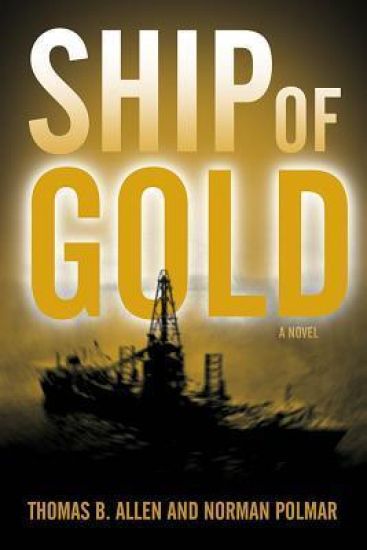
Ship of Gold

Ship of Gold

Norman C. Polmar; Thomas B Allen

Naval Institute Press
2014
pokkari
This taut thriller provides the behind-the-scenes reality of the national security system at work --the CIA, the Oval Office, the Pentagon, and the National Security Council -- and is must-reading for fans of Tom Clancy and W.E.B. Griffin.In 1945, the U.S. submarine Tigerfish mistakenly torpedoed and sunk a Japanese merchant ship. Reportedly carrying supplies to allied POWs, the ship had been given safe passage, but was actually a cunning ruse devised by a powerful secret society to transport tons of gold out of Japan under the very eyes of the enemy. Some thirty years later, the captain of the Tigerfish is murdered in Washington. As the CIA launches its investigation into his death, a race to raise the ship and recover its treasure begins, which mounts to an international incident involving the U.S., China, the Soviet Union and Japan.
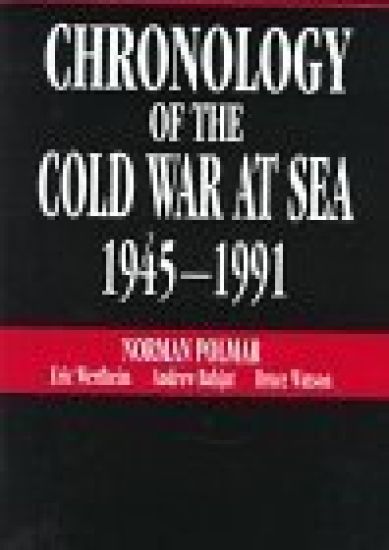
Chronology of the Cold War at Sea, 1945-1991

Chronology of the Cold War at Sea, 1945-1991

Norman C. Polmar; Eric M. Wertheim; Andrew Bahjat; Bruce Watson

Naval Institute Press
1998
sidottu
The Cold War that dominated world political, economic and military activities for almost half of the 20th century was, in many respects, ""fought"" at sea between the United States and the Soviet Union. The U.S. Navy played a central role from the outset, projecting America's presence and power to the far corners of the globe while attempting to stop Soviet aggressions and to advance its own agenda. This useful reference provides a detailed chronological outline of Cold War developments and events as they relate to U.S. and Soviet naval forces and their allies. Chronology covers naval forward-presence and combat operations from the Berlin crisis, Korea, the Suez campaign, and the Vietnam War to the Iran-Iraq conflict, the Falkands War, and the Gulf War. Smaller-scale confrontations are also included. Events of the Cuban Missile Crisis, Stalin's massive naval expansion, the largest peace-time U.S. naval buildup in history during the 1980s, and other crucial events are presented. The authors present a wealth of information on naval technological and personnel developments, such as the unveiling of new ship types, advances in missile technology, the introduction of new aircraft, and changes in naval leadership. By showcasing new information made available through the opening of Russian archives, this book serves as a walk through history as well as an indispensable reference for naval history buffs and serious students of the Cold War.