
Kirjailija
Norman Crowe
Kirjat ja teokset yhdessä paikassa: 3 kirjaa, julkaisuja vuosilta 1997-2012, suosituimpien joukossa Nature and the Idea of a Man-Made World. Vertaile teosten hintoja ja tarkista saatavuus suomalaisista kirjakaupoista.
3 kirjaa
Kirjojen julkaisuhaarukka 1997-2012.
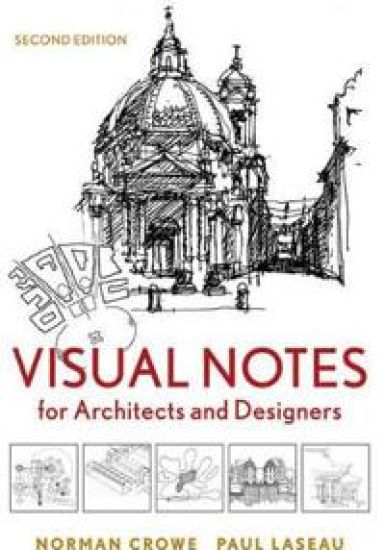
Visual Notes for Architects and Designers
Norman Crowe; Paul Laseau
John Wiley Sons Inc
2011
nidottu
The completely updated step-by-step guide to¿capturing experiences in sketch format—regardless of artistic ability Recording your ideas and observations primarily in pictures instead of words can help you become more creative and constructive on the job, no matter what your level of artistic ability. Featuring completely new coverage of visual note-taking in a digital world, Visual Notes for Architects and Designers, Second Edition demonstrates how to make rapid, notational sketches that serve as visual records for future reference, as well as improve understanding and facilitate the development of ideas. It shows you how to expand your knowledge of a subject beyond what is gained through observation or verbal representation alone. You gain access to simple techniques for collecting, analyzing, and applying information. Crowe and Laseau examine the relationship between note-taking, visualization, and creativity. They give practical guidance on how to develop: Visual acuity—the ability to see more in what you experience Visual literacy—expressing yourself clearly and accurately with sketches Graphic analysis—using sketches to analyze observations Numerous examples demonstrate some of the many uses of visual notes. They help you develop a keener awareness of environments, solve design problems, and even get more out of lectures and presentations. The authors also discuss types of notebooks suitable for taking visual notes. If you want to develop your perceptual and creative skills to their utmost, you will want to follow the strategies outlined in Visual Notes for Architects and Designers, Second Edition. It is a valuable guide for architects, landscape architects, designers, and anyone interested in recording experience in sketch form.
Over the course of this century, nature has increasingly been relegated to the province of environmentalists while cities and towns have been turned over to developers and planners. Norman Crowe seeks to overcome this division into the respective realms of specialists by recognizing the independence of both the natural and the manmade through an understanding of the often hidden roots of the world we contrive for ourselves. Crowe argues that we have lost a vital balance by neglecting our traditional motives for building in the first place. He argues for a symbiotic theory of man's making and nature's activity that views the built environment as a form of nature, one that nourishes the generative power as well as other enduring qualities of nature. In this sweeping view of architecture and urbanism across cultural boundaries, Crowe evaluates the connections between the natural and manmade in our towns and cities, farms and gardens, architecture and works of civil engineering. He draws on the lessons to be learned from the buildings and cities of the past in restoring critical traditional values that have been lost to modernism which tends to see the built world almost exclusively through the abstractions of postenlightenment science. Crowe's starting point is indigenous architecture, the origins of our cities and towns where the first geometries were imposed on nature. He traces our separation from nature over time, from the long period of human history when nature served as a paradigm for creation. The first chapter considers the psychological and practical origins for the practice of what amounts to building an "alternative" nature. Crowe then explores the likely historical roots of this world and investigates our intrinsic quest for unity, the ancient idea that we are responsible for maintaining a harmony between ourselves, what we make, and nature. He traces the effect of our responses to the passing of time and the inevitability of change in the built world and then considers its opposite, the quest for timelessness in response to the inevitability of time passing. Crowe concludes by looking at the idea of the city as the culminating expression of all of these characteristic responses to nature that manifest themselves in what we build.