Kirjojen hintavertailu. Mukana 12 595 353 kirjaa ja 12 kauppaa.

Kirjailija

Norman H. Nie

Kirjat ja teokset yhdessä paikassa: 3 kirjaa, julkaisuja vuosilta 1979-1996, suosituimpien joukossa The Changing American Voter. Vertaile teosten hintoja ja tarkista saatavuus suomalaisista kirjakaupoista.

Mukana myös kirjoitusasut: Norman H Nie

3 kirjaa

Kirjojen julkaisuhaarukka 1979-1996.

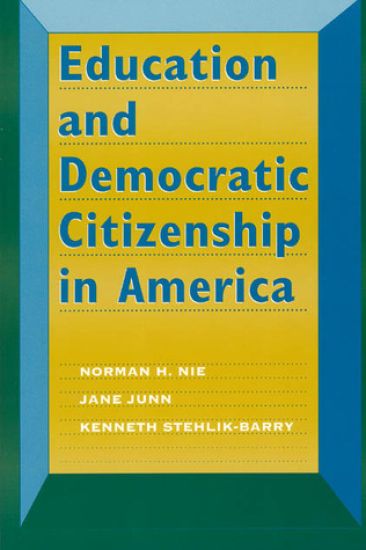
Education and Democratic Citizenship in America

Education and Democratic Citizenship in America

Norman H. Nie; Jane Junn; Kenneth Stehlik-Barry

University of Chicago Press
1996
nidottu
Formal education is crucial for creating enlightened and active citizens. However, despite an increase in education attainment since the 1970s, political engagement has not risen at a commensurate level. This text explores how and why education affects citizenship in these ways. The authors seek to provide answers by uncovering the causal relationship between education and democratic citizenship. They argue that citizenship encompasses both political engagement in pursuit of interests and commitment to democratic values that temper what citizens can do to win in politics. Education affects the two dimensions in distinct ways. Especially significant is the influence of education on political engagement through occupational prominence and position in social networks. Formal education orders the distribution of social position and connections, and creates an uneven political playing field.
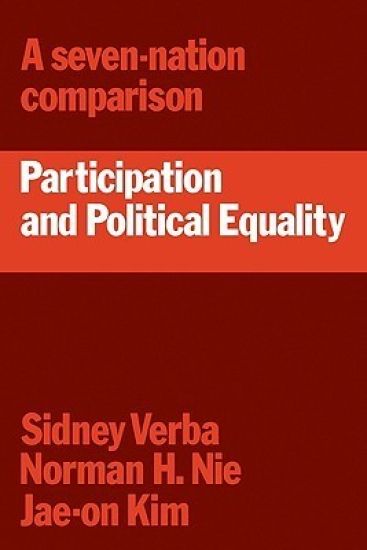
Participation and Political Equality

Participation and Political Equality

Sidney Verba; Norman H. Nie; Jae-on Kim

Cambridge University Press
1979
pokkari
In this survey of political participation in seven nations - Nigeria, Austria, Japan, India, the Netherlands, Yugoslavia and the United States - the authors examine the relationship between social, economic, and educational factors and political participation. The book provides insight into an ongoing debate among political scientists and sociologist: why is political participation in some nations distributed evenly across economic, social, and educational lines, whereas other nations foster participation only by their privileged classes? The book treats politics not only as a dependent variable influenced by socioeconomic factors, but also as an independent variable that affects levels of political participation through variations in party systems and linkages between parties and other organizations.