Kirjojen hintavertailu. Mukana 12 657 676 kirjaa ja 12 kauppaa.

Kirjailija

Norman Rice

Kirjat ja teokset yhdessä paikassa: 5 kirjaa, julkaisuja vuosilta 1994-2022, suosituimpien joukossa Queen's Land. Vertaile teosten hintoja ja tarkista saatavuus suomalaisista kirjakaupoista.

5 kirjaa

Kirjojen julkaisuhaarukka 1994-2022.

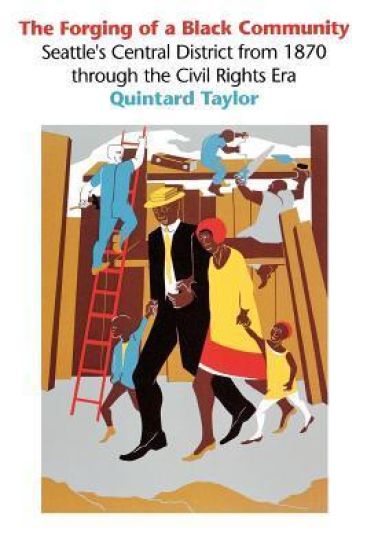
The Forging of a Black Community

The Forging of a Black Community

Quintard Taylor; Quin'Nita Cobbins-Modica; Norman Rice; Albert S. Broussard

UNIVERSITY OF WASHINGTON PRESS
2022
pokkari
Seattle's first black resident was a sailor named Manuel Lopes who arrived in 1858 and became the small community's first barber. He left in the early 1870s to seek economic prosperity elsewhere, but as Seattle transformed from a stopover town to a full-fledged city, African Americans began to stay and build a community. By the early twentieth century, black life in Seattle coalesced in the Central District, a four-square-mile section east of downtown. Black Seattle, however, was never a monolith. Through world wars, economic booms and busts, and the civil rights movement, black residents and leaders negotiated intragroup conflicts and had varied approaches to challenging racial inequity. Despite these differences, they nurtured a distinct African American culture and black urban community ethos. With a new foreword and afterword, this second edition of The Forging of a Black Community is essential to understanding the history and present of the largest black community in the Pacific Northwest.
The Forging of a Black Community

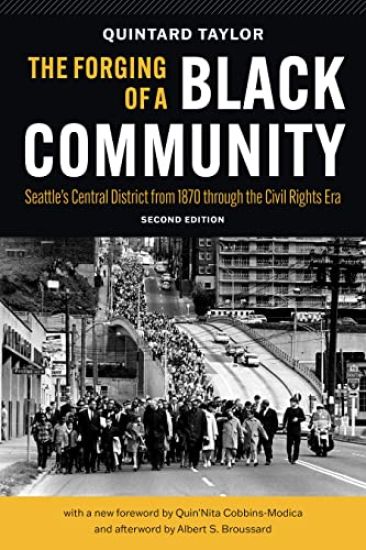
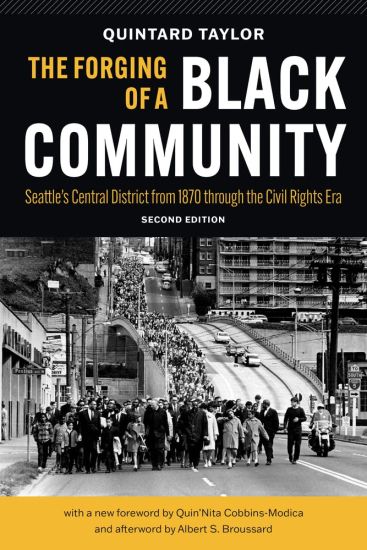
The Forging of a Black Community

Quintard Taylor; Quin'Nita Cobbins-Modica; Norman Rice; Albert S. Broussard

UNIVERSITY OF WASHINGTON PRESS
2022
sidottu
Seattle's first black resident was a sailor named Manuel Lopes who arrived in 1858 and became the small community's first barber. He left in the early 1870s to seek economic prosperity elsewhere, but as Seattle transformed from a stopover town to a full-fledged city, African Americans began to stay and build a community. By the early twentieth century, black life in Seattle coalesced in the Central District, a four-square-mile section east of downtown. Black Seattle, however, was never a monolith. Through world wars, economic booms and busts, and the civil rights movement, black residents and leaders negotiated intragroup conflicts and had varied approaches to challenging racial inequity. Despite these differences, they nurtured a distinct African American culture and black urban community ethos. With a new foreword and afterword, this second edition of The Forging of a Black Community is essential to understanding the history and present of the largest black community in the Pacific Northwest.

Experimental Methods in Kinetic Studies

Experimental Methods in Kinetic Studies

Bohdan Wojciechowski; Norman Rice

Elsevier Science Ltd
2003
sidottu
This book is a guide to kinetic studies of reaction mechanisms. It reviews conventional reactor types and data collection methods, and introduces a new methodology for data collection using Temperature Scanning Reactors (TSR). It provides a theoretical and practical approach to temperature scanning (TS) methodology and supports a revival of kinetic studies as a useful approach to the fundamental understanding of chemical reaction mechanisms and the consequential reaction kinetics.
The Forging of a Black Community

The Forging of a Black Community

Quintard Taylor; Norman Rice

University of Washington Press
1994
pokkari
Through much of the twentieth century, black Seattle was synonymous with the Central District--a four-square-mile section near the geographic center of the city. Quintard Taylor explores the evolution of this community from its first few residents in the 1870s to a population of nearly forty thousand in 1970. With events such as the massive influx of rural African Americans beginning with World War II and the transformation of African American community leadership in the 1960s from an integrationist to a “black power” stance, Seattle both anticipates and mirrors national trends. Thus, the book addresses not only a particular city in the Pacific Northwest but also the process of political change in black America.Seattle's first black resident was a sailor named Manuel Lopes who arrived in 1858 and became the small community's first barber. By the early twentieth century, black life in Seattle coalesced in the Central District, a four-square-mile section east of downtown. Black Seattle, however, was never a monolith. Through world wars, economic booms and busts, and the civil rights and black power movements of the 1960s, the African American community negotiated intragroup conflicts and used varied approaches to challenge racial inequity. Despite these differences, the community shared a distinct African American culture and black urban ethos. With a new foreward and afterword, this second edition of The Forging of a Black Community is essential to understanding the history and present of the largest black community in the Pacific Northwest.