Kirjojen hintavertailu. Mukana 12 303 700 kirjaa ja 12 kauppaa.

Kirjailija

Obaid Younossi

Kirjat ja teokset yhdessä paikassa: 22 kirjaa, julkaisuja vuosilta 2001-2024, suosituimpien joukossa Recommended Research Priorities for the Qatar Foundation's Environment and Energy Research Institute. Vertaile teosten hintoja ja tarkista saatavuus suomalaisista kirjakaupoista.

22 kirjaa

Kirjojen julkaisuhaarukka 2001-2024.

Recommended Research Priorities for the Qatar Foundation's Environment and Energy Research Institute

Recommended Research Priorities for the Qatar Foundation's Environment and Energy Research Institute

Nidhi Kalra; Obaid Younossi; Kristy N. Kamarck; Sarah Al-Dorani; Gary Cecchine; Aimee E. Curtright; Chaoling Feng; Aviva Litovitz; David E. Johnson; Mohammed Makki; Shanthi Nataraj; David S. Ortiz; Parisa Roshan; Constantine Samaras

RAND
2011
pokkari
The Qatar Foundation is establishing a national research institute to conduct and collaborate on applied research in energy, environment, and water issues, the Qatar Environment and Energy Research Institute. This book recommends research priorities for the new institution and reports on a survey of relevant research institutions in the region.
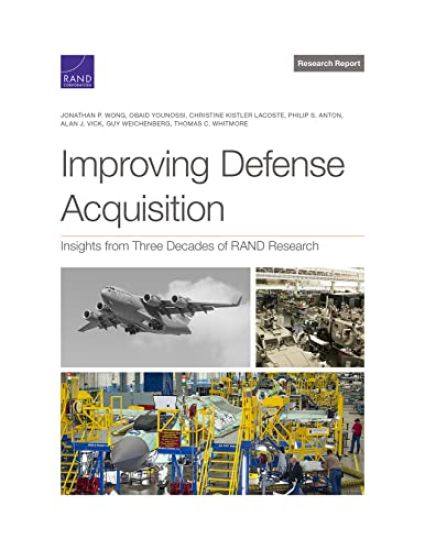
Improving Defense Acquisition

Improving Defense Acquisition

Jonathan P Wong; Obaid Younossi; Christine Kistler Lacoste; Philip S Anton; Alan J Vick; Guy Weichenberg; Thomas C Whitmore

RAND Corporation
2022
pokkari
In this report, researchers describe overarching trends that affect defense acquisition, outline challenges in the defense acquisition process, and suggest improvements that might help address those challenges. The study is informed by open-source documents and insights from publicly available RAND Corporation defense acquisition research, especially reports published since 1986, when a similar review of RAND research was published.
Australia's Naval Shipbuilding Enterprise

Australia's Naval Shipbuilding Enterprise

John Birkler; John F. Schank; Mark V. Arena; Edward G. Keating; Joel B. Predd; James Black; Irina Danescu; Dan Jenkins; James G. Kallimani; Gordon T. Lee; Roger Lough; Robert Murphy; David Nicholls; Deborah Peetz; Brian Perkinson; Jerry M. Sollinger; Shane Tierney; Obaid Younossi

RAND
2015
pokkari
To prepare for its next Defence White Paper, Australia is examining an enterprise-level naval shipbuilding plan. To support this effort, RAND researchers explore the feasibility of Australia sustaining a domestic naval shipbuilding industry compared with buying ships from foreign shipbuilders. The authors outline the complex consequences and trade-offs of both options.
Future U.S. Security Relationship with Iraq and Afghanistan

Future U.S. Security Relationship with Iraq and Afghanistan

David E. Thaler; Theodore W. Karasik; Dalia Dassa Kaye; Jennifer D. P. Moroney; Frederic M. Wehrey; Obaid Younossi; Farhana Ali; Robert A. Guffey

RAND
2008
pokkari
The authors describe possible regional security structures and bilateral U.S. relationships with Iraq and Afghanistan. They recommend that the United States offer a wide range of security cooperation activities to compatible future governments in Kabul and Baghdad and should also plan to hedge against less-favorable contingencies. They emphasize that the U.S. Air Force should expect to remain heavily tasked for the foreseeable future.This book frames potential long-term U.S. security relationships with Iraq and Afghanistan in a regional context and posits roles of U.S. forces, especially the Air Force, in supporting these relationships under a variety of contingencies.
Impact of Digital Engineering on Defense Acquisition and the Supply Chain

Impact of Digital Engineering on Defense Acquisition and the Supply Chain

Brittany Clayton; Obaid Younossi; Hilary Reininger; Angela Yun; David M Adamson; Thao Liz Nguyen; Jonathan Roberts; Padmaja Vedula; Thomas Light; Augustine Bravo; Oluwatimilehin Sotubo; Mohammad Ahmadi

RAND Corporation
2024
pokkari
This report summarizes the results of an industry survey designed to assess the progress of digital engineering (DE) implementation and to identify (1) implementation challenges and opportunities and (2) possible metrics for tracking DE implementation. Although the benefits of DE might not be immediately apparent in terms of cost savings or schedule reduction, it has the potential to provide significant long-term benefits to defense acquisition.
Life Cycle Management of Military Commercial Derivative Aircraft

Life Cycle Management of Military Commercial Derivative Aircraft

Brittany Clayton; Obaid Younossi; Brian Dolan; Thomas Goughnour; Devon Hill; Gwen Mazzotta; Benjamin J Sacks; Barbara Bicksler

RAND Corporation
2024
pokkari
The authors examined retention of racial-ethnic minorities in the Regular Army's enlisted and officer ranks and how racial-ethnic composition changes as soldiers progress in their careers. The authors also explored reasons that individuals stay in the Army or leave at given points, how unit leader decisionmaking affects such decisions, and what influences promotion decisions.
Qatar's School Transportation System

Qatar's School Transportation System

Keith Henry; Obaid Younossi; Maryah Al-Dafa; Shelly Culbertson; Michael G. Mattock; Thomas Light; Charlene Rohr

RAND
2012
pokkari
In consideration of the many challenges associated with Qatar's continued growth and demographic changes, the government of Qatar is interested in updating its school transportation system (STS). This volume assesses parents' and school administrators' perspectives on Qatar's STS, identifies a vision and goals for the STS, and discusses strategies to achieve the vision and better align Qatar's STS with international norms.
Ending F22a Production

Ending F22a Production

Obaid Younossi; Kevin Brancato; John C. Graser; Thomas Light; Rena Rudavsky

RAND
2009
pokkari
In April 2009, the Department of Defense decided to terminate production of the F-22A Raptor. In advance of the decision, the Air Force asked RAND Project AIR FORCE to identify the costs and the industrial base implications of various shutdown options. This monograph evaluates the implications of three shutdown options for the F-22A industrial capability: shutdown; shutdown and restart; and warm production, in which a small number of aircraft are produced until a decision is made to return to full-rate production.
The Long March

The Long March

Obaid Younossi; Peter Dahl Thruelsen; Jonathan Vaccaro; Jerry M Sollinger; Brian Grady

RAND
2009
pokkari
The Afghan National Army (ANA) is critical to the success of the allied efforts in Afghanistan and the ultimate stability of the national government. This monograph assesses the ANA's progress in the areas of recruitment, training, facilities, and operational capability. Coalition forces will continue to play a crucial role with the ANA in Afghanistan, particularly in light of the increased threat from Taliban forces and other criminal groups.
Why Has the Cost of Fixed-wing Aircraft Risen?

Why Has the Cost of Fixed-wing Aircraft Risen?

Mark V. Arena; Obaid Younossi; Kevin Brancato; Irv Blickstein; Clifford A. Grammich

RAND
2008
pokkari
This report explores why, in recent decades, military fixed-wing aircraft costs have escalated beyond the rates of commonly used inflation indices, examining both economy-driven factors that the Services cannot control and customer-driven ones that they can. The authors found that this trend of cost increases is true for all types of aircraft
Improving the Cost Estimation of Space Systems

Improving the Cost Estimation of Space Systems

Obaid Younossi; Mark A. Lorell; Kevin Brancato; Cynthia R. Cook; Mel Eisman; Bernard Fox; John C. Graser; Kim Yool; Robert S. Leonard; Shari Lawrence Pfleeger

RAND
2008
pokkari
Why have the costs of acquiring space systems been so high? What are the sources of the problem? To answer these questions, RAND undertook an extensive study of two space systems - the Space Based Infrared SystemHigh (SBIRS) and the Global Positioning System (GPS).This title analyzes the reason for the comparatively high growth in the cost of space systems by means of an in-depth study of two systems: SBIRS-High and GPS.
Sources of Weapon System Cost Growth

Sources of Weapon System Cost Growth

Joseph G. Bolten; Robert S. Leonard; Mark V. Arena; Obaid Younossi; Jerry M. Sollinger

RAND
2008
pokkari
This analysis uses data from Selected Acquisition Reports to determine the causes of cost growth in 35 mature major defense acquisition programs. Four major sources of growth are identified: errors in estimation and scheduling, decisions by the government, financial matters, and miscellaneous. The analysis shows that more than two-thirds of cost growth (measured as simple averages) is caused by decisions, most of which involve quantity changes, requirements growth, and schedule changes.Cost growth in major weapon-systems programs results from errors in estimation and scheduling, government decisions, financial matters, and miscellaneous sources, with decisions involving changes in requirements, quantities, and production schedules the dominant cause.
F-22a Multiyear Procurement Program: an Assessment of Cost Savings

F-22a Multiyear Procurement Program: an Assessment of Cost Savings

Obaid Younossi; Mark V. Arena; Kevin Brancato; John C. Graser; Benjamin W. Goldsmith

RAND
2007
pokkari
Congress asked RAND for an independent review of whether the estimated savings from proposed multiyear contracts for 60 F-22A aircraft over three years would yield the promised savings. Researchers found that a multiyear procurement of three lots of F-22A fighters would save an estimated $411 million-about 4.5 percent of the total contract value-and that savings attributed to the multiyear contract by the contractors appear to be reasonable.
Is Weapon System Cost Growth Increasing?

Is Weapon System Cost Growth Increasing?

Obaid Younossi; Mark V Arena; Robert S Leonard; Charles Robert Roll; Arvind Jain

RAND
2007
pokkari
In recent decades, there have been numerous attempts to rein in the cost growth of U.S. Department of Defense acquisition programs. Drawing on prior RAND research, new analyses of completed and ongoing weapon system programs, and data drawn from Selected Acquisition Reports, this study finds that development cost growth over the past three decades has remained high and without any significant improvement.
Historical Cost Growth of Completed Weapon System Programs

Historical Cost Growth of Completed Weapon System Programs

Mark V Arena; Robert S Leonard; Sheila E Murray; Obaid Younossi

RAND
2006
pokkari
Our analysis shows that the Department of Defense (DoD) and the military departments have generally underestimated the cost of buying new weapon systems and that this growth is higher than previously thought. It indicates a systematic bias toward underestimating costs and substantial uncertainty in estimating the final cost of a weapon system.
Why Has the Cost of Navy Ships Risen?

Why Has the Cost of Navy Ships Risen?

Mark V Arena; Irv Blickstein; Obaid Younossi; Clifford A Grammich

RAND
2006
pokkari
Over the past several decades, increases in acquisition costs for U.S. Navy combatants have outpaced the rate of inflation. To understand why, the authors of this book examined two principal source categories of ship cost escalation (economy-driven factors and customer-driven factors) and interviewed various shipbuilders. Based on their analysis, the authors propose some ways the Navy might reduce ship costs in the future.
Evolutionary Acquisition

Evolutionary Acquisition

Mark A Lorell; Julia Lowell; Obaid Younossi

RAND
2006
pokkari
This monograph presents findings of a RAND Project AIR FORCE research project documenting lessons learned by the U.S. Air Force (USAF) and other Department of Defense (DoD) cost analysis and acquisition community members from the implementation of evolutionary acquisition (EA) strategies for major Air Force defense space acquisition programs. In May 2003, DoD mandated EA strategies relying on spiral development as the preferred approach to satisfying operational needs.
Impossible Certainty

Impossible Certainty

Obaid Younossi; Lionel A Galway; Bernard Fox; John C Graser

RAND
2006
pokkari
Cost analysts must predict-sometimes very far-into the future how much money the military will spend on weapon systems. But these analysts do not have perfect knowledge about tomorrow's technology, economic conditions, or any other future event. This book looks at how estimates for future weapon systems can be more realistic than in the past and how cost uncertainty analyses can be more comprehensive and informative.
Lessons Learned from the F/A-22 and F/A-18 E/F Development Programs
How can the Air Force and the other services profit from the experience of these two programs? Although the F/A-18E/F is an upgrade of an existing airframe and the F/A-22 is a new platform, the authors believe their divergent histories have lessons to teach acquisition decisionmakers. The authors present a history of the two programs and conclude that decisionmakers can reduce risk and improve acquisition by taking several steps, including setting realistic schedule and cost estimates and establishing a stable and experienced development team.