Kirjojen hintavertailu. Mukana 12 459 402 kirjaa ja 12 kauppaa.

Kirjailija

Ofer Zeitouni

Kirjat ja teokset yhdessä paikassa: 3 kirjaa, julkaisuja vuosilta 2004-2012, suosituimpien joukossa Large Deviations Techniques and Applications. Vertaile teosten hintoja ja tarkista saatavuus suomalaisista kirjakaupoista.

3 kirjaa

Kirjojen julkaisuhaarukka 2004-2012.

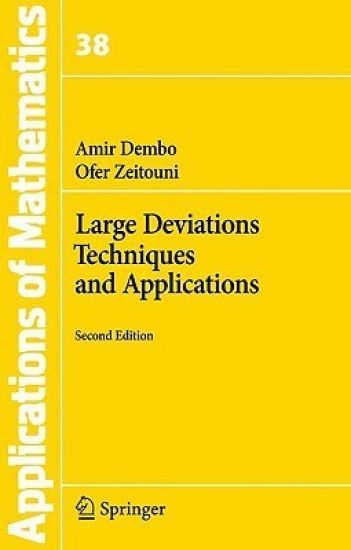
Large Deviations Techniques and Applications

Large Deviations Techniques and Applications

Amir Dembo; Ofer Zeitouni

Springer-Verlag Berlin and Heidelberg GmbH Co. K
2009
nidottu
Large deviation estimates have proved to be the crucial tool required to handle many questions in statistics, engineering, statistial mechanics, and applied probability. Amir Dembo and Ofer Zeitouni, two of the leading researchers in the field, provide an introduction to the theory of large deviations and applications at a level suitable for graduate students. The mathematics is rigorous and the applications come from a wide range of areas, including electrical engineering and DNA sequences. The second edition, printed in 1998, included new material on concentration inequalities and the metric and weak convergence approaches to large deviations. General statements and applications were sharpened, new exercises added, and the bibliography updated. The present soft cover edition is a corrected printing of the 1998 edition.
Lectures on Probability Theory and Statistics

Lectures on Probability Theory and Statistics

Simon Tavaré; Ofer Zeitouni

Springer-Verlag Berlin and Heidelberg GmbH Co. K
2004
nidottu
This volume contains lectures given at the 31st Probability Summer School in Saint-Flour (July 8-25, 2001). Simon Tavaré’s lectures serve as an introduction to the coalescent, and to inference for ancestral processes in population genetics. The stochastic computation methods described include rejection methods, importance sampling, Markov chain Monte Carlo, and approximate Bayesian methods. Ofer Zeitouni’s course on "Random Walks in Random Environment" presents systematically the tools that have been introduced to study the model. A fairly complete description of available results in dimension 1 is given. For higher dimension, the basic techniques and a discussion of some of the available results are provided. The contribution also includes an updated annotated bibliography and suggestions for further reading. Olivier Catoni's course appears separately.