Kirjojen hintavertailu. Mukana 12 303 914 kirjaa ja 12 kauppaa.

Kirjailija

Ole B. Jensen

Kirjat ja teokset yhdessä paikassa: 10 kirjaa, julkaisuja vuosilta 2003-2026, suosituimpien joukossa Det epidemiske samfund. Vertaile teosten hintoja ja tarkista saatavuus suomalaisista kirjakaupoista.

10 kirjaa

Kirjojen julkaisuhaarukka 2003-2026.

Det epidemiske samfund

Det epidemiske samfund

Anders Fogh Jensen; Bente Halkier; Anders Petersen; Michael Hviid Jacobsen; Ole B. Jensen; Bjørn Schiermer Andersen; Lene Tanggaard Pedersen; Anders Blok; Pernille Tanggaard Andersen; Christian Borch; Claus D. Hansen; Anders Albrechtslund; Anders Kristian Munk; Stine Thidemann Faber; Lars Tønder; Nikolaj Schultz; Jonas Toubøl; Ninna Nyberg Sørensen; Anna Ilsøe; Trine Pernille Larsen; Hjalmar Bang Carlsen; Stine Krøijer; Mia Lunding Christensen; Esben Brøgger Lemminger; Marie Haarmark Nielsen; Jonathan Holm Salka

Gyldendal
2020
nidottu
Bogen analyserer vores samfund ramt af epidemien og ser COVID-19 som en forandrende begivenhed og et historisk brud. Bogen sporer de dybereliggende brud og de myriader af tanker og relationer, som COVID-19 har ført med sig og reflekterer over tilstedeværelsen af epidemien i en historisk kontekst. I bogens analyser aner vi nye former for magt og betragtninger om bl.a. krop, køn, by, klima og klasse. I Det epidemiske samfund opfattes samfundet som en tilstand af refleksivitet, hvis forandringspotentialer er igangsat af tilstedeværelsen af virus. Bogens bidrag er skrevet af førende danske forskere og vækker til eftertanke. Bogen er redigeret af Ole B. Jensen, professor på Institut for Arkitektur og Medieteknologi, Aalborg Universitet, og Nikolaj Schultz, ph.d.-stipendiat i sociologi på Københavns Universitet. Begge kendte for deres engagement i at åbne nye mulige tankerum.

Kulturteori og kultursociologi

Kulturteori og kultursociologi

Anne Scott Sørensen; Henning Mathias Goldbæk; Anders Petersen; Anni Greve; Annick Prieur; Christian Borch; Henning Bech; Michael Hviid Jacobsen; Ole B. Jensen; Sara Malou Strandvad; Casper Bruun Jensen; Bjørn Schiermer Andersen; Mikkel Bolt Rasmussen; Stine Willum Adrian; Jakob Skjøtt-Larsen; Morten Kyndrup; Jørgen Bruhn; Britta Timm Knudsen; Mads Krogh; Anja Mølle Lindelof; Camilla Jalving; Carsten Stage; Sanne Krogh Groth; Martin Zerlang; Ulrik Schmidt; Marie Bruvik Heinskou

Gyldendal
2016
nidottu
Kultursociologi og kulturstudier placerer sig i mellemrummet mellem samfundsvidenskab og humaniora og beskæftiger sig med kulturelle fænomener af enhver slags: med kunst og subkultur, med æstetik og sociale omgangsformer, med følelsernes kultur, med seksualitetens kultur, med oplevelsen af byens rum og med byudvikling, og i det hele taget med grundlæggende perspektiver på sammenhængen mellem samfund, kultur, magt og politik. Kultursociologien udgør en kernedisciplin i sociologien, og med opblomstringen af humanistiske kulturstudieuddannelser på en række danske universiteter de senere årtier er også store dele af de humanistiske fag orienteret i en kulturteoretisk og sociologisk retning. Denne bog giver en autoritativ indføring i klassiske og nyere tendenser, tænkere og teorier i kultursociologi og kulturteori i tre dele: Ny teori, som for en stor del præsenteres for første gang på dansk Klassiske og nyklassiske teorier, som på forskellige måder tegner fagets tradition Temaer og begreber, der indkredser de vigtigste områder, som kultursociologien og kulturteorien beskæftiger sig med. Bogen vil kunne fungere som en vigtig støtte i arbejdet med kultursociologiske eller kulturteoretiske originaltekster både for undervisere og studerende på de højere læreanstalter. Men den henvender sig også til den ”kulturarbejdende” eller blot kulturinteresserede læser uden for universitetet, som gerne vil have udvidet eller opdateret sin teoretiske horisont.
Mobilities Design

Mobilities Design

Ole B. Jensen; Ditte Bendix Lanng

Routledge
2016
sidottu
Contemporary society is marked and defined by the ways in which mobile goods, bodies, vehicles, objects, and data are organized, moved and staged. Against the background of the ‘mobilities turn’ this book articulates a new and emerging research field, namely that of ‘mobilities design’. The book revolves around the following research question: How are design decisions and interventions staging mobilities? It builds upon the ‘Staging Mobilities’ model (Jensen 2013) in an exploratory inquiry into the problems and potentials of the design of mobilities. The exchange value between mobilities and design research is twofold. To mobilities research this means getting closer to the ‘material’, and to engage in the creative, exploratory and experimental approaches of the design world which offer new potential for innovative research. Design research, on the other hand, might enter into a fruitful relationship with mobilities research, offering a relational and mobile design thinking and a valuable basis for design reflections around the ubiquitous structures, spaces and systems of mobilities.
Mobility Injustice by Design

Mobility Injustice by Design

Ole B. Jensen

TAYLOR FRANCIS LTD
2026
nidottu
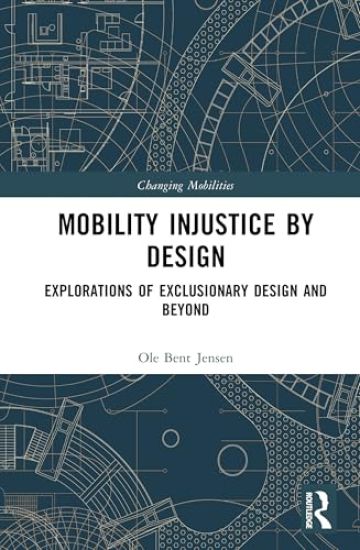
Mobility Injustice by Design examines the social exclusion of vulnerable people in urban spaces, revealing how millions of citizens have their ‘right to roam’ curbed by design and planning decisions made either intentionally to facilitate immobility or social exclusion, or because of a lack of awareness of the aggregated consequences. Ole B. Jensen’s insightful volume offers a theoretically informed framework, allowing us to ‘see’ mobility injustices more clearly, consider how new knowledge can mobilize design ethics, and to think about how mobility justice be brought about. It challenges us to reassess how choices of materials, design of spaces, and implementation of technologies affords or hinders particular mobilities. It explores a way of thinking about mobility and injustice that recognises that everyone is assisted in their mobility practices and that human capacity for acting in the world is mediated by spaces, things, artefacts, and technologies. It examines the centrality of design but also that design may be working counter to the widespread cultural belief that design is in the service of ‘the good’. It locates thinking about mobilities injustice between affect, experiences, and sensations on the one hand and reason, principles, and formal rules on the other. Focussing on three realms of practice, it reveals the ways in which the design of cities and urban spaces accommodate the needs of people living as unhoused, disabled, and aged, and how these groups experience mobility injustice. Crucially, it provides insight into the potential to move toward a future, more mobility-just society on a local, national and global scale, in light of warfare, environmental- and migration crises. Mobility Injustice by Design informs the future agenda of both critical mobilities research and the design fields and reflects on the potential for those in the arts and design to provoke public engagement in these timely issues. It is essential reading for all those concerned with the study and practice of mobilities theory, urban sociology, urban planning and design, architecture, urban geography, disability studies and gerontology.
Mobility Injustice by Design

Mobility Injustice by Design

Ole B. Jensen

TAYLOR FRANCIS LTD
2026
sidottu
Mobility Injustice by Design examines the social exclusion of vulnerable people in urban spaces, revealing how millions of citizens have their ‘right to roam’ curbed by design and planning decisions made either intentionally to facilitate immobility or social exclusion, or because of a lack of awareness of the aggregated consequences. Ole B. Jensen’s insightful volume offers a theoretically informed framework, allowing us to ‘see’ mobility injustices more clearly, consider how new knowledge can mobilize design ethics, and to think about how mobility justice be brought about. It challenges us to reassess how choices of materials, design of spaces, and implementation of technologies affords or hinders particular mobilities. It explores a way of thinking about mobility and injustice that recognises that everyone is assisted in their mobility practices and that human capacity for acting in the world is mediated by spaces, things, artefacts, and technologies. It examines the centrality of design but also that design may be working counter to the widespread cultural belief that design is in the service of ‘the good’. It locates thinking about mobilities injustice between affect, experiences, and sensations on the one hand and reason, principles, and formal rules on the other. Focussing on three realms of practice, it reveals the ways in which the design of cities and urban spaces accommodate the needs of people living as unhoused, disabled, and aged, and how these groups experience mobility injustice. Crucially, it provides insight into the potential to move toward a future, more mobility-just society on a local, national and global scale, in light of warfare, environmental- and migration crises. Mobility Injustice by Design informs the future agenda of both critical mobilities research and the design fields and reflects on the potential for those in the arts and design to provoke public engagement in these timely issues. It is essential reading for all those concerned with the study and practice of mobilities theory, urban sociology, urban planning and design, architecture, urban geography, disability studies and gerontology.
Staging Mobilities

Staging Mobilities

Ole B. Jensen

TAYLOR FRANCIS LTD
2024
nidottu
In recent years, the social sciences have taken a ‘mobilities turn’. There has been a developing realisation that mobilities do not ‘just happen’. Mobilities are carefully and meticulously designed, planned and staged (from above). However, they are equally importantly acted out, performed and lived as people are ‘staging themselves’ (from below). Staging mobilities is a dynamic process between ‘being staged’ (for example, being stopped at traffic lights) and the ‘mobile staging’ of interacting individuals (negotiating a passage on the pavement).Staging Mobilities is about the fact that mobility is more than movement between point A and B. It explores how the movement of people, goods, information, and signs influences human understandings of self, other and the built environment. Moving towards a new understanding of the relationship between movement, interaction and environments, the book asks: what are the physical, social, technical, and cultural conditions to the staging of contemporary urban mobilities? Jensen argues that we need to understand the contemporary city as an assemblage of circulating people, goods, information and signs in relational networks creating the ‘meaning of movement’. The book will be of interest to students and scholars of sociology, urban studies, mobility studies, architecture and cultural studies.
Mobilities Design

Mobilities Design

Ole B. Jensen; Ditte Bendix Lanng

Routledge
2019
nidottu
Contemporary society is marked and defined by the ways in which mobile goods, bodies, vehicles, objects, and data are organized, moved and staged. Against the background of the ‘mobilities turn’ this book articulates a new and emerging research field, namely that of ‘mobilities design’. The book revolves around the following research question: How are design decisions and interventions staging mobilities? It builds upon the ‘Staging Mobilities’ model (Jensen 2013) in an exploratory inquiry into the problems and potentials of the design of mobilities. The exchange value between mobilities and design research is twofold. To mobilities research this means getting closer to the ‘material’, and to engage in the creative, exploratory and experimental approaches of the design world which offer new potential for innovative research. Design research, on the other hand, might enter into a fruitful relationship with mobilities research, offering a relational and mobile design thinking and a valuable basis for design reflections around the ubiquitous structures, spaces and systems of mobilities.
Staging Mobilities

Staging Mobilities

Ole B. Jensen

Routledge
2013
sidottu
In recent years, the social sciences have taken a ‘mobilities turn’. There has been a developing realisation that mobilities do not ‘just happen’. Mobilities are carefully and meticulously designed, planned and staged (from above). However, they are equally importantly acted out, performed and lived as people are ‘staging themselves’ (from below). Staging mobilities is a dynamic process between ‘being staged’ (for example, being stopped at traffic lights) and the ‘mobile staging’ of interacting individuals (negotiating a passage on the pavement).Staging Mobilities is about the fact that mobility is more than movement between point A and B. It explores how the movement of people, goods, information, and signs influences human understandings of self, other and the built environment. Moving towards a new understanding of the relationship between movement, interaction and environments, the book asks: what are the physical, social, technical, and cultural conditions to the staging of contemporary urban mobilities? Jensen argues that we need to understand the contemporary city as an assemblage of circulating people, goods, information and signs in relational networks creating the ‘meaning of movement’. The book will be of interest to students and scholars of sociology, urban studies, mobility studies, architecture and cultural studies.
Making European Space

Making European Space

Ole B. Jensen; Tim Richardson

Routledge
2003
sidottu
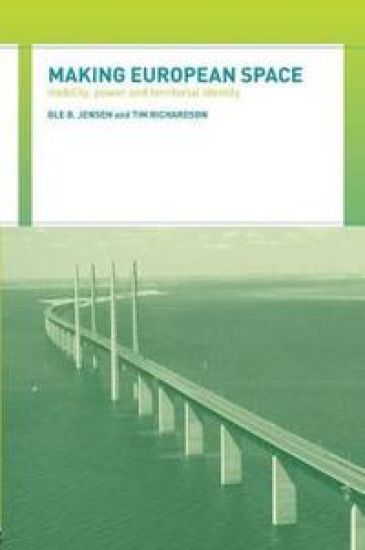
Making European Space explores how future visions of Europe's physical space are being decisively shaped by transnational politics and power struggles, which are being played out in new multi-level arenas of governance across the European Union. At stake are big ideas about mobility and friction, about relations between core and peripheral regions, and about the future Europe's cities and countryside. The book builds a critical narrative of the emergence of a new discourse of Europe as 'monotopia', revealing a very real project to shape European space in line with visions of high speed, frictionless mobility, the transgression of borders, and the creation of city networks. The narrative explores in depth how the particular ideas of mobility and space which underpin this discourse are being constructed in policy making, and reflects on the legitimacy of these policy processes. In particular, it shows how spatial ideas are becoming embedded in the everyday practices of the social and political organisation of space, in ways that make a frictionless Europe seem natural, and part of a common European territorial identity.
Making European Space

Making European Space

Ole B. Jensen; Tim Richardson

Routledge
2003
nidottu
Making European Space explores how future visions of Europe's physical space are being decisively shaped by transnational politics and power struggles, which are being played out in new multi-level arenas of governance across the European Union. At stake are big ideas about mobility and friction, about relations between core and peripheral regions, and about the future Europe's cities and countryside. The book builds a critical narrative of the emergence of a new discourse of Europe as 'monotopia', revealing a very real project to shape European space in line with visions of high speed, frictionless mobility, the transgression of borders, and the creation of city networks. The narrative explores in depth how the particular ideas of mobility and space which underpin this discourse are being constructed in policy making, and reflects on the legitimacy of these policy processes. In particular, it shows how spatial ideas are becoming embedded in the everyday practices of the social and political organisation of space, in ways that make a frictionless Europe seem natural, and part of a common European territorial identity.