Kirjojen hintavertailu. Mukana 12 213 780 kirjaa ja 12 kauppaa.

Kirjailija

Oleg I. Larichev

Kirjat ja teokset yhdessä paikassa: 4 kirjaa, julkaisuja vuosilta 1997-2010, suosituimpien joukossa Verbal Decision Analysis for Unstructured Problems. Vertaile teosten hintoja ja tarkista saatavuus suomalaisista kirjakaupoista.

4 kirjaa

Kirjojen julkaisuhaarukka 1997-2010.

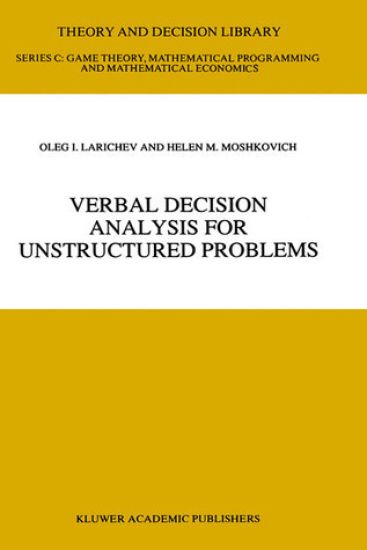
Verbal Decision Analysis for Unstructured Problems

Verbal Decision Analysis for Unstructured Problems

Oleg I. Larichev; Helen M. Moshkovich

Springer-Verlag New York Inc.
2010
nidottu
A central problem of prescriptive decision making is the mismatch between the elegant formal models of decision theory and the less elegant, informal thinking of decision makers, especially when dealing with ill-structured situations. This problem has been a central concern of the authors and their colleagues over the past two decades. They have wisely (to my mind) realized that any viable solution must be informed by a deep understanding of both the structural properties of alternative formalisms and the cognitive demands that they impose on decision makers. Considering the two in parallel reduces the risk of forcing decision makers to say things and endorse models that they do not really understand. It opens the door for creative solutions, incorporating insights from both decision theory and cognitive psychology. It is this opportunity that the authors have so ably exploited in this important book. Under the pressures of an interview situation, people will often answer a question that is put to them. Thus, they may be willing to provide a decision consultant with probability and utility assessments for all manner of things. However, if they do not fully understand the implications of what they are saying and the use to which it will be put, then they cannot maintain cognitive mastery of the decision models intended to represent their beliefs and interests.

Multiple Criteria Analysis in Strategic Siting Problems

Multiple Criteria Analysis in Strategic Siting Problems

Oleg I. Larichev; David L. Olson

Springer-Verlag New York Inc.
2010
nidottu
1 Facility Location Problems The location problem has been with humans for all of their history. In the past, many rulers had the decision of locating their capital. Reasons for selecting various locations included central location,transportation benefits to foster trade, and defensibility. The development of industry involved location problems for production facilities and trade outlets. Obvious th criteria for location ofbusiness facilities includedprofit impact. In the 19 century, there seemed to be a focus on the cost of transporting raw materials versus the cost of transporting goods to consumers. Location decisions were made considering all potential gains and expenses. Some judgment was required, because while most benefits and costs could be measured accurately, not all could be. Successful business practice depended on the soundjudgment of the decision-maker in solvinglocation problems. Each of these enterprises produced some wastes. Finding a location to dispose of these wastes was not a difficult task. In less-enlightened times, governments resorted to fiat and land-condemnationto take the sites needed th for disposal. In the 19 century, industry grew rapidly in Great Britain and elsewhere as mass production served expanding populations of consumers. The by-products of mass-production were often simply discarded in the most expeditious manner. There are still mountains in the United States Introduction 2 with artificial facades created from the excess material discarded from mining activity. We have developed the ability to create waste of lethal toxicity.
Multiple Criteria Analysis in Strategic Siting Problems

Multiple Criteria Analysis in Strategic Siting Problems

Oleg I. Larichev; David L. Olson

Springer
2001
sidottu
1 Facility Location Problems The location problem has been with humans for all of their history. In the past, many rulers had the decision of locating their capital. Reasons for selecting various locations included central location,transportation benefits to foster trade, and defensibility. The development of industry involved location problems for production facilities and trade outlets. Obvious th criteria for location ofbusiness facilities includedprofit impact. In the 19 century, there seemed to be a focus on the cost of transporting raw materials versus the cost of transporting goods to consumers. Location decisions were made considering all potential gains and expenses. Some judgment was required, because while most benefits and costs could be measured accurately, not all could be. Successful business practice depended on the soundjudgment of the decision-maker in solvinglocation problems. Each of these enterprises produced some wastes. Finding a location to dispose of these wastes was not a difficult task. In less-enlightened times, governments resorted to fiat and land-condemnationto take the sites needed th for disposal. In the 19 century, industry grew rapidly in Great Britain and elsewhere as mass production served expanding populations of consumers. The by-products of mass-production were often simply discarded in the most expeditious manner. There are still mountains in the United States Introduction 2 with artificial facades created from the excess material discarded from mining activity. We have developed the ability to create waste of lethal toxicity.
Verbal Decision Analysis for Unstructured Problems

Verbal Decision Analysis for Unstructured Problems

Oleg I. Larichev; Helen M. Moshkovich

Springer
1997
sidottu
A central problem of prescriptive decision making is the mismatch between the elegant formal models of decision theory and the less elegant, informal thinking of decision makers, especially when dealing with ill-structured situations. This problem has been a central concern of the authors and their colleagues over the past two decades. They have wisely (to my mind) realized that any viable solution must be informed by a deep understanding of both the structural properties of alternative formalisms and the cognitive demands that they impose on decision makers. Considering the two in parallel reduces the risk of forcing decision makers to say things and endorse models that they do not really understand. It opens the door for creative solutions, incorporating insights from both decision theory and cognitive psychology. It is this opportunity that the authors have so ably exploited in this important book. Under the pressures of an interview situation, people will often answer a question that is put to them. Thus, they may be willing to provide a decision consultant with probability and utility assessments for all manner of things. However, if they do not fully understand the implications of what they are saying and the use to which it will be put, then they cannot maintain cognitive mastery of the decision models intended to represent their beliefs and interests.