Kirjojen hintavertailu. Mukana 12 595 353 kirjaa ja 12 kauppaa.

Kirjailija

Oleg Reichmann

Kirjat ja teokset yhdessä paikassa: 3 kirjaa, julkaisuja vuosilta 2010-2015, suosituimpien joukossa Lévy Matters I. Vertaile teosten hintoja ja tarkista saatavuus suomalaisista kirjakaupoista.

3 kirjaa

Kirjojen julkaisuhaarukka 2010-2015.

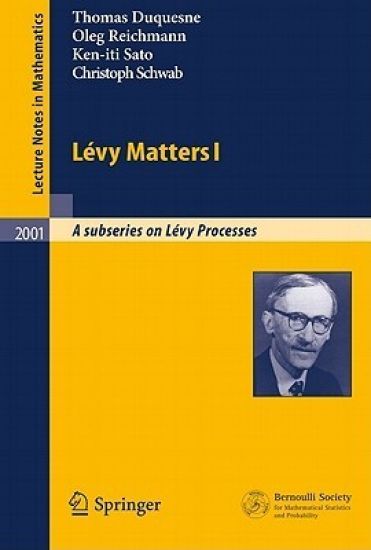
Lévy Matters I

Lévy Matters I

Thomas Duquesne; Oleg Reichmann; Ken-iti Sato; Christoph Schwab

Springer-Verlag Berlin and Heidelberg GmbH Co. K
2010
nidottu
Over the past 10-15 years, we have seen a revival of general Levy ' processes theory as well as a burst of new applications. In the past, Brownian motion or the Poisson process have been considered as appropriate models for most applications. Nowadays, the need for more realistic modelling of irregular behaviour of phen- ena in nature and society like jumps, bursts, and extremeshas led to a renaissance of the theory of general Levy ' processes. Theoretical and applied researchers in elds asdiverseas quantumtheory,statistical physics,meteorology,seismology,statistics, insurance, nance, and telecommunication have realised the enormous exibility of Lev ' y models in modelling jumps, tails, dependence and sample path behaviour. L' evy processes or Levy ' driven processes feature slow or rapid structural breaks, extremal behaviour, clustering, and clumping of points. Toolsandtechniquesfromrelatedbut disctinct mathematical elds, such as point processes, stochastic integration,probability theory in abstract spaces, and differ- tial geometry, have contributed to a better understanding of Le 'vy jump processes. As in many other elds, the enormous power of modern computers has also changed the view of Levy ' processes. Simulation methods for paths of Levy ' p- cesses and realisations of their functionals have been developed. Monte Carlo simulation makes it possible to determine the distribution of functionals of sample paths of Levy ' processes to a high level of accuracy.
Computational Methods for Quantitative Finance

Computational Methods for Quantitative Finance

Norbert Hilber; Oleg Reichmann; Christoph Schwab; Christoph Winter

Springer-Verlag Berlin and Heidelberg GmbH Co. K
2015
nidottu
Many mathematical assumptions on which classical derivative pricing methods are based have come under scrutiny in recent years. The present volume offers an introduction to deterministic algorithms for the fast and accurate pricing of derivative contracts in modern finance. This unified, non-Monte-Carlo computational pricing methodology is capable of handling rather general classes of stochastic market models with jumps, including, in particular, all currently used Lévy and stochastic volatility models. It allows us e.g. to quantify model risk in computed prices on plain vanilla, as well as on various types of exotic contracts. The algorithms are developed in classical Black-Scholes markets, and then extended to market models based on multiscale stochastic volatility, to Lévy, additive and certain classes of Feller processes. This book is intended for graduate students and researchers, as well as for practitioners in the fields of quantitative finance and applied and computational mathematics with a solid background in mathematics, statistics or economics.?
Computational Methods for Quantitative Finance

Computational Methods for Quantitative Finance

Norbert Hilber; Oleg Reichmann; Christoph Schwab; Christoph Winter

Springer-Verlag Berlin and Heidelberg GmbH Co. K
2013
sidottu
Many mathematical assumptions on which classical derivative pricing methods are based have come under scrutiny in recent years. The present volume offers an introduction to deterministic algorithms for the fast and accurate pricing of derivative contracts in modern finance. This unified, non-Monte-Carlo computational pricing methodology is capable of handling rather general classes of stochastic market models with jumps, including, in particular, all currently used Lévy and stochastic volatility models. It allows us e.g. to quantify model risk in computed prices on plain vanilla, as well as on various types of exotic contracts. The algorithms are developed in classical Black-Scholes markets, and then extended to market models based on multiscale stochastic volatility, to Lévy, additive and certain classes of Feller processes. This book is intended for graduate students and researchers, as well as for practitioners in the fields of quantitative finance and applied and computational mathematics with a solid background in mathematics, statistics or economics.?