Kirjojen hintavertailu. Mukana 12 152 606 kirjaa ja 12 kauppaa.

Kirjailija

Oleg V. Gendelman

Kirjat ja teokset yhdessä paikassa: 4 kirjaa, julkaisuja vuosilta 2008-2016, suosituimpien joukossa Nonlinear Targeted Energy Transfer in Mechanical and Structural Systems. Vertaile teosten hintoja ja tarkista saatavuus suomalaisista kirjakaupoista.

4 kirjaa

Kirjojen julkaisuhaarukka 2008-2016.

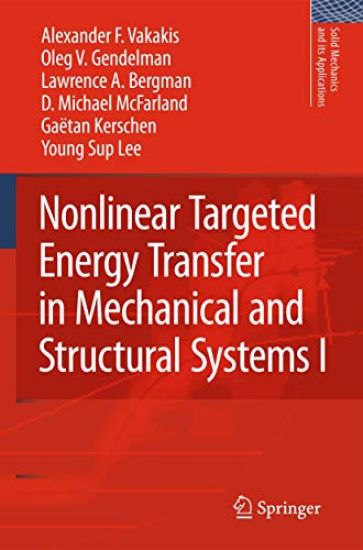
Nonlinear Targeted Energy Transfer in Mechanical and Structural Systems

Nonlinear Targeted Energy Transfer in Mechanical and Structural Systems

Alexander F. Vakakis; Oleg V. Gendelman; Lawrence A. Bergman; D. Michael McFarland; Gaëtan Kerschen; Young Sup Lee

Springer
2016
nidottu
This monograph evolved over a period of nine years from a series of papers and presentations addressing the subject of passive vibration control of mechanical s- tems subjected to broadband, transient inputs. The unifying theme is Targeted - ergy Transfer – TET, which represents a new and unique approach to the passive control problem, in which a strongly nonlinear, fully passive, local attachment, the Nonlinear Energy Sink – NES, is employed to drastically alter the dynamics of the primary system to which it is attached. The intrinsic capacity of the properly - signed NES to promote rapid localization of externally applied (narrowband) - bration or (broadband) shock energy to itself, where it can be captured and dis- pated, provides a powerful strategy for vibration control and the opens the pos- bility for a wide range of applications of TET, such as, vibration and shock i- lation, passive energy harvesting, aeroelastic instability (?utter) suppression, se- mic mitigation, vortex shedding control, enhanced reliability designs (for ex- ple in power grids) and others. The monograph is intended to provide a thorough explanation of the analytical, computational and experimental methods needed to formulate and study TET in mechanical and structural systems. Several prac- cal engineering applications are examined in detail, and experimental veri?cation and validation of the theoretical predictions are provided as well. The authors also suggest a number of possible future applications where application of TET seems promising. The authors are indebted to a number of sponsoring agencies.
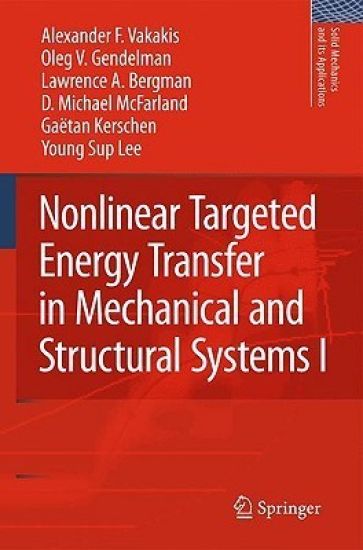
Nonlinear Targeted Energy Transfer in Mechanical and Structural Systems

Nonlinear Targeted Energy Transfer in Mechanical and Structural Systems

Alexander F. Vakakis; Oleg V. Gendelman; Lawrence A. Bergman; D. Michael McFarland; Gaëtan Kerschen; Young Sup Lee

Springer-Verlag New York Inc.
2008
sidottu
This monograph evolved over a period of nine years from a series of papers and presentations addressing the subject of passive vibration control of mechanical s- tems subjected to broadband, transient inputs. The unifying theme is Targeted - ergy Transfer – TET, which represents a new and unique approach to the passive control problem, in which a strongly nonlinear, fully passive, local attachment, the Nonlinear Energy Sink – NES, is employed to drastically alter the dynamics of the primary system to which it is attached. The intrinsic capacity of the properly - signed NES to promote rapid localization of externally applied (narrowband) - bration or (broadband) shock energy to itself, where it can be captured and dis- pated, provides a powerful strategy for vibration control and the opens the pos- bility for a wide range of applications of TET, such as, vibration and shock i- lation, passive energy harvesting, aeroelastic instability (?utter) suppression, se- mic mitigation, vortex shedding control, enhanced reliability designs (for ex- ple in power grids) and others. The monograph is intended to provide a thorough explanation of the analytical, computational and experimental methods needed to formulate and study TET in mechanical and structural systems. Several prac- cal engineering applications are examined in detail, and experimental veri?cation and validation of the theoretical predictions are provided as well. The authors also suggest a number of possible future applications where application of TET seems promising. The authors are indebted to a number of sponsoring agencies.
Tractable Models of Solid Mechanics

Tractable Models of Solid Mechanics

Oleg V. Gendelman; Leonid I. Manevitch

Springer-Verlag Berlin and Heidelberg GmbH Co. K
2013
nidottu
This book describes significant tractable models used in solid mechanics - classical models used in modern mechanics as well as new ones. The models are selected to illustrate the main ideas which allow scientists to describe complicated effects in a simple manner and to clarify basic notations of solid mechanics. A model is considered to be tractable if it is based on clear physical assumptions which allow the selection of significant effects and relatively simple mathematical formulations. The first part of the book briefly reviews classical tractable models for a simple description of complex effects developed from the 18th to the 20th century and widely used in modern mechanics. The second part describes systematically the new tractable models used today for the treatment of increasingly complex mechanical objects – from systems with two degrees of freedom to three-dimensional continuous objects.
Tractable Models of Solid Mechanics

Tractable Models of Solid Mechanics

Oleg V. Gendelman; Leonid I. Manevitch

Springer-Verlag Berlin and Heidelberg GmbH Co. K
2011
sidottu
This book describes significant tractable models used in solid mechanics - classical models used in modern mechanics as well as new ones. The models are selected to illustrate the main ideas which allow scientists to describe complicated effects in a simple manner and to clarify basic notations of solid mechanics. A model is considered to be tractable if it is based on clear physical assumptions which allow the selection of significant effects and relatively simple mathematical formulations. The first part of the book briefly reviews classical tractable models for a simple description of complex effects developed from the 18th to the 20th century and widely used in modern mechanics. The second part describes systematically the new tractable models used today for the treatment of increasingly complex mechanical objects – from systems with two degrees of freedom to three-dimensional continuous objects.