Kirjojen hintavertailu. Mukana 12 126 892 kirjaa ja 12 kauppaa.

Kirjailija

Olga Oliker

Kirjat ja teokset yhdessä paikassa: 21 kirjaa, julkaisuja vuosilta 2001-2019, suosituimpien joukossa Aid During Conflict. Vertaile teosten hintoja ja tarkista saatavuus suomalaisista kirjakaupoista.

21 kirjaa

Kirjojen julkaisuhaarukka 2001-2019.

In the Middle of the Fight

In the Middle of the Fight

David E. Johnson; Adam Grissom; Olga Oliker

RAND
2008
pokkari
The authors find that medium-armored forces fare poorly against competent, heavily armored opponents, and that the Stryker and Future Combat Systems will not fill the void created by the retirement of the M551 Sheridan. An analysis of the performance of medium-armored forces across the range of military operations since World War I yields insights with significant implications for U.S. Army decisions about fielding these units in the Future Force.
U.S. Interests in Central Asia

U.S. Interests in Central Asia

Olga Oliker; David A. Shlapak

RAND
2005
pokkari
One-liner: Examines long-term U.S. military interests in Central Asia 450-character abstract: The republics of Central Asia became more important to United States when U.S. forces were deployed there in support of Operation Enduring Freedom. The authors examine U.S. interests in the region, identify three main components of a successful military strategy there; and conclude that the U.S. military should have a relatively minor, but important, role in U.S. policy toward this part of the world.
Aid During Conflict

Aid During Conflict

Olga Oliker; Richard Kauzlarich; James Dobbins; Kurt W. Basseuner; Donald L. Sampler; John G. McGinn; Michael J. Dziedzic; Adam Grissom; Bruce R. Pirnie; Nora Bensahel; A.Istar Guven

RAND
2004
pokkari
An assessment of humanitarian-assistance efforts by and interaction between civilian and military providers in the early phases of Operation Enduring Freedom in Afghanistan Description and evaluation of relief, reconstruction, humanitarian, and humanitarian-type aid efforts in Afghanistan during the most intense phase of military operations, from September 2001 to June 2002. The efforts were generally successful, but there were serious coordination problems among the various civilian and military aid providers. Critical issues, both positive and negative, are identified, and a list of recommendations is provided for policymakers, implementers, and aid providers, based on lessons learned.
Trends in Russia's Armed Forces

Trends in Russia's Armed Forces

Keith Crane; Olga Oliker; Brian Nichiporuk

RAND
2019
nidottu
The authors assess how Russian military forces are postured and resourced and how they are likely to operate. They also discuss the goals and effects of Russian military reform efforts, including initiatives that span all of the Russian armed forces' services and independent branches. Touching on most of Russia's armed forces' major capabilities, the authors conclude with a look at how those capabilities are being integrated in practice.
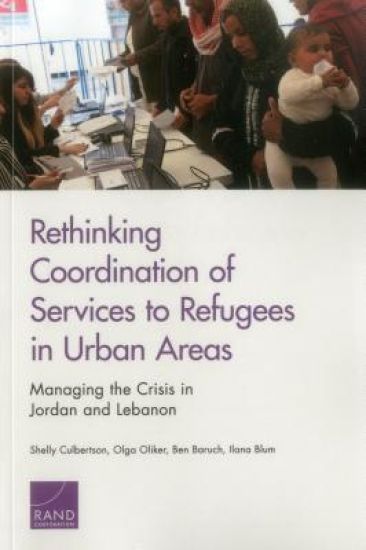
Rethinking Coordination of Services to Refugees in Urban Areas

Rethinking Coordination of Services to Refugees in Urban Areas

Shelly Culbertson; Olga Oliker; Ben Baruch; Ilana Blum

RAND
2016
pokkari
This study analyzes coordination of international and national entities managing the Syrian refugee response in urban areas in Jordan and Lebanon and provides recommendations on improving coordination strategies and practices. It presents a new framework for planning, evaluating, and managing refugee crises in urban settings, both in the Syrian refugee crisis as well as other such situations going forward.
Security Force Assistance in Afghanistan: Identifying Lessons for Future Efforts
Security force assistance (SFA) is a central pillar of the counterinsurgency campaign being waged by U.S. and coalition forces in Afghanistan. This monograph analyzes SFA efforts in Afghanistan over time, documents U.S. and international approaches to building the Afghan force from 2001 to 2009, and provides observations and recommendations that emerged from extensive fieldwork in Afghanistan in 2009 and their implications for the U.S. Army. This title analyzes security force assistance efforts in Afghanistan, focusing on lessons and themes that emerged from extensive fieldwork in Afghanistan in 2009 and their implications for the U.S. Army.
Nuclear Deterrence in Europe

Nuclear Deterrence in Europe

James T. Quinlivan; Olga Oliker

RAND
2011
pokkari
Through a variety of policies and actions and most recently in a new military doctrine adopted in February 2010 Russia has indicated the types of situations and threats that might cause it to resort to using nuclear weapons. This volume examines Russia's evolving framework for nuclear deterrence and its implications for U.S. military operations in Europe.
Russian Foreign Policy

Russian Foreign Policy

Olga Oliker; Keith Crane

RAND
2009
pokkari
As Russia's economy has grown, so have the country's global involvement and influence, which often take forms that the United States neither expects nor likes. The authors assess Russia's strategic interests and goals, examining the country's domestic policies, economic development, security goals, and worldview. They assess implications for U.S. interests and present ways that Washington could work to improve its relations with Moscow.
Guidebook for Supporting Economic Development in Stability Operations

Guidebook for Supporting Economic Development in Stability Operations

Keith Crane; Olga Oliker; Nora Bensahel; Derek Eaton; Jamie S Gayton

RAND
2009
pokkari
This guidebook is designed to help U.S. Army personnel more effectively use economic assistance to support economic and infrastructure development. It should help tactical commanders choose and implement more effective programs and projects in their areas of responsibility and better understand the economic context of their efforts. It also provides suggestions on what to and what not to do, with examples from current and past operations.
After Saddam

After Saddam

Nora Bensahel; Olga Oliker; Keith Crane; Richard R. Brennan; Heather Selma Gregg; Thomas Sullivan; Andrew Rathmell

RAND
2008
pokkari
This monograph examines prewar planning efforts for the reconstruction of postwar Iraq. It then examines the role of U.S. military forces after major combat officially ended on May 1, 2003, through June 2004. Finally, it examines civilian efforts at reconstruction, focusing on the activities of the Coalition Provisional Authority and its efforts to rebuild structures of governance, security forces, economic policy, and essential services.
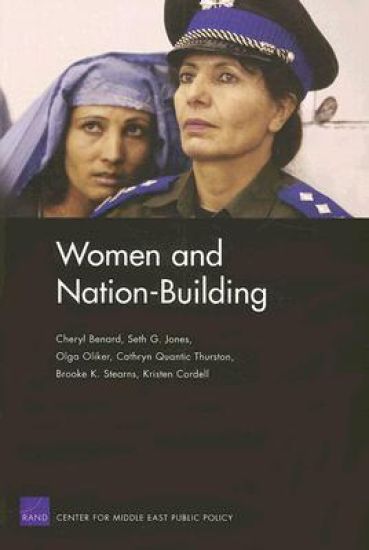
Women and Nation-building

Women and Nation-building

Cheryl Benard; Seth G. Jones; Olga Oliker; Cathryn Quantic Thurston; Brooke K. Stearns; Kristen Cordell

RAND
2008
pokkari
The challenges of nation-building and of dealing with the societal and political aftermaths of conflicts have consumed tremendous international energy during the past decades. "Women and Nation-Building" tackles the exceedingly complex task of assessing the multilayered development of women's diverse roles in the post-conflict context. The author examines the role of women in the recent reconstruction activities in Afghanistan, while evaluating the effect of societal circumstances and nation-building processes on the status of female populations in post-conflict regions. Does women's part make a difference to the post-conflict trajectories of very volatile societies? "Women and Nation-Building" presents compelling findings for policymakers, practitioners, and scholars concerned with both the academic and pragmatic implementation of a more engendered approach to nation-building.The book concludes that the steps necessary to strengthen nation-building activities include an emphasis on human security, establishing governance based on the principles of equity and the rule of law, and women's early economic inclusion in reconstruction activities.Societies on a path toward equity and the rule of law are more peaceful and more prosperous, and the status of women is not merely a litmus test but an active agent in bringing about such an outcome.
U.S. Policy Options for Iraq

U.S. Policy Options for Iraq

Olga Oliker; Keith Crane; Audra K Grant; Terrence K Kelly; Andrew Rathmell

RAND
2007
pokkari
This book examines five possible U.S. strategies for Iraq. It offers recommendations for ways in which U.S. political, security, and economic policies in Iraq could be improved. It argues that the focus of policy must be the security of Iraq's population. It also emphasizes the need for policymakers to prepare and plan not only for success, but also for failure.
Making Liberia Safe

Making Liberia Safe

Daivd C Gompert; Olga Oliker; Brooke Stearns; Keith Crane; Jack K Riley

RAND
2007
pokkari
Liberia's new government has made security sector transformation a high priority. The authors analyze Liberia's complex security environment, set forth an integrated security concept to guide the formation and use of those forces and assemble a complete security structure. They develop specific force-structure options, discuss the cost-effectiveness of each, and suggest immediate steps toward implementation of the new security structure.
Securing Tyrants or Fostering Reform?

Securing Tyrants or Fostering Reform?

Seth G Jones; Olga Oliker; Peter Chalk; Christine Fair; Rollie Lal

RAND
2006
pokkari
This study examines the results of U.S. assistance to the internal security forces of four repressive states: El Salvador, Uzbekistan, Afghanistan, and Pakistan. Efforts to improve the security, human rights, and accountability of security forces appear more likely to succeed in states transitioning from repressive to democratic systems. In addition, several factors are critical for success: the duration of assistance, viability of the justice system, and support and buy-in from the local government (including key ministries).
Developing Iraq's Security Sector

Developing Iraq's Security Sector

Andrew Rathmell; Olga Oliker; Terrence K. Kelly; David Brannan; Keith Crane

RAND
2005
pokkari
Looks at the Coalition Provisional Authority's efforts to rebuild Iraq's security sector and provides lessons learned. From May 2003 to June 28, 2004 (when it handed over authority to the Iraqi Interim Government), the Coalition Provisional Authority (CPA) worked to field Iraqi security forces and to develop security sector institutions. This book - all of whose authors were advisors to the CPA-breaks out the various elements of Iraq's security sector, including the defense, interior, and justice sectors, and assesses the CPA's successes and failures.
Faultlines of Conflict in Central Asia and the South Caucasus
Central Asia and the South Caucasus is a region that has witnessed violent clashes both within and between states in recent decades. Moreover, conflict is likely to be a continuing problem over the next 10-15 years. Depending on how the region develops, the form and degree of conflict may or may not grow to involve other states, including the United States. The authors identify and evaluate key faultlines in Central Asia and the South Caucasus and how they affect the like-lihood and possible evolution of armed conflict in these regions. These faultlines include the role of state political and economic weakness; the impact of crime and the drug trade; the effects of ethnic tensions, foreign interests, and influence; and the impact of competition over natural resources. The analysis then examines the ways in which the emergence of conflict could draw the United States into the strife and examines the operational challenges the region poses for possible Army deployments in the 2010-2015 time frame. Although this research was largely completed prior to the 9/11 attacks on the United States, the report has been updated in light of the changed security environment and U.S. military presence on the ground in the Caspian region.The operations in Afghanistan have not altered the faultlines; they are long-term and structural in nature. In fact, U.S. presence on the ground highlights the importance of understanding these faultlines and responding to them effectively.
Assessing Russia's Decline

Assessing Russia's Decline

Olga Oliker; Tanya Charlick-Paley

RAND
2002
pokkari
Trends in the Russian Federation are of concern because they indicate the potential for instability and unrest in a country that remains a vital interest for the United States. Continuing trends toward military, political, economic, and social decline in Russia threaten the interests of the United States and its allies. Moscow's capacity to govern is called into question by increasing crime and corruption (and by political and economic regionalization). Both the military nuclear arsenal and the civilian nuclear power sector present risks of materials theft or diversion, as well as of tragic accident. An increasingly aging and ailing population bodes ill for Russia's future. Reversing the country's economic decline and rebuilding an effective military have proven difficult for the financially strapped government. While improvements, especially in the economic realm, are now evident, their sustainability is far from certain. The future development of these trends is critical to U.S. interests. Nuclear material from Russia could fall into the hands of terrorists-organized crime in Russia is part of a multinational network with links to global and local terror.Russia is a major oil and gas producer and transit state, and the U.S. government has identified energy interests as key to national security. A humanitarian crisis in Russia could threaten U.S. allies with refugee flows, environmental crisis, or conflict spillover. In many scenarios, it seems likely that the United States would respond. If so, the U.S. Air Force is certain to be called upon for transportation and perhaps military missions in a very demanding environment. (author) What challenges does today's Russia pose for the United States and the U.S. Air Force? If certain economic, military, social, and political negative trends in Russia continue, they may create a new set of dangers that might prove more real, and therefore more frightening, than the far-off specter of Russian attack ever was. In a number of scenarios, the U.S. Air Force is certain to be called upon for transportation and perhaps for various military missions in a very demanding environment.