Kirjojen hintavertailu. Mukana 12 390 323 kirjaa ja 12 kauppaa.

Kirjailija

Oliver De la Paz

Kirjat ja teokset yhdessä paikassa: 8 kirjaa, julkaisuja vuosilta 2001-2024, suosituimpien joukossa Requiem for the Orchard. Vertaile teosten hintoja ja tarkista saatavuus suomalaisista kirjakaupoista.

8 kirjaa

Kirjojen julkaisuhaarukka 2001-2024.

The Diaspora Sonnets

The Diaspora Sonnets

Oliver de la Paz

WW NORTON CO
2024
nidottu
In 1972, after Ferdinand Marcos declared martial law, Oliver de la Paz’s father, in a last fit of desperation to leave the Philippines, threw his papers at an immigration clerk, hoping to get them stamped. He was prepared to leave, having already quit his job and having exchanged pesos for dollars; but he couldn’t anticipate the challenges of the migratory lifestyle he and his family would soon adopt in America. Their search for a sense of “home” and boundless feelings of deracination are evocatively explored by award-winning poet de la Paz in this formally inventive collection of sonnets. Broken into three parts—“The Implacable West”, “Landscape with Work, Rest, and Silence” and “Dwelling Music”—The Diaspora Sonnets eloquently invokes the perseverance and bold possibilities of de la Paz’s displaced family as they strove for stability and belonging. In order to establish her medical practice, de la Paz’s mother had to relocate often for residencies. As they moved from state to state his father worked to support the family. Sonnets thus flit from coast to coast, across prairies and deserts, along the way musing on shadowy dreams of a faraway country. Written with the deft touch of a virtuoso and the compassion of a loving son, The Diaspora Sonnets powerfully captures the peculiar pangs of a diaspora “that has left and is forever leaving.”
The Diaspora Sonnets

The Diaspora Sonnets

Oliver de la Paz

WW NORTON CO
2023
sidottu
In 1972, after Ferdinand Marcos declared martial law, Oliver de la Paz’s father, in a last fit of desperation to leave the Philippines, threw his papers at an immigration clerk, hoping to get them stamped. He was prepared to leave, having already quit his job and having exchanged pesos for dollars; but he couldn’t anticipate the challenges of the migratory lifestyle he and his family would soon adopt in America. Their search for a sense of “home” and boundless feelings of deracination are evocatively explored by award-winning poet de la Paz in this formally inventive collection of sonnets. Broken into three parts—“The Implacable West,” “Landscape with Work, Rest, and Silence,” and “Dwelling Music”—The Diaspora Sonnets eloquently invokes the perseverance and bold possibilities of de la Paz’s displaced family as they strove for stability and belonging. In order to establish her medical practice, de la Paz’s mother had to relocate often for residencies. As they moved from state to state his father worked to support the family. Sonnets thus flit from coast to coast, across prairies and deserts, along the way musing on shadowy dreams of a faraway country. The sonnet proves formally malleable as de la Paz breaks and rejoins its tradition throughout this collection, embarking on a broader conversation about what fits and how one adapts—from the restrained use of rhyme in “Diaspora Sonnet in the Summer with the River Water Low” and carefully metered “Diaspora Sonnet Imagining My Father’s Uncertainty and Nothing Else” to the hybridized “Diaspora Sonnet at the Feeders Before the Freeze.” A series of “Chain Migration” poems viscerally punctuate the sonnets, giving witness to the labor and sacrifice of the immigrant experience, as do a series of hauntingly beautiful pantoums. Written with the deft touch of a virtuoso and the compassion of a loving son, The Diaspora Sonnets powerfully captures the peculiar pangs of a diaspora “that has left and is forever leaving.”

The Boy in the Labyrinth: Poems

The Boy in the Labyrinth: Poems

Oliver de la Paz

University of Akron Press
2019
nidottu
In a long sequence of prose poems, questionnaires, and standardized tests, The Boy in the Labyrinth interrogates the language of autism and the language barriers between parents, their children, and the fractured medium of science and school. Structured as a Greek play, the book opens with a parents' earnest quest for answers, understanding, and doubt. Each section of the Three Act is highlighted by "Autism Spectrum Questionnaires" which are in dialogue with and in opposition to what the parent perceives to be their relationship with their child. Interspersed throughout each section are sequences of standardized test questions akin to those one would find in grade school, except these questions unravel into deeper mysteries. The depth of the book is told in a series of episodic prose poems that parallel the parable of Theseus and the Minotaur. In these short clips of montage the unnamed "boy" explores his world and the world of perception, all the while hearing the rumblings of the Minotaur somewhere in the heart of an immense Labyrinth. Through the medium of this allusion, de la Paz meditates on failures, foundering, and the possibility of finding one's way.
Little Anodynes

Little Anodynes

Jon Pineda; Oliver de la Paz

University of South Carolina Press
2015
nidottu
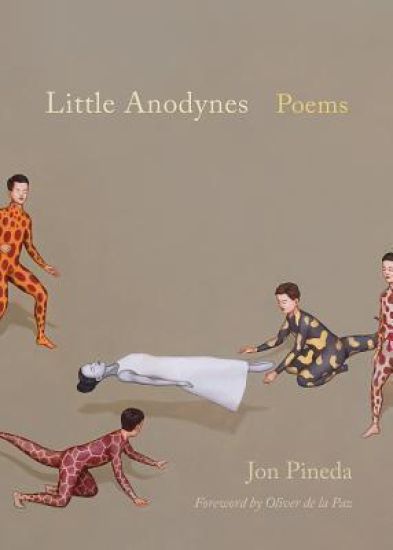
The third collection by the prize-winning Asian American poet Jon Pineda, Little Anodynes is a sequence of lyrical, personal narratives that continue Pineda’s exploration of his biracial identity, the haunting loss of his sister, and the joys - and fears - of fatherhood. With its title inspired by Emily Dickinson, Little Anodynes offers its poems as “respites,” as breaks in the reader’s life that serve as opportunities for discovery and healing. Pineda deftly uses shortened lines and natural pauses to create momentum, which allows the poems to play out in a manner evocative of fine cinema, as if someone had left a projector running and these narratives were flickering and blending endlessly in an experience shared by the viewer, the storyteller, and the story itself.
Requiem for the Orchard

Requiem for the Orchard

Oliver De la Paz

The University of Akron Press
2010
nidottu
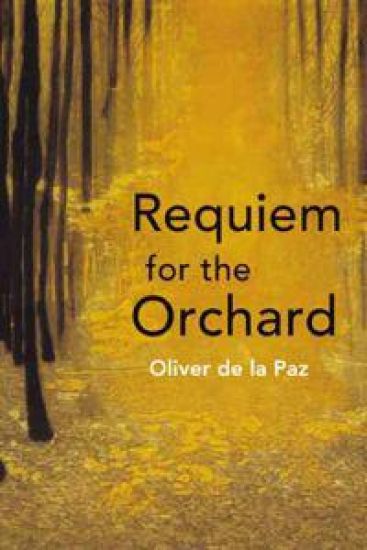
"These are vivid, visceral poems about coming of age in a place 'where the Ferris Wheel / was the tallest thing in the valley,' where a boy would learn 'to fire a shotgun at nine and wring a chicken's neck / with one hand by twirling the bird and whipping it straight like a towel.' ...In spite of such hardscrabble cruelties -- or because of them -- there is also a real tenderness in these poems, the revelations of bliss driving along an empty highway 'like opening a heavy book, / letting the pages feather themselves and finding a dried flower.' ...The poet has a gift for rendering his world in cinematic images...In short, these poems are the stuff of life itself, ugly and beautiful, wherever or whenever we happen to live it." -- Martin Espada
Furious Lullaby

Furious Lullaby

Oliver De la Paz

Southern Illinois University Press
2007
nidottu
Furious Lullaby is both a celebration of and a eulogy to the body in the twenty-first century. The collection, which examines the larger concepts of salvation and temptation in a world of blossoming strife, includes a series of aubades - dramatic poems culminating with the separation of lovers at dawn. The lovers suffer a metaphysical crisis, seeking to know what is good, what is evil, and how to truly know the difference. Knowing, however, invites the terrible into their world. The Devil, a seductive trickster, haunts the landscape as a voice who dares each inquisitor to learn about mortality, morality, the beautiful, and the unspeakable through direct experience. ""Furious Lullaby"" offers a departure from the lighter prose poetry of de la Paz's ""Names above Houses"" and preserves the author's concern with the nature of human grace.
Names Above Houses

Names Above Houses

Oliver De la Paz

Southern Illinois University Press
2001
nidottu
In Names above Houses, Oliver de la Paz uses both prose and verse poems to create the magical realm of Fidelito Recto - a boy who wants to fly - and his family of Filipino immigrants. Fidelito's mother, Maria Elena, tries to keep her son grounded while struggling with her own moorings. Meanwhile, Domingo, Fidelito's fisherman father, is always at sea, even when among them. From the archipelago of the Philippines to San Francisco, horizontal and vertical movements shape moments of displacement and belonging for this marginalized family. Fidelito approaches life with a sense of wonder, finding magic in the mundane and becoming increasingly uncertain whether he is in the sky or whether his feet are planted firmly on the ground.