Kirjojen hintavertailu. Mukana 12 390 323 kirjaa ja 12 kauppaa.

Kirjailija

Oriol Gomis-Bellmunt

Kirjat ja teokset yhdessä paikassa: 6 kirjaa, julkaisuja vuosilta 2008-2016, suosituimpien joukossa Design Rules for Actuators in Active Mechanical Systems. Vertaile teosten hintoja ja tarkista saatavuus suomalaisista kirjakaupoista.

6 kirjaa

Kirjojen julkaisuhaarukka 2008-2016.

Energy Storage in Power Systems

Energy Storage in Power Systems

Francisco Díaz-González; Andreas Sumper; Oriol Gomis-Bellmunt

John Wiley Sons Inc
2016
sidottu
Over the last century, energy storage systems (ESSs) have continued to evolve and adapt to changing energy requirements and technological advances. Energy Storage in Power Systems describes the essential principles needed to understand the role of ESSs in modern electrical power systems, highlighting their application for the grid integration of renewable-based generation. Key features: Defines the basis of electrical power systems, characterized by a high and increasing penetration of renewable-based generation.Describes the fundamentals, main characteristics and components of energy storage technologies, with an emphasis on electrical energy storage types.Contains real examples depicting the application of energy storage systems in the power system.Features case studies with and without solutions on modelling, simulation and optimization techniques. Although primarily targeted at researchers and senior graduate students, Energy Storage in Power Systems is also highly useful to scientists and engineers wanting to gain an introduction to the field of energy storage and more specifically its application to modern power systems.
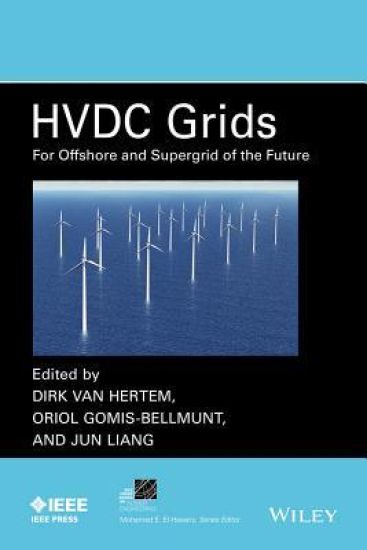
HVDC Grids

HVDC Grids

Dirk Van Hertem; Oriol Gomis-Bellmunt; Jun Liang

John Wiley Sons Inc
2016
sidottu
This book discusses HVDC grids based on multi-terminal voltage-source converters (VSC), which is suitable for the connection of offshore wind farms and a possible solution for a continent wide overlay grid. HVDC Grids: For Offshore and Supergrid of the Future begins by introducing and analyzing the motivations and energy policy drives for developing offshore grids and the European Supergrid. HVDC transmission technology and offshore equipment are described in the second part of the book. The third part of the book discusses how HVDC grids can be developed and integrated in the existing power system. The fourth part of the book focuses on HVDC grid integration, in studies, for different time domains of electric power systems. The book concludes by discussing developments of advanced control methods and control devices for enabling DC grids. Presents the technology of the future offshore and HVDC gridExplains how offshore and HVDC grids can be integrated in the existing power systemProvides the required models to analyse the different time domains of power system studies: from steady-state to electromagnetic transients This book is intended for power system engineers and academics with an interest in HVDC or power systems, and policy makers. The book also provides a solid background for researchers working with VSC-HVDC technologies, power electronic devices, offshore wind farm integration, and DC grid protection.
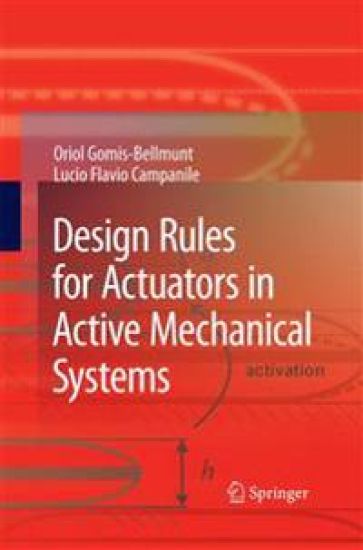
Design Rules for Actuators in Active Mechanical Systems

Design Rules for Actuators in Active Mechanical Systems

Oriol Gomis-Bellmunt; Lucio Flavio Campanile

Springer London Ltd
2014
nidottu
"Design Rules for Actuators in Active Mechanical Systems" deals with the formulation of model-based design rules to be used in the conception of optimized mechatronic and adaptronic systems. The book addresses the comparison of different actuator classes for given applications and offers answers to the following questions: What is the relationship between actuator geometry and primary output quantities? How scalable are actuators based on the same principle? How are energetic output quantities (work and power) related to mechanical load and geometry? How should actuators be designed and sized to obtain the best performance for the chosen actuator kind, and for a given application? "Design Rules for Actuators in Active Mechanical Systems" will be of use to industry professionals, such as actuator and machine designers, as well as to researchers and students of mechanical engineering, mechatronics, and electrical engineering.
Identification and Control of Piezoelectric Actuators

Identification and Control of Piezoelectric Actuators

Oriol Gomis-Bellmunt

AV Akademikerverlag
2012
pokkari
Revision with unchanged content. Piezoelectric actuators are proving to be a reliable solution for many engineering applications, ranging from micro-positioning (machine tools, optic devices or modern microscopes) to active control of structures. The main motivation of this work is to delve into models to represent the hysteretic behavior of piezoelectric actuators in order to apply them to the conception of controllers for such hysteretic systems. A general study of piezoelectric actuators is performed to later deal with the modeling of such actuators. Due to the high non-linear behavior observed, the problem of identifying and modeling the actuator requires a hysteresis model. The Bouc-Wen model has been chosen and investigations to identify its parameters and to validate the model have been undertaken. Once the system has been identified, a linear controller has been designed and implemented in a real platform, employing a Digital Signal Processor.
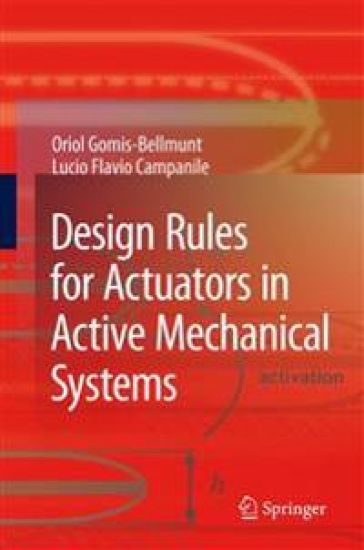
Design Rules for Actuators in Active Mechanical Systems

Design Rules for Actuators in Active Mechanical Systems

Oriol Gomis-Bellmunt; Lucio Flavio Campanile

Springer London Ltd
2010
sidottu
"Design Rules for Actuators in Active Mechanical Systems" deals with the formulation of model-based design rules to be used in the conception of optimized mechatronic and adaptronic systems. The book addresses the comparison of different actuator classes for given applications and offers answers to the following questions: What is the relationship between actuator geometry and primary output quantities? How scalable are actuators based on the same principle? How are energetic output quantities (work and power) related to mechanical load and geometry? How should actuators be designed and sized to obtain the best performance for the chosen actuator kind, and for a given application? "Design Rules for Actuators in Active Mechanical Systems" will be of use to industry professionals, such as actuator and machine designers, as well as to researchers and students of mechanical engineering, mechatronics, and electrical engineering.