Kirjojen hintavertailu. Mukana 12 595 353 kirjaa ja 12 kauppaa.

Kirjailija

Ortwin Renn

Kirjat ja teokset yhdessä paikassa: 23 kirjaa, julkaisuja vuosilta 1993-2026, suosituimpien joukossa Fairness and Competence in Citizen Participation. Vertaile teosten hintoja ja tarkista saatavuus suomalaisista kirjakaupoista.

23 kirjaa

Kirjojen julkaisuhaarukka 1993-2026.

Fairness and Competence in Citizen Participation

Fairness and Competence in Citizen Participation

Ortwin Renn; Thomas Webler; Pia-Johanna Schweizer

Springer Nature Switzerland AG
2026
sidottu
It addresses scholars, practitioners, and representatives of administrations, public and private institutions, and NGOs interested in a better understanding of the selection and design of the most effective formats for competent and fair policymaking, ensuring each format meets its full potential.
Das Gruppendelphi-Verfahren

Das Gruppendelphi-Verfahren

Marlen Niederberger; Ortwin Renn

Springer vs
2017
nidottu
Das Gruppendelphi-Verfahren ermöglicht einen wissensbasierten und konstruktiven Diskurs mit einer interdisziplinären Gruppe an Experten, die unterschiedliche Sichtweisen und Urteile präsentieren. Dieses Lehrbuch führt in die Grundlagen der Methode des Gruppendelphis ein und stellt dessen praktische Anwendung anschaulich und anhand von konkreten Forschungsprojekten dar. Das Gruppendelphi wurde in Anlehnung an das klassische Delphi-Verfahren zur Entwicklung von wissensbasierten Interpretationen, politischen Leitbildern und Planungsaufgaben mit dem Ziel der Kalibrierung von interdisziplinären Expertenurteilen entwickelt. Die Anwendung des Verfahrens in der Forschungspraxis verdeutlicht die Vielfalt an Einsatzmöglichkeiten und offenbart die dabei auftretenden Stärken und Schwächen. Eine besondere Herausforderung stellt die Entwicklung des standardisierten Fragebogens, dem methodischen Herzstück des Gruppendelphi-Verfahrens, dar.
The Risk Society Revisited

The Risk Society Revisited

Eugene Rosa; Aaron McCright; Ortwin Renn

Temple University Press,U.S.
2015
pokkari
Risk is a part of life. How we handle uncertainty and deal with potential threats influence decision making throughout our lives. In The Risk Society Revisited, Eugene A. Rosa, Ortwin Renn, and Aaron M. McCright offer the first book to present an integrated theory of risk and governance.The authors examine our sociological understanding of risk and how we reconcile modern human conditions with our handling of risk in our quest for improved quality of life. They build a new framework for understanding risk-one that provides an innovative connection between social theory and the governance of technological and environmental risks and the sociopolitical challenges they pose for a sustainable future.Showing how our consciousness affects risk in the decisions we make-as individuals and as members of a democratic society-The Risk Society Revisited makes an important contribution to the literature of risk research.
Radioactive Waste

Radioactive Waste

Christian Streffer; Carl Friedrich Gethmann; Georg Kamp; Wolfgang Kröger; Eckard Rehbinder; Ortwin Renn

Springer-Verlag Berlin and Heidelberg GmbH Co. K
2014
nidottu
Radioactive waste (above all highly radioactive wastes from nuclear installations) caused by research, medicine and technology must be disposed of safely. However both the strategies disputed for the disposal of radioactive waste as well as concrete proposals for choosing a location for final waste disposal are highly debatable. An appropriate disposal must conform to both complex, technical requirements and fulfill the radio-biological conditions to appropriately protect man and nature. Ethical, legal and social conditions must also be considered. An interdisciplinary team from various, relevant fields compiled the current status-quo and developed criteria and strategies, which on the one hand meet the requirements of optimal warning and prevention of risk for present and future generations, and additionally on the other hand meet the needs of what current society agrees what is expected to be allowed. This study can be understood as an advanced and continuing contribution to the corresponding scientific specialized debates, due to its interdisciplinary treatment. At the same time it serves as a fundamentally informing contribution to public and political debates, offering an easily comprehensible executive summary and precise content recommendations.
Safe or Not Safe

Safe or Not Safe

Paul Pechan; Ortwin Renn; Allan Watt; Ingemar Pongratz

Springer-Verlag New York Inc.
2014
nidottu
Based on an EU workshop at the end of 2005, the book discusses risk and our food supply. The introductory chapter will discuss all aspects of risk and how it applies to food, from risk classification to risk management. Following a discussion of risk, the authors will present three different case studies that will emphasize the following issues:• What do we want as individuals, as a society• What is the political context of the risk discussion • When do we act and what are the costs of not acting/acting• International trade and legal issues• Moral dimensions of decision making • How do we deal with the disproportionate "power" of the various stakeholders• Rationality/emotive aspects of argumentation (connection between perception /live experiences, knowledge)• What are facts- and do they change with time • Psychological aspects: rapture of trust; the need for certainty; connection between danger, fear and risk
Structural Human Ecology

Structural Human Ecology

Nadine Bratchatzek; Paul Ehrlich; Sylvia Hiller; Roger E. Kasperson; Sandra T. Marquart-Pyatt; Allan Mazur; Ortwin Renn; Dirk Scheer

Washington State University Press
2013
pokkari
The desire to understand people's influence on ecosystems has inspired scientific studies and analyses of the stress individuals and communities place on the environment, human well-being, and the tradeoffs between them. As an emerging discipline, Structural Human Ecology is devoted to unlocking the dynamic links between population, environment, social organization, and technology. The new field offers cutting-edge research in risk analysis that can be used to evaluate environmental policies and thus help citizens and societies worldwide learn how to most effectively mitigate human impacts on the biosphere. The essays in this volume were presented by leading international scholars at a 2011 symposium honoring the late Dr. Eugene Rosa, then Boeing Distinguished Professor of Environmental Sociology at WSU.
The Risk Society Revisited

The Risk Society Revisited

Eugene Rosa; Aaron McCright; Ortwin Renn

Temple University Press,U.S.
2013
sidottu
Risk is a part of life. How we handle uncertainty and deal with potential threats influence decision making throughout our lives. In The Risk Society Revisited, Eugene A. Rosa, Ortwin Renn, and Aaron M. McCright offer the first book to present an integrated theory of risk and governance.The authors examine our sociological understanding of risk and how we reconcile modern human conditions with our handling of risk in our quest for improved quality of life. They build a new framework for understanding risk-one that provides an innovative connection between social theory and the governance of technological and environmental risks and the sociopolitical challenges they pose for a sustainable future.Showing how our consciousness affects risk in the decisions we make-as individuals and as members of a democratic society-The Risk Society Revisited makes an important contribution to the literature of risk research.
Risiko- und Technikakzeptanz

Risiko- und Technikakzeptanz

Ortwin Renn; Michael M. Zwick

Springer-Verlag Berlin and Heidelberg GmbH Co. K
2012
nidottu
Die langfristige Sieherung der natiirliehen Lebensgrundlagen, wirtschaftliehe Stabilitat und soziale Vertragliehkeit bilden die drei Dimensionen, die das Leitbild der Nachhaltigkeit zu vereinbaren sueht. Dabei verlangt nachhaltige Entwicklung einen Riehtungswechsel, wenn es zukiinftig gelingen soli, nieht mehr yom Naturkapital selbst, sondem von den Zinsen zu leben. Die Idee, aueh kiinftigen Generationen eine lebenswerte Umwelt zu hinterlassen, findet breite Zustimmung, doch iiber das Wie herrscht Unsieherheit. Wie konnen die Ziele einer nachhaltigen Entwicklung gefunden werden, und wie sieht ein soleher Weg fur Deutschland aus? Welehe Voraussetzungen miissen Staat, Wirtschaft und Gesellschaft erfiilien, urn die Weichen zu stelien? Urn diese komplexen Fragen zu beantworten, beauftragte die Enquete- Kommission Schutz des Mensehen und der Umwelt Wissensehaftler und Forsehungsinstitute mit der Aufarbeitung einzelner Themenbereiche: - Nationaler Umweltplan - Globalisierung und Nachhaltigkeit - Institutionelle Reformen - UmweltbewuBtsein und -verhalten - Risiko-und Technikakzeptanz - Bauen und Wohnen - Versauerung von Boden Mit der Veroffentliehung ihres Studienprogramms unter dem Titel Konzept Nachhaltigkeit will die Enquete-Kommission die aktuelien Forschungsergeb- nisse Politik, Wissensehaft, Wirtsehaft und nieht zuletzt einer interessierten Offentlichkeit zur Verfiigung stelien. Die in den Studien geauBerten An- siehten miissen nieht mit denen der Enquete-Kommission iibereinstimmen. leh hoffe, daB die Veroffentliehung dazu beitragt, die Diskussion zu beleben, und daB sie Mut macht zu weiteren Schritten in Riehtung Nachhaltigkeit.
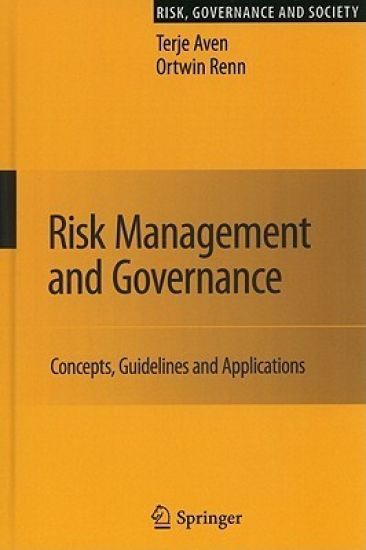
Risk Management and Governance

Risk Management and Governance

Terje Aven; Ortwin Renn

Springer-Verlag Berlin and Heidelberg GmbH Co. K
2012
nidottu
Risk is a popular topic in many sciences - in natural, medical, statistical, engineering, social, economic and legal disciplines. Yet, no single discipline can grasp the full meaning of risk. Investigating risk requires a multidisciplinary approach. The authors, coming from two very different disciplinary traditions, meet this challenge by building bridges between the engineering, the statistical and the social science perspectives. The book provides a comprehensive, accessible and concise guide to risk assessment, management and governance. A basic pillar for the book is the risk governance framework proposed by the International Risk Governance Council (IRGC). This framework offers a comprehensive means of integrating risk identification, assessment, management and communication. The authors develop and explain new insights and add substance to the various elements of the framework. The theoretical analysis is illustrated by several examples from different areas of applications.
Radioactive Waste

Radioactive Waste

Christian Streffer; Carl Friedrich Gethmann; Georg Kamp; Wolfgang Kröger; Eckard Rehbinder; Ortwin Renn

Springer-Verlag Berlin and Heidelberg GmbH Co. K
2011
sidottu
Radioactive waste (above all highly radioactive wastes from nuclear installations) caused by research, medicine and technology must be disposed of safely. However both the strategies disputed for the disposal of radioactive waste as well as concrete proposals for choosing a location for final waste disposal are highly debatable. An appropriate disposal must conform to both complex, technical requirements and fulfill the radio-biological conditions to appropriately protect man and nature. Ethical, legal and social conditions must also be considered. An interdisciplinary team from various, relevant fields compiled the current status-quo and developed criteria and strategies, which on the one hand meet the requirements of optimal warning and prevention of risk for present and future generations, and additionally on the other hand meet the needs of what current society agrees what is expected to be allowed. This study can be understood as an advanced and continuing contribution to the corresponding scientific specialized debates, due to its interdisciplinary treatment. At the same time it serves as a fundamentally informing contribution to public and political debates, offering an easily comprehensible executive summary and precise content recommendations.
Safe or Not Safe

Safe or Not Safe

Paul Pechan; Ortwin Renn; Allan Watt; Ingemar Pongratz

Springer-Verlag New York Inc.
2011
sidottu
Based on an EU workshop at the end of 2005, the book discusses risk and our food supply. The introductory chapter will discuss all aspects of risk and how it applies to food, from risk classification to risk management. Following a discussion of risk, the authors will present three different case studies that will emphasize the following issues:• What do we want as individuals, as a society• What is the political context of the risk discussion • When do we act and what are the costs of not acting/acting• International trade and legal issues• Moral dimensions of decision making • How do we deal with the disproportionate "power" of the various stakeholders• Rationality/emotive aspects of argumentation (connection between perception /live experiences, knowledge)• What are facts- and do they change with time • Psychological aspects: rapture of trust; the need for certainty; connection between danger, fear and risk
Environmental Standards

Environmental Standards

Christian Streffer; Josef Bücker; Adrienne Cansier; Dieter Cansier; Carl Friedrich Gethmann; Robert Guderian; Gerd Hanekamp; Dietrich Henschler; Gerald Pöch; Eckard Rehbinder; Ortwin Renn; Marco Slesina; Kerstin Wuttke

Springer-Verlag Berlin and Heidelberg GmbH Co. K
2010
nidottu
The rapid growth of the world population - nearly six-fold over the last hundred years - combined with the rising number of technical installations especially in the industrialized countries has lead to ever tighter and more strained living spaces on our planet. Because ofthe inevitable processes oflife, man was at first an exploiter rather than a careful preserver of the environment. Environmental awareness with the intention to conserve the environment has grown only in the last few decades. Environmental standards have been defined and limit values have been set largely guided, however, by scientific and medical data on single exposures, while public opinion, on the other hand, now increasingly calls for astronger consideration of the more complex situations following combined exposures. Furthermore, it turned out that environmental standards, while necessarily based on scientific data, must also take into account ethical, legal, economic, and sociological aspects. A task of such complexity can only be dealt with appropriately in the framework of an inter­ disciplinary group.
Risk Management and Governance

Risk Management and Governance

Terje Aven; Ortwin Renn

Springer-Verlag Berlin and Heidelberg GmbH Co. K
2010
sidottu
Risk is a popular topic in many sciences - in natural, medical, statistical, engineering, social, economic and legal disciplines. Yet, no single discipline can grasp the full meaning of risk. Investigating risk requires a multidisciplinary approach. The authors, coming from two very different disciplinary traditions, meet this challenge by building bridges between the engineering, the statistical and the social science perspectives. The book provides a comprehensive, accessible and concise guide to risk assessment, management and governance. A basic pillar for the book is the risk governance framework proposed by the International Risk Governance Council (IRGC). This framework offers a comprehensive means of integrating risk identification, assessment, management and communication. The authors develop and explain new insights and add substance to the various elements of the framework. The theoretical analysis is illustrated by several examples from different areas of applications.
Risk Governance

Risk Governance

Ortwin Renn

Earthscan Ltd
2008
sidottu
'Risk Governance is a tour de force. Every risk manager, every risk analyst, every risk researcher must read this book - it is the demarcation point for all further advances in risk policy and risk research. Renn provides authoritative guidance on how to manage risks based on a definitive synthesis of the research literature. The skill with which he builds practical recommendations from solid science is unprecedented.'Thomas Dietz, Director, Environmental Science and Policy Program, Michigan State University, USA 'A masterpiece of new knowledge and wisdom with illustrative examples of tested applications to realworld cases. The book is recommendable also to interested students in different disciplines as a timely textbook on 'risk beyond risk'.'Norio Okada, Full Professor and Director at the Disaster Prevention Research Institute (DPRI), Kyoto University, Japan 'There are classic environmental works such as The Tragedy of the Commons by Hardin, Risk Society by Beck, The Theory of Communicative Action by Habermas, and the seminal volumes by Ostrom on governing the commons. Renn's book fits right into this series of important milestones of environmental studies.'Jochen Jaeger, Professor at Concordia University, Montreal, Canada 'Risk Governance provides a valuable survey of the whole field of risk and demonstrates how scientific, economic, political and civil society actors can participate in inclusive risk governance.'Jobst Conrad, Senior Scientist, Social Science Research Center Berlin, Germany 'Renn offers a remarkably fair-minded and systematic approach to bringing together the diverse fields that have something to say about 'risk'. Risk Governance moves us along the path from the noisy, formative stage of thinking about risk to one with a stronger empirical, theoretical, and analytical foundation.'Baruch Fischhoff, PhD, Howard Heinz University Professor, Carnegie Mellon University, Pittsburgh, USA 'I cannot describe how impressed I am at the breadth and coherence of Renn's career's work! Written with remarkable clarity and minimal technical jargon... [this] should be required reading in risk courses!' John Graham, former director of the Harvard Risk Center and former deputy director of the Office of Budget and Management of the Unites States Administration This book, for the first time, brings together and updates the groundbreaking work of renowned risk theorist and researcher Ortwin Renn, integrating the major disciplinary concepts of risk in the social, engineering and natural sciences. The book opens with the context of risk handling before flowing through the core topics of assessment, evaluation, perception, management and communication, culminating in a look at the transition from risk management to risk governance and a glimpse at a new understanding of risk in (post)modern societies.
Risk Governance

Risk Governance

Ortwin Renn

Earthscan Ltd
2008
nidottu
'Risk Governance is a tour de force. Every risk manager, every risk analyst, every risk researcher must read this book - it is the demarcation point for all further advances in risk policy and risk research. Renn provides authoritative guidance on how to manage risks based on a definitive synthesis of the research literature. The skill with which he builds practical recommendations from solid science is unprecedented.'Thomas Dietz, Director, Environmental Science and Policy Program, Michigan State University, USA 'A masterpiece of new knowledge and wisdom with illustrative examples of tested applications to realworld cases. The book is recommendable also to interested students in different disciplines as a timely textbook on 'risk beyond risk'.'Norio Okada, Full Professor and Director at the Disaster Prevention Research Institute (DPRI), Kyoto University, Japan 'There are classic environmental works such as The Tragedy of the Commons by Hardin, Risk Society by Beck, The Theory of Communicative Action by Habermas, and the seminal volumes by Ostrom on governing the commons. Renn's book fits right into this series of important milestones of environmental studies.'Jochen Jaeger, Professor at Concordia University, Montreal, Canada 'Risk Governance provides a valuable survey of the whole field of risk and demonstrates how scientific, economic, political and civil society actors can participate in inclusive risk governance.'Jobst Conrad, Senior Scientist, Social Science Research Center Berlin, Germany 'Renn offers a remarkably fair-minded and systematic approach to bringing together the diverse fields that have something to say about 'risk'. Risk Governance moves us along the path from the noisy, formative stage of thinking about risk to one with a stronger empirical, theoretical, and analytical foundation.'Baruch Fischhoff, PhD, Howard Heinz University Professor, Carnegie Mellon University, Pittsburgh, USA 'I cannot describe how impressed I am at the breadth and coherence of Renn's career's work! Written with remarkable clarity and minimal technical jargon... [this] should be required reading in risk courses!' John Graham, former director of the Harvard Risk Center and former deputy director of the Office of Budget and Management of the Unites States Administration This book, for the first time, brings together and updates the groundbreaking work of renowned risk theorist and researcher Ortwin Renn, integrating the major disciplinary concepts of risk in the social, engineering and natural sciences. The book opens with the context of risk handling before flowing through the core topics of assessment, evaluation, perception, management and communication, culminating in a look at the transition from risk management to risk governance and a glimpse at a new understanding of risk in (post)modern societies.
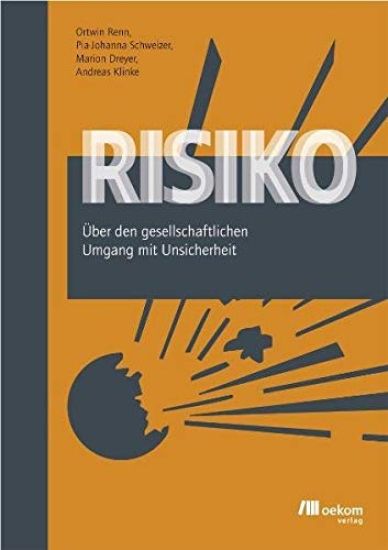
Risiko

Risiko

Ortwin Renn; Pia J. Schweizer; Marion Dreyer

Oekom Verlag GmbH
2007
nidottu
Ob Terror, Nanotechnologie oder Klimawandel - die Öffentlichkeit ist häufig einem Wechselbad aus Schreckensnachrichten, euphorischen Innovationsberichten, Dramatisierungen und Verharmlosungen ausgesetzt. Die Folge ist schlichtweg Verunsicherung. Das Wirrwarr sich widersprechender Aussagen wirft Fragen auf: Welche Risiken birgt die moderne Welt wirklich? Wie kann man Risiken messen und bewerten? Können Frühwarnsysteme helfen, um Lebensmittelkrisen, Umweltschäden oder Naturkatastrophen zu verhindern? Dieses Buch gibt wissenschaftlich fundierte, praxisnahe und politisch umsetzbare Antworten. Im Vordergrund steht die Integration unterschiedlicher Disziplinen, die sich mit dem vielseitigen Begriff "Risiko" befassen - von der Berechnung der Eintrittswahrscheinlichkeit bis zur menschlichen Reaktion auf riskante Situationen. So entstand das erste deutschsprachige Standardwerk zu Risikoanalyse, -wahrnehmung und -management. Es präsentiert ein umfassendes sozial-ökologisches Konzept, wie die Gesellschaft Risiken erfassen und ihnen adäquat begegnen kann.
Leitbild Nachhaltigkeit

Leitbild Nachhaltigkeit

Ortwin Renn; Jürgen Deuschle; Alexander Jäger; Wolfgang Weimer-Jehle

Vs Verlag Fur Sozialwissenschaften
2007
nidottu
„Man könnte bilanzieren: Seit Rio (1992) ist nichts so nachhaltig wie das Reden und Schreiben über 'Nachhaltige Entwicklung' oder 'Sustainable Development' und gleichzeitig nichts so aussichtslos wie der Versuch, den Begriff konsensfähig und allgemeinverbindlich zu definieren“ (Jüdes 1997: 1). Mit diesen bitteren Worten beginnt eine kritische Analyse in der Zeitschrift „Politische Ökologie“ über die bisherige Nachhaltigkeitsdebatte in Deutschland. Wird der inflationäre Gebrauch des Wortes „Nachhaltigkeit“ dazu führen, dass wir nur noch mit einer Worthülse alles, was uns edel, hilfreich und gut erscheint, unter einen Begriff fassen wollen? Oder ist der Begriff mehr als eine dehnbare Schablone für Sonntagsreden und folgenlose Absich- erklärungen? Der Begriff der Nachhaltigkeit stammt ursprünglich aus der Forstwirtschaft und - deutet, dass nur soviel Holz geerntet werden darf, wie in dem jeweiligen Anbaugebiet nachwächst. Der sächsische Oberberghauptmann von Carlowitz hat im Jahre 1713 in s- nem Werk "Sylvicultura Oeconomica" zum ersten Male den Begriff der Nachhaltigkeit verwendet, ohne zu ahnen, dass dieser Begriff 274 Jahre nach dem Erscheinen seines W- kes international in aller Munde sein würde (Peters 1984: 4; 261). Eine nachhaltige For- wirtschaft, so der Oberberghauptmann, beruhe auf dem Grundsatz, dass man nur so viel an Holz einschlagen dürfe wie durch Neupflanzung an Bäumen nachwachsen würde. Die Idee hat die sog. Brundtland-Kommission übernommen. Sie definiert nachhaltige Entwicklung als eine „Entwicklung, die die Bedürfnisse der Gegenwart befriedigt, ohne zu riskieren, dass künftige Generationen ihre eigenen Bedürfnisse nicht befriedigen können” (Hauff 1987: 46).
Environmental Standards

Environmental Standards

Christian Streffer; Josef Bücker; Adrienne Cansier; Dieter Cansier; Carl Friedrich Gethmann; Robert Guderian; Gerd Hanekamp; Dietrich Henschler; Gerald Pöch; Eckard Rehbinder; Ortwin Renn; Marco Slesina; Kerstin Wuttke

Springer-Verlag Berlin and Heidelberg GmbH Co. K
2003
sidottu
The rapid growth of the world population - nearly six-fold over the last hundred years - combined with the rising number of technical installations especially in the industrialized countries has lead to ever tighter and more strained living spaces on our planet. Because ofthe inevitable processes oflife, man was at first an exploiter rather than a careful preserver of the environment. Environmental awareness with the intention to conserve the environment has grown only in the last few decades. Environmental standards have been defined and limit values have been set largely guided, however, by scientific and medical data on single exposures, while public opinion, on the other hand, now increasingly calls for astronger consideration of the more complex situations following combined exposures. Furthermore, it turned out that environmental standards, while necessarily based on scientific data, must also take into account ethical, legal, economic, and sociological aspects. A task of such complexity can only be dealt with appropriately in the framework of an inter­ disciplinary group.