Kirjojen hintavertailu. Mukana 12 390 323 kirjaa ja 12 kauppaa.

Kirjailija

Oscar E. Gilbert

Kirjat ja teokset yhdessä paikassa: 6 kirjaa, julkaisuja vuosilta 2015-2025, suosituimpien joukossa Marine Corps Tank Battles in the Middle East. Vertaile teosten hintoja ja tarkista saatavuus suomalaisista kirjakaupoista.

6 kirjaa

Kirjojen julkaisuhaarukka 2015-2025.

True for the Cause of Liberty

True for the Cause of Liberty

Catherine R. Gilbert; Oscar E. Gilbert

Casemate Publishers
2025
nidottu
Following their defeat at Saratoga in upstate New York in 1777, the British decided to implement a Southern Strategy against the American insurgents, a plan to “roll up” the rebellious colonies from Georgia through the Carolinas to Virginia. Instead, they triggered a savage partisan war of raids, ambushes, assassinations, and large pitched battles that rivaled any fought in the northern colonies. Untrained Patriot militiamen—occasionally stiffened by contingents of the Continental Line—were pitted against Britain’s Cherokee and Creek allies, and Loyalist militia and British regulars led by General Cornwallis and his two ablest subordinates, Patrick Ferguson and the ruthless Banastre “Bloody Ban” Tarleton. In October 1780 the Loyalist militia was virtually destroyed at King’s Mountain, the battle that Lord Clinton, the British commander in Chief, said was “the first link in a chain of events that followed each other in regular succession until they at last ended in the total loss of America.” Other defeats at Blackstock’s Farm and Cowpens, and a Pyhrric victory at Guilford Courthouse, gutted the British Southern Army and drove Cornwallis north to encirclement and surrender at Yorktown. This study uses battlefield terrain analysis and the words of the officers and common soldiers, from pension records and littleknown interviews, to bring to life the crucial role of one militia regiment—the Second Spartans of South Carolinathat fought in virtually every action of the vicious backcountry war that decided the fate of America. Or as one private in the Second Spartans said, expressing admiration for his colonel: “. . . a few Brave Men stood true for the cause of liberty.”

Bloody Ban

Bloody Ban

Oscar E. Gilbert; Catherine R. Gilbert

Savas Beatie
2023
sidottu
The Continentals had no doubt: Banastre Tarleton was the most barbaric and hated officer in America. Given his historical importance, surprisingly little has been written about the dashing cavalry leader. Oscar and Catherine Gilbert rectify this oversight with Bloody Ban: Banastre Tarleton and the American Revolution, 1776-1783, the first modern biography to appear in more than half a century.Tarleton enjoyed a meteoric rise in rank and stature. He began the war at age 22 in 1776 as a cornet (lieutenant), and by 1781, the 26-year-old was a lieutenant colonel and leader of the feared Loyalist British Legion (“Tarleton’s Raiders”), a combined arms brigade recruited in the northern colonies and sent south to terrorize and subdue its rebellious citizenry. Lord Cornwallis considered him his right-hand man, and entrusted Tarleton with the most difficult of missions.The cavalryman came to fame early by capturing Gen. Charles Lee, second in rank only to George Washington. In early battles like Paoli (September 1777), Tarleton learned that surprise attacks and ruthless violence—18th century “shock and awe” tactics—resulted in victory. His transfer south to help “roll up” the rebels from South Carolina to Virginia triggered a brutal partisan war. Though his personal behavior proved impeccable, from his first notable skirmish at Monck’s Corner (April 14, 1780) Tarleton failed to control the excesses of his favored Green Dragoons, including rape. At the Waxhaws (May 29, 1780), the Legion massacred surrendering Continentals and mutilated the wounded. “Tarleton’s Quarter” became the byword of the rebel militia: No quarter asked or given. His reputation for invincibility was punctured at Blackstock’s Farm (November 20, 1780), after which he lied to Cornwallis to conceal his defeat, and the ramifications of his tactical rashness at The Cowpens (January 17, 1781) played a major role in the eventual defeat of the British.After the war Tarleton returned to Britain where, despite a scandalous personal life and massive gambling debts he parlayed his fame and royal connections into higher rank and a long career in Parliament. Nearly two centuries after his death the question remains: Was Banastre Tarleton the Revolution’s finest cavalry leader, or a charlatan and war criminal?The authors utilized period records and personal accounts to unravel the complex story (and debunk several myths) of Tarleton’s extraordinary career. As Bloody Ban makes clear, the cavalryman possessed an exceedingly talented military mind, but was consumed by overweening ambition that clouded his judgments. His growing penchant for unprepared frontal assaults no matter the odds, and willingness to push his troops beyond the limits of endurance in his quest for glory, proved the bane of his career.The smooth prose, exceptional research, and original maps make Bloody Ban: Banastre Tarleton and the American Revolution, 1776-1783 one of the most important books on the Revolutionary War.
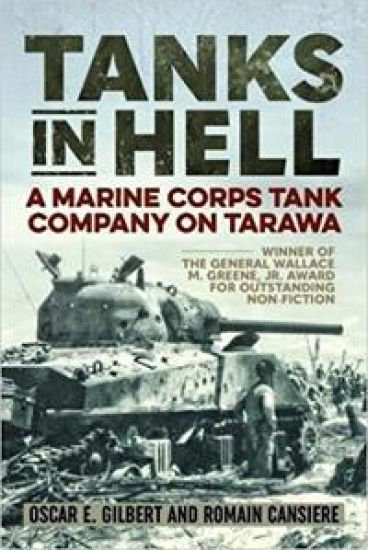
Tanks in Hell

Tanks in Hell

Oscar E. Gilbert; Romain Cansiere

Casemate Publishers
2018
nidottu
Winner of THE GENERAL WALLACE M. GREENE, JR. AWARD for outstanding nonfictionIn May 1943 a self-described “really young, green, ignorant lieutenant” assumed command of a new Marine Corps company. His even younger enlisted Marines were learning to use an untested weapon, the M4A2 “Sherman” medium tank. His sole combat veteran was the company bugler, who had salvaged his dress cap and battered horn from a sinking aircraft carrier. Just six months later the company would be thrown into one of the ghastliest battles of World War II.On 20 November 1943 the Second Marine Division launched the first amphibious assault of the Pacific War, directly into the teeth of powerful Japanese defenses on Tarawa. In that blood-soaked invasion, a single company of Sherman tanks, of which only two survived, played a pivotal role in turning the tide from looming disaster to legendary victory. In this unique study Oscar Gilbert and Romain Cansiere use official documents, memoirs, interviews with veterans, as well as personal and aerial photographs to follow Charlie Company from its formation, and trace the movement, action—and loss—of individual tanks in this horrific four-day struggle.The authors have used official documents and interviews with veterans to follow the company from training through the brutal 76-hour struggle for Tarawa. Survivor accounts and air photo analysis document the movements –and destruction – of the company’s individual tanks. It is a story of escapes from drowning tanks, and even more harrowing escapes from tanks knocked out behind Japanese lines. It is a story of men doing whatever needed to be done, from burying the dead to hand-carrying heavy cannon ammunition forward under fire. It is the story of how the two surviving tanks and their crews expanded a perilously thin beachhead, and cleared the way for critical reinforcements to come ashore. But most of all it is a story of how a few unsung Marines helped turn near disaster into epic victory.
First to Fight

First to Fight

Oscar E. Gilbert; Romain Cansiere

Casemate Publishers
2017
sidottu
“Retreat, hell! We just got here!” The words of Captain Lloyd Williams at Belleau Wood in June 1918 entered United States Marine Corps legend, and the Marine Brigade’s actions there—along with the censor’s failure to take out the name of the Brigade in the battle reports—made the Corps famous. The Marines went to war as part of the American Expeditionary Force, bitterly resented by the Army and General Pershing. The Army tried to use them solely as labor troops and replacements, but the German spring offensive of 1918 forced the issue. The French begged Pershing to commit his partially trained men, and two untested American divisions, supported by British and French units, were thrown into the path of five German divisions. Three horrific weeks later, the Marines held the entirety of Belleau Wood. The Marines then fought in the almost forgotten Blanc Mont Ridge Offensive in October, as well as in every well-known AEF action until the end of the war. This book will look at all the operations of the Marine Corps in World War I, cover the activities of both ground and air units, and consider the units that supported the Marine Brigade. It will examine how, during the war years, the Marine Corps changed from a small organization of naval security detachments to an elite land combat force.
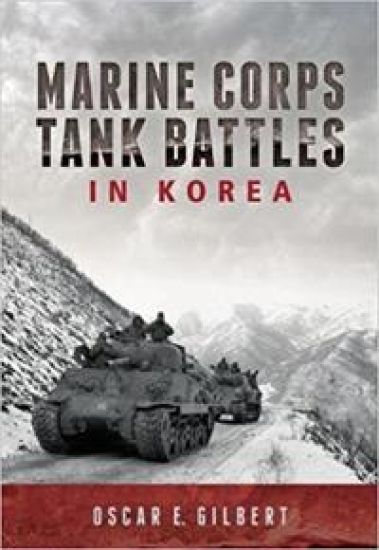
Marine Corps Tank Battles in Korea

Marine Corps Tank Battles in Korea

Oscar E. Gilbert

Casemate Publishers
2017
nidottu
Reviews for Hardback Edition: “In order to produce this fine book, the author has conducted extensive interviews with participants and consulted archival and published materials. This gives the book an excellent balance between the events as witnessed by the participants and the broader historic, strategic and tactical issues. It also makes for a great reading experience. The text is full of excellent “war stories” and covers a wide variety of combat and non-combat scenarios... You’ll not be disappointed. Highly recommended.” Missing Lynx
Marine Corps Tank Battles in the Middle East

Marine Corps Tank Battles in the Middle East

Oscar E. Gilbert

Casemate Publishers
2015
sidottu
In the aftermath of Vietnam a new generation of U.S. Marines was determined to wage a smarter kind of war. The tank, the very symbol of power and violence, would play a key role in a new concept of mobile warfare, not seen since the dashes of World War II. The emphasis would be not on brutal battles of attrition, but on paralyzing the enemy by rapid manoeuvre and overwhelming but judicious use of firepower. Yet in two wars with Iraq, the tankers, as well as the crews of the new Light Armoured Vehicles, quickly found themselves in a familiar role—battering through some of the strongest defenses in the world by frontal assault, fighting their way through towns and cities. In America’s longest continual conflict, armoured Marines became entangled in further guerilla war, this time amid the broiling deserts, ancient cities, and rich farmlands of Iraq, and in the high, bleak wastes of Afghanistan. It was a familiar kind of war against a fanatical foe who brutalised civilians, planted sophisticated roadside bombs, and seized control of entire cities. It has been a maddening war of clearing roads, escorting convoys, endless sweep operations to locate and destroy insurgent strongholds, protecting voting sites for free elections, and recapturing and rebuilding urban centers. It’s been a war in which the tanks repeatedly provided the outnumbered infantry with precise and decisive firepower. The tankers even added a new trick to their repertoire—long-range surveillance. Our fights against Iraq in 1991 and in the post-9/11 years have seen further wars that demanded a particular combination of courage, tenacity, professionalism, and versatility fully described herein.