Kirjojen hintavertailu. Mukana 12 273 346 kirjaa ja 12 kauppaa.

Kirjailija

Osvaldo N. Feinstein

Kirjat ja teokset yhdessä paikassa: 10 kirjaa, julkaisuja vuosilta 2001-2023, suosituimpien joukossa Evaluating Climate Change and Development. Vertaile teosten hintoja ja tarkista saatavuus suomalaisista kirjakaupoista.

10 kirjaa

Kirjojen julkaisuhaarukka 2001-2023.

Environmental Evaluation and Global Development Institutions

Environmental Evaluation and Global Development Institutions

Geeta Batra; Juha I. Uitto; Osvaldo N. Feinstein

TAYLOR FRANCIS LTD
2023
nidottu
Evaluation is increasingly important for finding sustainable solutions for the people and the planet, based on a systematic analysis of what works, for whom, and under what circumstances, and to contribute to the achievement of the Sustainable Development Goals, as they pertain to the environment.This book explores why the Global Environment Facility (GEF) invests in evaluation for accountability and learning to inform its decision-making on programming priorities, and how this leads to wiser funding decisions and better program performance on the ground. The book is based on real-life experiences of how to make evaluation count for international environmental action. Drawing upon comprehensive evaluations of the GEF, it provides unique insights from authors responsible for designing, implementing, and disseminating the findings of the evaluations. No other multilateral development or environment agency places evaluation fully at the center of their decision-making. The book outlines the trends in the global environment and the changing landscape of international environmental finance. It defines the role of the GEF and explains its institutional framework and the unique partnership that involves donor and recipient countries, multilateral development banks, UN agencies, nongovernmental organizations (NGOs), and national agencies in the developing countries. Further, it provides useful pointers to other organizations wishing to enhance evidence-based decision-making for improving their relevance, performance, and impact.The book will be most suitable for graduate-level, specialized study in a variety of disciplines such as environmental and development economics, political science, international relations, geography, sociology, and social anthropology.The Open Access version of this book, available at http://www.taylorfrancis.com, has been made available under a Creative Commons Attribution-Non Commercial-No Derivatives 4.0 license.
Environmental Evaluation and Global Development Institutions

Environmental Evaluation and Global Development Institutions

Geeta Batra; Juha I. Uitto; Osvaldo N. Feinstein

Taylor Francis Ltd
2021
sidottu
Evaluation is increasingly important for finding sustainable solutions for the people and the planet, based on a systematic analysis of what works, for whom, and under what circumstances, and to contribute to the achievement of the Sustainable Development Goals, as they pertain to the environment.This book explores why the Global Environment Facility (GEF) invests in evaluation for accountability and learning to inform its decision-making on programming priorities, and how this leads to wiser funding decisions and better program performance on the ground. The book is based on real-life experiences of how to make evaluation count for international environmental action. Drawing upon comprehensive evaluations of the GEF, it provides unique insights from authors responsible for designing, implementing, and disseminating the findings of the evaluations. No other multilateral development or environment agency places evaluation fully at the center of their decision-making. The book outlines the trends in the global environment and the changing landscape of international environmental finance. It defines the role of the GEF and explains its institutional framework and the unique partnership that involves donor and recipient countries, multilateral development banks, UN agencies, nongovernmental organizations (NGOs), and national agencies in the developing countries. Further, it provides useful pointers to other organizations wishing to enhance evidence-based decision-making for improving their relevance, performance, and impact.The book will be most suitable for graduate-level, specialized study in a variety of disciplines such as environmental and development economics, political science, international relations, geography, sociology, and social anthropology.The Open Access version of this book, available at http://www.taylorfrancis.com, has been made available under a Creative Commons Attribution-Non Commercial-No Derivatives 4.0 license.
Evaluation for Inclusive and Sustainable Rural Transformation

Evaluation for Inclusive and Sustainable Rural Transformation

Oscar A. García; Osvaldo N. Feinstein

Routledge
2020
nidottu
Written by a team of expert practitioners at the Independent Office of Evaluation of IFAD, this book gives an overview of evaluation practice at IFAD.It looks at how evaluation practice has evolved to reflect, respond to and inform changing expectations of development assistance. It reveals how evaluation products and methodologies have benefited from key reviews, revisions and lessons learned, and also how they have progressively strengthened IFAD’s capacity to assess its operations and better understand its results. The book concludes with reflections on some of the challenges that lie ahead, including how the independent evaluation function can continue to evolve to meet future challenges and enhance the impact of development initiatives on people’s lives.This valuable insight into practice will be of interest to researchers, practitioners and policymakers in development economics, development studies and rural studies.
Evaluation for Inclusive and Sustainable Rural Transformation

Evaluation for Inclusive and Sustainable Rural Transformation

Oscar A. García; Osvaldo N. Feinstein

Routledge
2018
sidottu
Written by a team of expert practitioners at the Independent Office of Evaluation of IFAD, this book gives an overview of evaluation practice at IFAD.It looks at how evaluation practice has evolved to reflect, respond to and inform changing expectations of development assistance. It reveals how evaluation products and methodologies have benefited from key reviews, revisions and lessons learned, and also how they have progressively strengthened IFAD’s capacity to assess its operations and better understand its results. The book concludes with reflections on some of the challenges that lie ahead, including how the independent evaluation function can continue to evolve to meet future challenges and enhance the impact of development initiatives on people’s lives.This valuable insight into practice will be of interest to researchers, practitioners and policymakers in development economics, development studies and rural studies.
Evaluating Climate Change and Development

Evaluating Climate Change and Development

Osvaldo N. Feinstein

AldineTransaction
2010
nidottu
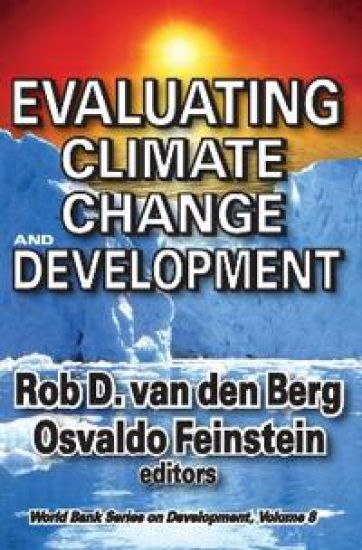
Climate change has become one of the most important global issues of our time, with far-reaching natural, socio-economic, and political effects. To address climate change and development issues from the perspective of evaluation, an international conference was held in Alexandria, Egypt. This book distills the essence of that timely conference, building on the experiences of more than 400 reports and studies presented.Developing countries may be particularly vulnerable to the expected onslaught of higher temperatures, rising sea levels, changing waterfall patterns, and increasing natural disasters. All societies will have to reduce their vulnerability to these changes, and this book describes how vulnerabilities may be addressed in a systematic manner so that governments and local communities may better understand what is happening. Different approaches are also discussed, including the use of human security as a criterion for evaluation as well as ways to deal with risk and uncertainty. Evaluating Climate Change and Development presents a rich variety of methods to assess adaptation through monitoring and evaluation.The volume deals with climate change, development, and evaluation; challenges and lessons learned from evaluations; mitigation of climate change; adaptation to climate change; vulnerability, risks and climate change; and presents a concluding chapter on the road ahead. Collectively the authors offer a set of approaches and techniques for the monitoring and evaluation of climate change.
Evaluating Climate Change and Development

Evaluating Climate Change and Development

Osvaldo N. Feinstein

AldineTransaction
2009
sidottu
Climate change has become one of the most important global issues of our time, with far-reaching natural, socio-economic, and political effects. To address climate change and development issues from the perspective of evaluation, an international conference was held in Alexandria, Egypt. This book distills the essence of that timely conference, building on the experiences of more than 400 reports and studies presented.Developing countries may be particularly vulnerable to the expected onslaught of higher temperatures, rising sea levels, changing waterfall patterns, and increasing natural disasters. All societies will have to reduce their vulnerability to these changes, and this book describes how vulnerabilities may be addressed in a systematic manner so that governments and local communities may better understand what is happening. Different approaches are also discussed, including the use of human security as a criterion for evaluation as well as ways to deal with risk and uncertainty. Evaluating Climate Change and Development presents a rich variety of methods to assess adaptation through monitoring and evaluation.The volume deals with climate change, development, and evaluation; challenges and lessons learned from evaluations; mitigation of climate change; adaptation to climate change; vulnerability, risks and climate change; and presents a concluding chapter on the road ahead. Collectively the authors offer a set of approaches and techniques for the monitoring and evaluation of climate change.
Evaluation and Development

Evaluation and Development

Osvaldo N. Feinstein

Transaction Publishers
2004
nidottu
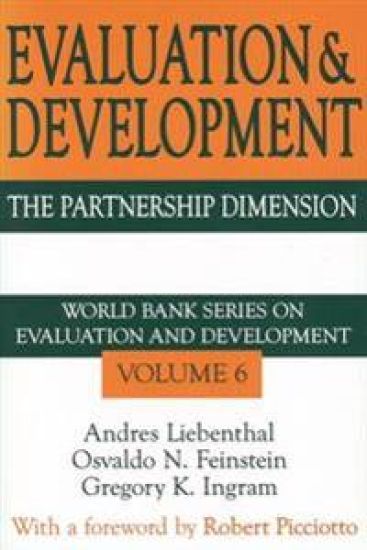
Partnership is of growing importance in development work. Partnerships among state, private business, and civil society organizations are increasingly used to deliver the goods and services required for balanced growth and poverty reduction. Aid activities have shifted from a project focus to a more strategic and holistic focus on programs, sectors, and policies. With this new orientation, partnerships are often essential to deal with the added complexity and the larger number of agencies, groups, and stakeholders involved.The Partnership Dimension takes on the issues in a series of chapters divided into two general parts: Part 1, "Foundations of Partnership and Their Evaluation," covers the types of development partnership and critical issues involved, and Part 2, "Partnerships in Practice," then illustrates the aspects and lessons of partnership experience through a series of case studies. Many of the studies focus on the benefits of partnerships between institutions of government and civil society. Benefits include effective knowledge transfer, greater cross-national cooperation, the creation of new networks and capacity, and penetration of new markets. Private firms use partnerships with competitors to learn or reduce risk.There is much to learn about when, where, and how best to use partnerships, and, in particular, partnerships that involve less traditional combinations of actors, such as global partnerships for public policy, country-focused aid partnerships, private sector partnerships for knowledge creation, and partnerships for community development involving business, nongovernmental organizations, and government.Relatively little is known about the costs and benefits, and the risks and rewards, of different types of partnerships, or about how best to conduct partnerships for different purposes. This is why the current volume in the World Bank series is relevant for both development practitioners and policy analysts.
Evaluation and Development

Evaluation and Development

Osvaldo N. Feinstein

Transaction Publishers
2004
sidottu
Partnership is of growing importance in development work. Partnerships among state, private business, and civil society organizations are increasingly used to deliver the goods and services required for balanced growth and poverty reduction. Aid activities have shifted from a project focus to a more strategic and holistic focus on programs, sectors, and policies. With this new orientation, partnerships are often essential to deal with the added complexity and the larger number of agencies, groups, and stakeholders involved.The Partnership Dimension takes on the issues in a series of chapters divided into two general parts: Part 1, "Foundations of Partnership and Their Evaluation," covers the types of development partnership and critical issues involved, and Part 2, "Partnerships in Practice," then illustrates the aspects and lessons of partnership experience through a series of case studies. Many of the studies focus on the benefits of partnerships between institutions of government and civil society. Benefits include effective knowledge transfer, greater cross-national cooperation, the creation of new networks and capacity, and penetration of new markets. Private firms use partnerships with competitors to learn or reduce risk.There is much to learn about when, where, and how best to use partnerships, and, in particular, partnerships that involve less traditional combinations of actors, such as global partnerships for public policy, country-focused aid partnerships, private sector partnerships for knowledge creation, and partnerships for community development involving business, nongovernmental organizations, and government.Relatively little is known about the costs and benefits, and the risks and rewards, of different types of partnerships, or about how best to conduct partnerships for different purposes. This is why the current volume in the World Bank series is relevant for both development practitioners and policy analysts.
Evaluation and Poverty Reduction

Evaluation and Poverty Reduction

Osvaldo N. Feinstein

Transaction Publishers
2001
sidottu
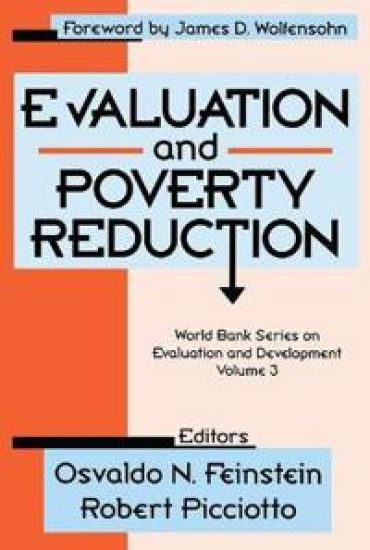
In his foreword, the president of the World Bank, James D. Wolfensohn, states plainly and precisely the rationale for this volume. "Evaluation is a central aspect of any poverty reduction endeavor. Evaluation implies that we have adopted a methodology that allows us to look in an effective way at the results of what we are doing so that we can, in turn, adapt our future actions toward the effective achievement of our goals. Evaluation adds value if we can learn something useful from it. It is not just a scorecard. It is something that helps us change our behavior or influence the behavior of others."This high powered collection of papers illustrates this statement. The network of world class scholars and development practitioners covers the gamut from methodological issues to policy concerns with respect to participatory evaluation, poverty reducing growth, macro and micro levels of intervention, health, nutrition and population programs, social inclusion and the changing role of the civil society. The participants include major figures, including a Nobel Laureate as well as cutting edge policy makers. Poverty reduction is examined in innovative ways-utilizing state of the art techniques of the social and economic sciences.The editors and contributors emphasize "what works" in poverty reduction programs. They point to making interventions context specific with a holistic vision of the problem. Contributors emphasize social funds and safety nets, social services, crisis prevention, informal social security and insurance systems, anti-corruption programs, mobilization of the poor, and ultimately, the creation, where none existed in the past, of a workable civil society. In short, this volume lies at the intersection of development economics and political economy. It seeks to promote development effectiveness through social learning and problem solving.The volume is unabashedly focussed on pro-poor growth. It has its roots in a conference sponsored by the Operations Evaluation Department, an independent unit within the World Bank. The goals of evaluation are to learn from experience, to provide an objective basis for assessing the results of the Bank's work, and to provide accountability in the achievement of its objectives.Osvaldo N. Feinstein is a manager, and Robert Picciotto, director general of the Operations Evaluation Department. The World Bank is located in Washington, D.C. with offices throughout the developing world.
Evaluation and Poverty Reduction

Evaluation and Poverty Reduction

Osvaldo N. Feinstein

Transaction Publishers
2001
nidottu
In his foreword, the president of the World Bank, James D. Wolfensohn, states plainly and precisely the rationale for this volume. "Evaluation is a central aspect of any poverty reduction endeavor. Evaluation implies that we have adopted a methodology that allows us to look in an effective way at the results of what we are doing so that we can, in turn, adapt our future actions toward the effective achievement of our goals. Evaluation adds value if we can learn something useful from it. It is not just a scorecard. It is something that helps us change our behavior or influence the behavior of others."This high powered collection of papers illustrates this statement. The network of world class scholars and development practitioners covers the gamut from methodological issues to policy concerns with respect to participatory evaluation, poverty reducing growth, macro and micro levels of intervention, health, nutrition and population programs, social inclusion and the changing role of the civil society. The participants include major figures, including a Nobel Laureate as well as cutting edge policy makers. Poverty reduction is examined in innovative ways-utilizing state of the art techniques of the social and economic sciences.The editors and contributors emphasize "what works" in poverty reduction programs. They point to making interventions context specific with a holistic vision of the problem. Contributors emphasize social funds and safety nets, social services, crisis prevention, informal social security and insurance systems, anti-corruption programs, mobilization of the poor, and ultimately, the creation, where none existed in the past, of a workable civil society. In short, this volume lies at the intersection of development economics and political economy. It seeks to promote development effectiveness through social learning and problem solving.The volume is unabashedly focussed on pro-poor growth. It has its roots in a conference sponsored by the Operations Evaluation Department, an independent unit within the World Bank. The goals of evaluation are to learn from experience, to provide an objective basis for assessing the results of the Bank's work, and to provide accountability in the achievement of its objectives.Osvaldo N. Feinstein is a manager, and Robert Picciotto, director general of the Operations Evaluation Department. The World Bank is located in Washington, D.C. with offices throughout the developing world.