Kirjojen hintavertailu. Mukana 12 595 353 kirjaa ja 12 kauppaa.

Kirjailija

Ottavio Quirico

Kirjat ja teokset yhdessä paikassa: 7 kirjaa, julkaisuja vuosilta 2019-2026, suosituimpien joukossa Implementing International Disability Law in the European Union. Vertaile teosten hintoja ja tarkista saatavuus suomalaisista kirjakaupoista.

7 kirjaa

Kirjojen julkaisuhaarukka 2019-2026.

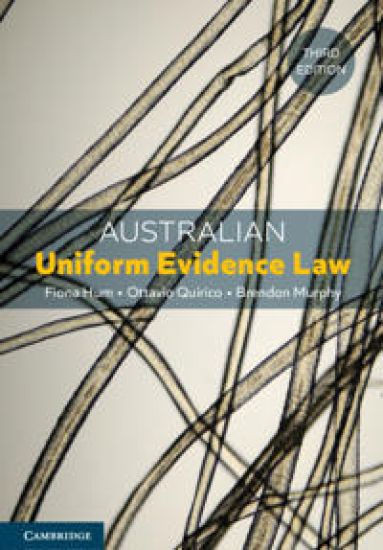
Australian Uniform Evidence Law

Australian Uniform Evidence Law

Fiona Hum; Ottavio Quirico; Brendon Murphy

Cambridge University Press
2026
pokkari
Australian Uniform Evidence Law is an essential textbook for students and emerging practitioners. Providing a practical and clear introduction to this complex subject, the text covers the Evidence Act 1995 (Cth) and its operation across uniform Evidence Act jurisdictions. The textbook highlights the legislative extracts for each uniform evidence jurisdiction and discusses cases that inform the application of these provisions. The third edition includes updated cases and changes to the law, guiding students through the application of the Act and providing opportunities to apply new knowledge of evidence law in its ever-changing context. Chapters are written in an accessible style, featuring a summary of key points, a list of key terms and definitions, and further readings. Practice questions with guided solutions ensure students effectively apply their learnt knowledge to real-world examples. The final chapter, 'Putting it all together', comprises complex practice problems that test students' understanding of the concepts and rules covered.
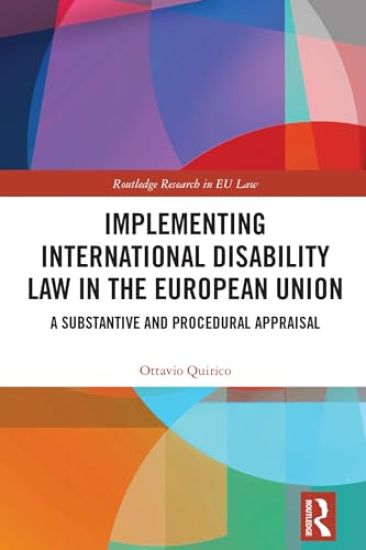
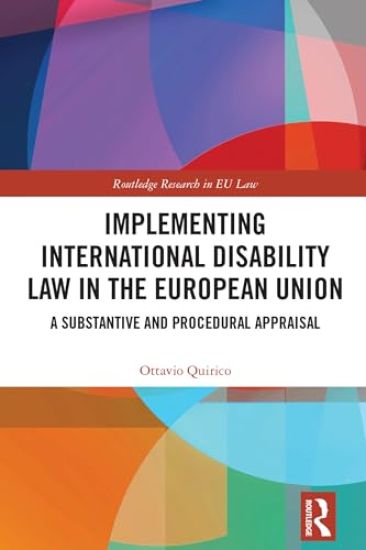
Implementing International Disability Law in the European Union
This book investigates the implementation of disability rights and duties in the European Union, aiming to understand its functioning and explore ways forward through a critical analysis of the Convention on the Rights of Persons with Disabilities (CRPD) within the context of international regulation. Along the lines of the integration of fundamental rights within the common market, the EU has indeed progressively adopted meaningful regulation to advance disability rights, which are now essentially shaped by the CRPD. The research considers the interaction between law and policy at the international, EU and Member States’ level, focusing on three essential elements, including the sources of disability law, institutional mechanisms and substantive regulation. Grounded in the distinction between primary rules on law-making and secondary norms on enforcement, the analysis unfolds against the background of the ‘twin’ transitions on sustainability and digitalisation and encompasses the Council of Europe system, particularly in the light of the foreseeable accession of the EU to the European Convention on Human Rights. Arguably, following the progressive development it has facilitated in other regulatory areas, the Court of Justice of the European Union can provide a decisive contribution to advancing inclusiveness for people with disabilities in the Union. The book is a useful resource for practitioners, policymakers, academics, students, researchers and anyone interested in EU and international disability law and politics.
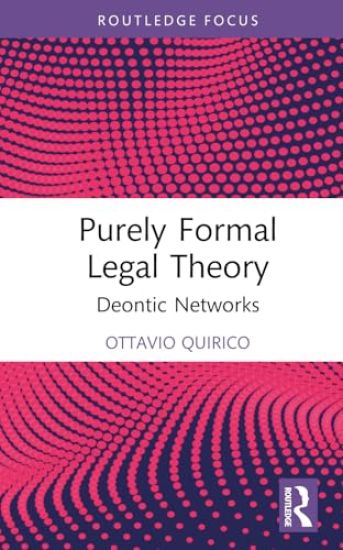
Purely Formal Legal Theory

Purely Formal Legal Theory

Ottavio Quirico

TAYLOR FRANCIS LTD
2025
sidottu
This book elaborates on deontic logic and network theory to present a reductionist theory of the law, disclosing a simple understanding of legal norms based on minimum necessary and sufficient notions. The analysis explores the concept of a ‘norm’ as a claim-obligation relation that regulates conduct, that is, action and inaction, among subjects, in space and time. Based on these five minimum notions, the study illustrates legal systems as networks of substantive right-duty relations that are procedurally organised according to time. The research relies on basic Kripke-style semantics as social matrixes to explain fundamental normative concepts and further on network science, social network theory and graph-theoretic notation, based on ties and nodes, to elaborate a formal representation of minimum necessary notions and of legal systems as deontic networks. The book will be of interest to academics, researchers and practitioners working in the areas of Legal Philosophy, Legal Theory and International Law.
Implementing International Disability Law in the European Union
This book investigates the implementation of disability rights and duties in the European Union, aiming to understand its functioning and explore ways forward through a critical analysis of the Convention on the Rights of Persons with Disabilities (CRPD) within the context of international regulation. Along the lines of the integration of fundamental rights within the common market, the EU has indeed progressively adopted meaningful regulation to advance disability rights, which are now essentially shaped by the CRPD. The research considers the interaction between law and policy at the international, EU and Member States’ level, focusing on three essential elements, including the sources of disability law, institutional mechanisms and substantive regulation. Grounded in the distinction between primary rules on law-making and secondary norms on enforcement, the analysis unfolds against the background of the ‘twin’ transitions on sustainability and digitalisation and encompasses the Council of Europe system, particularly in the light of the foreseeable accession of the EU to the European Convention on Human Rights. Arguably, following the progressive development it has facilitated in other regulatory areas, the Court of Justice of the European Union can provide a decisive contribution to advancing inclusiveness for people with disabilities in the Union.The book is a useful resource for practitioners, policymakers, academics, students, researchers and anyone interested in EU and international disability law and politics.
Australian Uniform Evidence Law

Australian Uniform Evidence Law

Fiona Hum; Gregor Urbas; Ottavio Quirico

Cambridge University Press
2022
pokkari
Now in its second edition, Australian Uniform Evidence Law provides a clear, accessible introduction to the law of evidence. Following the structure of the Evidence Act 1995 (Cth), the text introduces students to basic principles, then covers more complex elements of evidence law. Cases and excerpts from legislation have been selected to guide students through the application of the Act. This edition has been updated to include significant recent case examples and decisions. Each chapter includes a summary of key points, definitions and practice questions to encourage students to apply their knowledge to realistic scenarios. The final chapter comprises longer-form, complex problems designed to test students' understanding of the concepts and rules covered in the Act as a whole. Guided solutions to each question are provided so students can check their understanding. Providing clear explanations and examples, Australian Uniform Evidence Law is an essential resource for all students of evidence law.
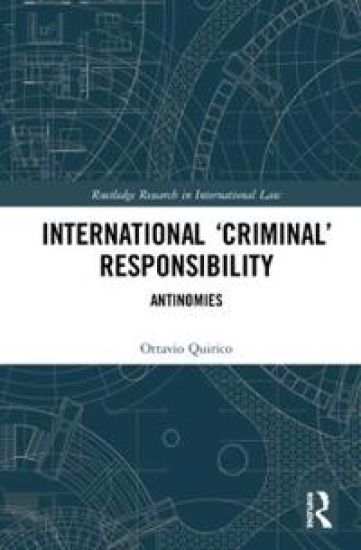
International ‘Criminal’ Responsibility

International ‘Criminal’ Responsibility

Ottavio Quirico

TAYLOR FRANCIS LTD
2021
nidottu
In the course of the 20th and 21st centuries, major offences committed by individuals have been subject to progressive systematisation in the framework of international criminal law. Proposals developed within the context of the League of Nations coordinated individual liability and State responsibility. By contrast, international law as codified after World War II in the framework of the United Nations embodies a neat divide between individual criminal liability and State aggravated responsibility. However, conduct of State organs and agents generates dual liability. Through a critical analysis of key international rules, the book assesses whether the divisive approach to individual and State responsibility is normatively consistent. Contemporary situations, such as the humanitarian crises in Syria and Libya, 9/11 and the Iraq wars demonstrate that the matter still gives rise to controversy: a set of systemic problems emerge. The research focuses on the substantive elements of major offences, notably agression, genocide, core war crimes, core crimes against humanity and terrorism, as well as relevant procedural implications.The book is a useful resource for practitioners, policymakers, academics, students, researchers and anyone interested in international law and politics.
International ‘Criminal’ Responsibility
In the course of the 20th and 21st centuries, major offences committed by individuals have been subject to progressive systematisation in the framework of international criminal law. Proposals developed within the context of the League of Nations coordinated individual liability and State responsibility. By contrast, international law as codified after World War II in the framework of the United Nations embodies a neat divide between individual criminal liability and State aggravated responsibility. However, conduct of State organs and agents generates dual liability. Through a critical analysis of key international rules, the book assesses whether the divisive approach to individual and State responsibility is normatively consistent. Contemporary situations, such as the humanitarian crises in Syria and Libya, 9/11 and the Iraq wars demonstrate that the matter still gives rise to controversy: a set of systemic problems emerge. The research focuses on the substantive elements of major offences, notably agression, genocide, core war crimes, core crimes against humanity and terrorism, as well as relevant procedural implications.The book is a useful resource for practitioners, policymakers, academics, students, researchers and anyone interested in international law and politics.