Kirjojen hintavertailu. Mukana 12 390 323 kirjaa ja 12 kauppaa.

Kirjailija

Ovid

Kirjat ja teokset yhdessä paikassa: 335 kirjaa, julkaisuja vuosilta 1914-2027, suosituimpien joukossa The Metamorphoses of Ovid. Vertaile teosten hintoja ja tarkista saatavuus suomalaisista kirjakaupoista.

Mukana myös kirjoitusasut: Ovid .

335 kirjaa

Kirjojen julkaisuhaarukka 1914-2027.

Ovid: Metamorphoses Book XIV

Ovid: Metamorphoses Book XIV

Ovid

Cambridge University Press
2009
pokkari
In Book XIV of the Metamorphoses Ovid takes his epic for the first time into Italy and continues from book XIII his close intertextual engagement with Virgil's Aeneid. His tendentious treatment of his model subordinates Virgil's epic plot to fantastic tales of metamorphosis, including the erotic Italian tales of Circe Glaucus, and Scylla, and Picus, and Canens. Other Roman myths include Pomona and Vertumnus, as well as events from Romulus' reign. The deifications of Aeneas and Romulus anticipate the poem's closing episodes of imperial apotheosis. This commentary provides guidance to advanced undergraduate and graduate students for understanding Ovid's language, style, artistry, and allusive techniques. The introduction discusses the major structures, themes, and stylistic features of book XIV, its place within the poem as a whole, and Ovid's interpretive imitation of Virgil's Aeneid.
The Metamorphoses of Ovid

The Metamorphoses of Ovid

Ovid

Mariner Books
1995
nidottu
Through National Book Award-winning translator Allen Mandelbaum's poetic artistry, this gloriously entertaining achievement of literature -- classical myths filtered through the worldly and far from reverent sensibility of the Roman poet Ovid -- is revealed anew.Savage and sophisticated, mischievious and majestic, witty and wicked, The Metamorphoses weaves together every major mythological story to display a dazzling array of miraculous changes, from the time chaos is transformed into order at the moment of creation, to the time when the soul of Julius Caeser is turned into a star and set in the heavens. In its earthiness, its psychological acuity, this classic work continues to speak over the centuries to our time. "Reading Mandelbaum's extraordinary translation, one imagines Ovid in his darkest moods with the heart of Baudelaire...Brilliant."--Booklist
Ovid's Metamorphoses, in Fifteen Books, With the Arguments and Notes of John Minellius Translated Into English To Which is Marginally Added, a Prose Version, For the use of Schools By Nathan Bailey, The Seventh Ed
The 18th century was a wealth of knowledge, exploration and rapidly growing technology and expanding record-keeping made possible by advances in the printing press. In its determination to preserve the century of revolution, Gale initiated a revolution of its own: digitization of epic proportions to preserve these invaluable works in the largest archive of its kind. Now for the first time these high-quality digital copies of original 18th century manuscripts are available in print, making them highly accessible to libraries, undergraduate students, and independent scholars.Western literary study flows out of eighteenth-century works by Alexander Pope, Daniel Defoe, Henry Fielding, Frances Burney, Denis Diderot, Johann Gottfried Herder, Johann Wolfgang von Goethe, and others. Experience the birth of the modern novel, or compare the development of language using dictionaries and grammar discourses. ++++The below data was compiled from various identification fields in the bibliographic record of this title. This data is provided as an additional tool in helping to insure edition identification: ++++Harvard University LibrariesN022090Latin and English texts.London: printed for J. Rivington and Sons; T. Longman; B. Law J. Johnson; G. G. J. and J. Robinson; and 8 others in London], 1787. viii,551, 5]p.; 8
P. Ovidii Nasonis Metamorphoseon Libri X. Or, Ten Select Books of Ovid's Metamorphoses; With an English Translation, Compiled From the two Former Translations, by Davidson and Clarke
The 18th century was a wealth of knowledge, exploration and rapidly growing technology and expanding record-keeping made possible by advances in the printing press. In its determination to preserve the century of revolution, Gale initiated a revolution of its own: digitization of epic proportions to preserve these invaluable works in the largest archive of its kind. Now for the first time these high-quality digital copies of original 18th century manuscripts are available in print, making them highly accessible to libraries, undergraduate students, and independent scholars.Western literary study flows out of eighteenth-century works by Alexander Pope, Daniel Defoe, Henry Fielding, Frances Burney, Denis Diderot, Johann Gottfried Herder, Johann Wolfgang von Goethe, and others. Experience the birth of the modern novel, or compare the development of language using dictionaries and grammar discourses. ++++The below data was compiled from various identification fields in the bibliographic record of this title. This data is provided as an additional tool in helping to insure edition identification: ++++Library of CongressW027557Philadelphia: Printed by William Spotswood, M.DCC.XC. 1790]. iv, 40], 328 p.; 12
Remedia A Moris or, The Remedy Of Love

Remedia A Moris or, The Remedy Of Love

Ovid

Createspace Independent Publishing Platform
2015
nidottu
Publius Ovidius Naso; 20 March 43 BC - AD 17/18), known as Ovid in the English-speaking world, was a Roman poet who lived during the reign of Augustus. He was a contemporary of Virgil and Horace. He is best known for the Metamorphoses, a 15-book continuous mythological narrative written in the meter of epic, and for collections of love poetry in elegiac couplets, especially the Amores ("Love Affairs") and Ars Amatoria ("The Art of Love"). His poetry was much imitated during Late Antiquity and the Middle Ages, and greatly influenced Western art and literature. The Metamorphoses remains one of the most important sources of classical mythology. Ovid is traditionally ranked alongside Virgil and Horace, his older contemporaries, as one of the three canonic poets of Latin literature. He was the first major Roman poet to begin his career during the reign of Augustus, and the Imperial scholar Quintilian considered him the last of the Latin love elegists. He enjoyed enormous popularity, but, in one of the mysteries of literary history, he was sent by Augustus into exile in a remote province on the Black Sea, where he remained until his death. Ovid himself attributes his exile to carmen et error, "a poem and a mistake", but his discretion in discussing the causes has resulted in much speculation among scholars. Ovid's prolific poetry includes the Heroides, a collection of verse epistles written as though by mythological heroines to the lovers who abandoned them; the Fasti, an incomplete six-book exploration of Roman religion with a calendar structure; and the Tristia and Epistulae ex Ponto, two collections of elegies in the form of complaining letters from his exile. His shorter works include the Remedia Amoris ("Cure for Love"), the curse-poem Ibis, and an advice poem on women's cosmetics. He wrote a lost tragedy, Medea, and mentions that some of his other works were adapted for staged performance.
Ovid: Epistulae ex Ponto Book I

Ovid: Epistulae ex Ponto Book I

Ovid

Cambridge University Press
2014
pokkari
When Ovid, already renowned for his love poetry, the Metamorphoses and other works, was exiled by Augustus to Tomis on the Black Sea in AD 8, he continued to write. After five books of Tristia, he composed a collection of verse letters, the Epistulae ex Ponto, in which he appeals to his friends and supporters in Rome, lamenting his lot and begging for their help in mitigating it. In these epistolary elegies his inventiveness flourishes no less than before and his imaginative self-fashioning is as ingenious and engaging as ever, although in a minor key. This commentary on Book I assists intermediate and advanced students in understanding Ovid's language and style, while guiding them in the appreciation of his poetic art. The introduction examines the literary background of the Epistulae ex Ponto, their relation to Ovid's earlier works, and their special interest and appeal to readers of Augustan poetry.
Ovid: Epistulae ex Ponto Book I

Ovid: Epistulae ex Ponto Book I

Ovid

Cambridge University Press
2014
sidottu
When Ovid, already renowned for his love poetry, the Metamorphoses and other works, was exiled by Augustus to Tomis on the Black Sea in AD 8, he continued to write. After five books of Tristia, he composed a collection of verse letters, the Epistulae ex Ponto, in which he appeals to his friends and supporters in Rome, lamenting his lot and begging for their help in mitigating it. In these epistolary elegies his inventiveness flourishes no less than before and his imaginative self-fashioning is as ingenious and engaging as ever, although in a minor key. This commentary on Book I assists intermediate and advanced students in understanding Ovid's language and style, while guiding them in the appreciation of his poetic art. The introduction examines the literary background of the Epistulae ex Ponto, their relation to Ovid's earlier works, and their special interest and appeal to readers of Augustan poetry.
Love Poems, Letters, and Remedies of Ovid

Love Poems, Letters, and Remedies of Ovid

Ovid

Harvard University Press
2011
sidottu
Widely praised for his recent translations of Boethius and Ariosto, David R. Slavitt returns to Ovid, once again bringing to the contemporary ear the spirited, idiomatic, audacious charms of this master poet. The love described here is the anguished, ruinous kind, for which Ovid was among the first to find expression. In the Amores, he testifies to the male experience, and in the companion Heroides—through a series of dramatic monologues addressed to absent lovers—he imagines how love goes for women. “You think she is ardent with you? So was she ardent with him,” cries Oenone to Paris. Sappho, revisiting the forest where she lay with Phaon, sighs, “The place / without your presence is just another place. / You were what made it magic.” The Remedia Amoris sees love as a sickness, and offers curative advice: “The beginning is your best chance to resist”; “Try to avoid onions, / imported or domestic. And arugula is bad. / Whatever may incline your body to Venus / keep away from.” The voices of men and women produce a volley of extravagant laments over love’s inconstancy and confusions, as though elegance and vigor of expression might compensate for heartache.Though these love poems come to us across millennia, Slavitt’s translations, introduced by Pulitzer Prize winner Michael Dirda, ensure that their sentiments have not faded with the passage of time. They delight us with their wit, even as we weep a little in recognition.
Ovid: Metamorphoses Book XIV

Ovid: Metamorphoses Book XIV

Ovid

Cambridge University Press
2009
sidottu
In Book XIV of the Metamorphoses Ovid takes his epic for the first time into Italy and continues from book XIII his close intertextual engagement with Virgil's Aeneid. His tendentious treatment of his model subordinates Virgil's epic plot to fantastic tales of metamorphosis, including the erotic Italian tales of Circe Glaucus, and Scylla, and Picus, and Canens. Other Roman myths include Pomona and Vertumnus, as well as events from Romulus' reign. The deifications of Aeneas and Romulus anticipate the poem's closing episodes of imperial apotheosis. This commentary provides guidance to advanced undergraduate and graduate students for understanding Ovid's language, style, artistry, and allusive techniques. The introduction discusses the major structures, themes, and stylistic features of book XIV, its place within the poem as a whole, and Ovid's interpretive imitation of Virgil's Aeneid.
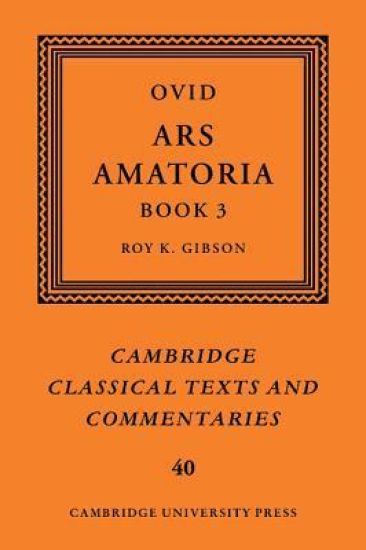
Ovid: Ars Amatoria, Book III

Ovid: Ars Amatoria, Book III

Ovid

Cambridge University Press
2009
pokkari
This is a full-scale commentary devoted to the third book of Ovid's Ars Amatoria. It includes an Introduction, a revision of E. J. Kenney's Oxford text of the book, and detailed line-by-line and section-by-section commentary on the language and ideas of the text. Combining traditional philological scholarship with some of the concerns of more recent critics, both Introduction and commentary place particular emphasis on: the language of the text; the relationship of the book to the didactic, 'erotodidactic' and elegiac traditions; Ovid's usurpation of the lena's traditional role of erotic instructor of women; the poet's handling of the controversial subjects of cosmetics and personal adornment; and the literary and political significances of Ovid's unexpected emphasis in the text of Ars III on restraint and 'moderation'. The book will be of interest to all postgraduates and scholars working on Augustan poetry.
Ovid: Ars Amatoria, Book III

Ovid: Ars Amatoria, Book III

Ovid

Cambridge University Press
2003
sidottu
This is a full-scale commentary devoted to the third book of Ovid's Ars Amatoria. It includes an Introduction, a revision of E. J. Kenney's Oxford text of the book, and detailed line-by-line and section-by-section commentary on the language and ideas of the text. Combining traditional philological scholarship with some of the concerns of more recent critics, both Introduction and commentary place particular emphasis on: the language of the text; the relationship of the book to the didactic, 'erotodidactic' and elegiac traditions; Ovid's usurpation of the lena's traditional role of erotic instructor of women; the poet's handling of the controversial subjects of cosmetics and personal adornment; and the literary and political significances of Ovid's unexpected emphasis in the text of Ars III on restraint and 'moderation'. The book will be of interest to all postgraduates and scholars working on Augustan poetry.
Ovid: Metamorphoses Book XIII

Ovid: Metamorphoses Book XIII

Ovid

Cambridge University Press
2000
pokkari
Book XIII of Ovid’s Metamorphoses presents a wide variety of brilliant episodes, from the rhetorically charged contest between Ulysses and Ajax over the arms of Achilles, to the tragic tale of Hecuba and her gruesome revenge, to the amusing story of Polyphemus’ unrequited love for Galatea and its bloody conclusion. This edition discusses in detail Ovid’s treatment of his sources and sets out the ways in which he has adapted earlier literature as material for his novel work. Guidance is offered on points of language and style, and the Introduction treats in general terms the themes of metamorphosis and the structure of the poem as a whole.