Kirjojen hintavertailu. Mukana 12 226 330 kirjaa ja 12 kauppaa.

Kirjailija

Ovidiu Calin

Kirjat ja teokset yhdessä paikassa: 19 kirjaa, julkaisuja vuosilta 2004-2026, suosituimpien joukossa Deep Learning Methods Of Mathematical Physics - Volume I: Direct And Inverse Problems. Vertaile teosten hintoja ja tarkista saatavuus suomalaisista kirjakaupoista.

19 kirjaa

Kirjojen julkaisuhaarukka 2004-2026.

Deep Learning Methods Of Mathematical Physics - Volume I: Direct And Inverse Problems
This book explores how Artificial Intelligence and Deep Learning are transforming Mathematical Physics, offering modern data-driven tools where traditional analytical and numerical methods fall short. As physical systems grow more complex or chaotic, deep learning provides efficient surrogates and physics-informed models capable of capturing dynamics and uncovering governing laws directly from data.This book introduces Neural ODEs, Physics-Informed Neural Networks (PINNs), and Hamiltonian and Lagrangian Neural Networks, showing how they enhance classical mechanics and PDE solvers for both forward and inverse problems. With Keras code examples, Google Colab notebooks, and practical exercises, this book serves researchers and students in physics, mathematics, and engineering seeking a concise, hands-on guide to applying deep learning in physical systems.
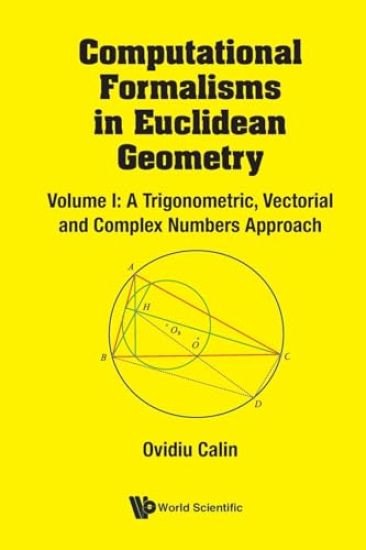
Computational Formalisms In Euclidean Geometry, Vol. I: A Trigonometric, Vectorial And Complex Numbers Approach
This book explores three computational formalisms for solving geometric problems. Part I introduces a trigonometric-based formalism, enabling calculations of distances, angles, and areas using basic trigonometry. Part II focuses on complex numbers, representing points in the plane to manipulate geometric properties like collinearity and concurrency, making it particularly useful for planar problems and rotations. Part III covers vector formalism, applying linear algebra to both plane and solid geometry. Vectors are effective for solving problems related to perpendicularity, collinearity, and the calculation of distances, areas, and volumes.Each formalism has its strengths and limitations, with complex numbers excelling in the plane and vectors being more versatile in three-dimensional space. This book equips readers to choose the best approach for various geometric challenges. This book, designed for math majors, especially future educators, is also valuable for gifted high school students and educators seeking diverse proofs and teaching inspiration.
Computational Formalisms In Euclidean Geometry, Vol. I: A Trigonometric, Vectorial And Complex Numbers Approach
This book explores three computational formalisms for solving geometric problems. Part I introduces a trigonometric-based formalism, enabling calculations of distances, angles, and areas using basic trigonometry. Part II focuses on complex numbers, representing points in the plane to manipulate geometric properties like collinearity and concurrency, making it particularly useful for planar problems and rotations. Part III covers vector formalism, applying linear algebra to both plane and solid geometry. Vectors are effective for solving problems related to perpendicularity, collinearity, and the calculation of distances, areas, and volumes.Each formalism has its strengths and limitations, with complex numbers excelling in the plane and vectors being more versatile in three-dimensional space. This book equips readers to choose the best approach for various geometric challenges. This book, designed for math majors, especially future educators, is also valuable for gifted high school students and educators seeking diverse proofs and teaching inspiration.
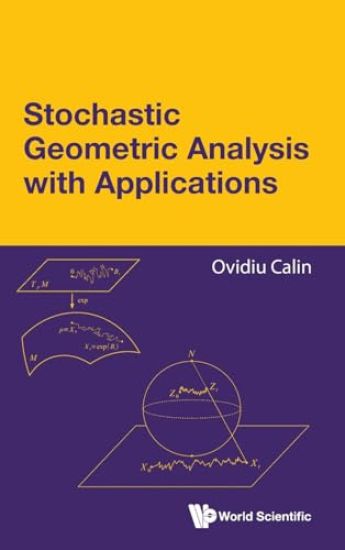
Stochastic Geometric Analysis With Applications

Stochastic Geometric Analysis With Applications

Ovidiu Calin

WORLD SCIENTIFIC PUBLISHING CO PTE LTD
2023
sidottu
This book is a comprehensive exploration of the interplay between Stochastic Analysis, Geometry, and Partial Differential Equations (PDEs). It aims to investigate the influence of geometry on diffusions induced by underlying structures, such as Riemannian or sub-Riemannian geometries, and examine the implications for solving problems in PDEs, mathematical finance, and related fields. The book aims to unify the relationships between PDEs, nonholonomic geometry, and stochastic processes, focusing on a specific condition shared by these areas known as the bracket-generating condition or Hörmander's condition. The main objectives of the book are:The intended audience for this book includes researchers and practitioners in mathematics, physics, and engineering, who are interested in stochastic techniques applied to geometry and PDEs, as well as their applications in mathematical finance and electrical circuits.
Informal Introduction To Stochastic Calculus With Applications, An

Informal Introduction To Stochastic Calculus With Applications, An

Ovidiu Calin

WORLD SCIENTIFIC PUBLISHING CO PTE LTD
2021
nidottu
Most branches of science involving random fluctuations can be approached by Stochastic Calculus. These include, but are not limited to, signal processing, noise filtering, stochastic control, optimal stopping, electrical circuits, financial markets, molecular chemistry, population dynamics, etc. All these applications assume a strong mathematical background, which in general takes a long time to develop. Stochastic Calculus is not an easy to grasp theory, and in general, requires acquaintance with the probability, analysis and measure theory.The goal of this book is to present Stochastic Calculus at an introductory level and not at its maximum mathematical detail. The author's goal was to capture as much as possible the spirit of elementary deterministic Calculus, at which students have been already exposed. This assumes a presentation that mimics similar properties of deterministic Calculus, which facilitates understanding of more complicated topics of Stochastic Calculus.The second edition contains several new features that improved the first edition both qualitatively and quantitatively. First, two more chapters have been added, Chapter 12 and Chapter 13, dealing with applications of stochastic processes in Electrochemistry and global optimization methods.This edition contains also a final chapter material containing fully solved review problems and provides solutions, or at least valuable hints, to all proposed problems. The present edition contains a total of about 250 exercises.This edition has also improved presentation from the first edition in several chapters, including new material.
Informal Introduction To Stochastic Calculus With Applications, An

Informal Introduction To Stochastic Calculus With Applications, An

Ovidiu Calin

WORLD SCIENTIFIC PUBLISHING CO PTE LTD
2021
sidottu
Most branches of science involving random fluctuations can be approached by Stochastic Calculus. These include, but are not limited to, signal processing, noise filtering, stochastic control, optimal stopping, electrical circuits, financial markets, molecular chemistry, population dynamics, etc. All these applications assume a strong mathematical background, which in general takes a long time to develop. Stochastic Calculus is not an easy to grasp theory, and in general, requires acquaintance with the probability, analysis and measure theory.The goal of this book is to present Stochastic Calculus at an introductory level and not at its maximum mathematical detail. The author's goal was to capture as much as possible the spirit of elementary deterministic Calculus, at which students have been already exposed. This assumes a presentation that mimics similar properties of deterministic Calculus, which facilitates understanding of more complicated topics of Stochastic Calculus.The second edition contains several new features that improved the first edition both qualitatively and quantitatively. First, two more chapters have been added, Chapter 12 and Chapter 13, dealing with applications of stochastic processes in Electrochemistry and global optimization methods.This edition contains also a final chapter material containing fully solved review problems and provides solutions, or at least valuable hints, to all proposed problems. The present edition contains a total of about 250 exercises.This edition has also improved presentation from the first edition in several chapters, including new material.
Deep Learning Architectures

Deep Learning Architectures

Ovidiu Calin

Springer Nature Switzerland AG
2021
nidottu
This book describes how neural networks operate from the mathematical point of view. As a result, neural networks can be interpreted both as function universal approximators and information processors. The book bridges the gap between ideas and concepts of neural networks, which are used nowadays at an intuitive level, and the precise modern mathematical language, presenting the best practices of the former and enjoying the robustness and elegance of the latter.This book can be used in a graduate course in deep learning, with the first few parts being accessible to senior undergraduates. In addition, the book will be of wide interest to machine learning researchers who are interested in a theoretical understanding of the subject.
Deep Learning Architectures

Deep Learning Architectures

Ovidiu Calin

Springer Nature Switzerland AG
2020
sidottu
This book describes how neural networks operate from the mathematical point of view. As a result, neural networks can be interpreted both as function universal approximators and information processors. The book bridges the gap between ideas and concepts of neural networks, which are used nowadays at an intuitive level, and the precise modern mathematical language, presenting the best practices of the former and enjoying the robustness and elegance of the latter.This book can be used in a graduate course in deep learning, with the first few parts being accessible to senior undergraduates. In addition, the book will be of wide interest to machine learning researchers who are interested in a theoretical understanding of the subject.
Geometric Modeling in Probability and Statistics

Geometric Modeling in Probability and Statistics

Ovidiu Calin; Constantin Udriste

Springer International Publishing AG
2017
nidottu
This book covers topics of Informational Geometry, a field which deals with the differential geometric study of the manifold probability density functions. This is a field that is increasingly attracting the interest of researchers from many different areas of science, including mathematics, statistics, geometry, computer science, signal processing, physics and neuroscience. It is the authors’ hope that the present book will be a valuable reference for researchers and graduate students in one of the aforementioned fields.This textbook is a unified presentation of differential geometry and probability theory, and constitutes a text for a course directed at graduate or advanced undergraduate students interested in applications of differential geometry in probability and statistics. The book contains over 100 proposed exercises meant to help students deepen their understanding, and it is accompanied by software that is able to provide numerical computations of several information geometric objects. The reader will understand a flourishing field of mathematics in which very few books have been written so far.
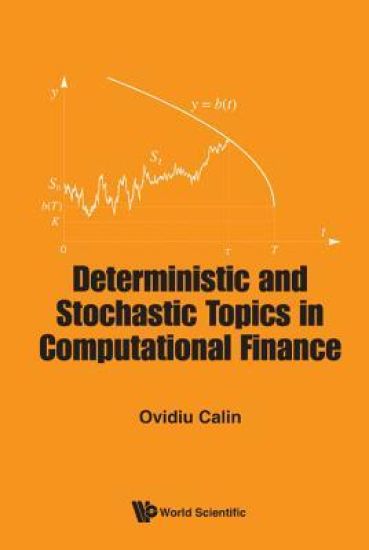
Deterministic And Stochastic Topics In Computational Finance
What distinguishes this book from other texts on mathematical finance is the use of both probabilistic and PDEs tools to price derivatives for both constant and stochastic volatility models, by which the reader has the advantage of computing explicitly a large number of prices for European, American and Asian derivatives.The book presents continuous time models for financial markets, starting from classical models such as Black-Scholes and evolving towards the most popular models today such as Heston and VAR.A key feature of the textbook is the large number of exercises, mostly solved, which are designed to help the reader to understand the material.The book is based on the author's lectures on topics on computational finance for senior and graduate students, delivered in USA (Princeton University and EMU), Taiwan and Kuwait. The prerequisites are an introductory course in stochastic calculus, as well as the usual calculus sequence.The book is addressed to undergraduate and graduate students in Masters of Finance programs as well as to those who wish to become more efficient in their practical applications.Topics covered:
Deterministic And Stochastic Topics In Computational Finance
What distinguishes this book from other texts on mathematical finance is the use of both probabilistic and PDEs tools to price derivatives for both constant and stochastic volatility models, by which the reader has the advantage of computing explicitly a large number of prices for European, American and Asian derivatives.The book presents continuous time models for financial markets, starting from classical models such as Black-Scholes and evolving towards the most popular models today such as Heston and VAR.A key feature of the textbook is the large number of exercises, mostly solved, which are designed to help the reader to understand the material.The book is based on the author's lectures on topics on computational finance for senior and graduate students, delivered in USA (Princeton University and EMU), Taiwan and Kuwait. The prerequisites are an introductory course in stochastic calculus, as well as the usual calculus sequence.The book is addressed to undergraduate and graduate students in Masters of Finance programs as well as to those who wish to become more efficient in their practical applications.Topics covered:
Informal Introduction To Stochastic Calculus With Applications, An

Informal Introduction To Stochastic Calculus With Applications, An

Ovidiu Calin

World Scientific Publishing Co Pte Ltd
2015
nidottu
The goal of this book is to present Stochastic Calculus at an introductory level and not at its maximum mathematical detail. The author aims to capture as much as possible the spirit of elementary deterministic Calculus, at which students have been already exposed. This assumes a presentation that mimics similar properties of deterministic Calculus, which facilitates understanding of more complicated topics of Stochastic Calculus.
Informal Introduction To Stochastic Calculus With Applications, An

Informal Introduction To Stochastic Calculus With Applications, An

Ovidiu Calin

World Scientific Publishing Co Pte Ltd
2015
sidottu
The goal of this book is to present Stochastic Calculus at an introductory level and not at its maximum mathematical detail. The author aims to capture as much as possible the spirit of elementary deterministic Calculus, at which students have been already exposed. This assumes a presentation that mimics similar properties of deterministic Calculus, which facilitates understanding of more complicated topics of Stochastic Calculus.
Geometric Modeling in Probability and Statistics

Geometric Modeling in Probability and Statistics

Ovidiu Calin; Constantin Udriste

Springer International Publishing AG
2014
sidottu
This book covers topics of Informational Geometry, a field which deals with the differential geometric study of the manifold probability density functions. This is a field that is increasingly attracting the interest of researchers from many different areas of science, including mathematics, statistics, geometry, computer science, signal processing, physics and neuroscience. It is the authors’ hope that the present book will be a valuable reference for researchers and graduate students in one of the aforementioned fields.This textbook is a unified presentation of differential geometry and probability theory, and constitutes a text for a course directed at graduate or advanced undergraduate students interested in applications of differential geometry in probability and statistics. The book contains over 100 proposed exercises meant to help students deepen their understanding, and it is accompanied by software that is able to provide numerical computations of several information geometric objects. The reader will understand a flourishing field of mathematics in which very few books have been written so far.
Heat Kernels for Elliptic and Sub-elliptic Operators

Heat Kernels for Elliptic and Sub-elliptic Operators

Ovidiu Calin; Der-Chen Chang; Kenro Furutani; Chisato Iwasaki

Birkhauser Boston Inc
2010
sidottu
With each methodology treated in its own chapter, this monograph is a thorough exploration of several theories that can be used to find explicit formulas for heat kernels for both elliptic and sub-elliptic operators. The authors show how to find heat kernels for classical operators by employing a number of different methods. Some of these methods come from stochastic processes, others from quantum physics, and yet others are purely mathematical. What is new about this work is the sheer diversity of methods that are used to compute the heat kernels. It is interesting that such apparently distinct branches of mathematics, including stochastic processes, differential geometry, special functions, quantum mechanics and PDEs, all have a common concept – the heat kernel. This unifying concept, that brings together so many domains of mathematics, deserves dedicated study. Heat Kernels for Elliptic and Sub-elliptic Operators is an ideal resource for graduate students, researchers, and practitioners in pure and applied mathematics as well as theoretical physicists interested in understanding different ways of approaching evolution operators.
Sub-Riemannian Geometry

Sub-Riemannian Geometry

Ovidiu Calin; Der-Chen Chang

Cambridge University Press
2009
sidottu
Sub-Riemannian manifolds are manifolds with the Heisenberg principle built in. This comprehensive text and reference begins by introducing the theory of sub-Riemannian manifolds using a variational approach in which all properties are obtained from minimum principles, a robust method that is novel in this context. The authors then present examples and applications, showing how Heisenberg manifolds (step 2 sub-Riemannian manifolds) might in the future play a role in quantum mechanics similar to the role played by the Riemannian manifolds in classical mechanics. Sub-Riemannian Geometry: General Theory and Examples is the perfect resource for graduate students and researchers in pure and applied mathematics, theoretical physics, control theory, and thermodynamics interested in the most recent developments in sub-Riemannian geometry.
Geometric Analysis on the Heisenberg Group and Its Generalizations

Geometric Analysis on the Heisenberg Group and Its Generalizations

Ovidiu Calin; Der-Chen Chang; Peter Greiner

Amer Mathematical Society
2007
sidottu
The theory of subRiemannian manifolds is closely related to Hamiltonian mechanics. In this book, the authors examine the properties and applications of subRiemannian manifolds that automatically satisfy the Heisenberg principle, which may be useful in quantum mechanics. In particular, the behavior of geodesics in this setting plays an important role in finding heat kernels and propagators for Schrodinger's equation. One of the novelties of this book is the introduction of techniques from complex Hamiltonian mechanics. Information for our distributors: Titles in this series are co-published with International Press, Cambridge, MA.
Geometric Mechanics on Riemannian Manifolds

Geometric Mechanics on Riemannian Manifolds

Ovidiu Calin; Der-Chen Chang

Birkhauser Boston Inc
2004
sidottu
Differential geometry techniques have very useful and important applications in partial differential equations and quantum mechanics. This work presents a purely geometric treatment of problems in physics involving quantum harmonic oscillators, quartic oscillators, minimal surfaces, and Schrödinger's, Einstein's and Newton's equations. Geometric Mechanics on Riemannian Manifolds is a fine text for a course or seminar directed at graduate and advanced undergraduate students interested in elliptic and hyperbolic differential equations, differential geometry, calculus of variations, quantum mechanics, and physics. The text is enriched with good examples and exercises at the end of every chapter. It is also an ideal resource for pure and applied mathematicians and theoretical physicists working in these areas.