Kirjojen hintavertailu. Mukana 12 595 353 kirjaa ja 12 kauppaa.

Kirjailija

Owen Gingerich

Kirjat ja teokset yhdessä paikassa: 8 kirjaa, julkaisuja vuosilta 1965-2017, suosituimpien joukossa Book Nobody Read. Vertaile teosten hintoja ja tarkista saatavuus suomalaisista kirjakaupoista.

8 kirjaa

Kirjojen julkaisuhaarukka 1965-2017.

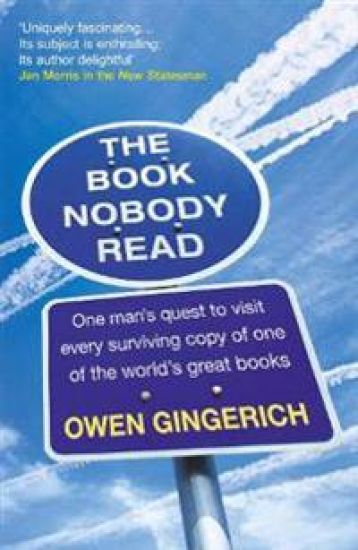
Book Nobody Read

Book Nobody Read

Owen Gingerich

Cornerstone
2017
pokkari
Part biography of a book and a man, part bibliographic and bibliophilic quest, Gingerich's The Book Nobody Read is an utterly captivating piece of writing, a testament to the power both of books and the love of books.
Copernicus

Copernicus

Owen Gingerich

Oxford University Press Inc
2016
nidottu
Nicolaus Copernicus (1473-1543) is a pivotal figure in the birth of modern science, the astronomer who "stopped the sun and set the earth in motion." Born in Poland, educated at Cracow and then in Italy, he served all of his adult life as a church administrator. His vision of a sun-centered universe, shocking to many and unbelievable to most, turned out to be the essential blueprint for a physical understanding of celestial motions, thereby triggering what is commonly called "the Copernican revolution." A first edition of his world-changing treatise, De Revolutionibus Orbium Coelestium, has most recently been auctioned for more than $2 million. In this book, leading historian of science Owen Gingerich sets Copernicus in the context of a rapidly changing world, where the recent invention of printing with moveable type not only made sources more readily available to him, but also fueled Martin's Luther's transformation of the religious landscape. In an era of geographical exploration and discovery, new ideas were replacing time-honored concepts about the extent of inhabited continents. Gingerich reveals Copernicus' heliocentric revolution as an aesthetic achievement not dictated by observational "proofs," but another new way of looking at the ancient cosmos. Deftly combining astronomy and history, this Very Short Introduction offers a fascinating portray of the man who launched the modern vision of the universe. Out of Gingerich's engaging biography emerges the image of a scientist, intellectual, patriot, and reformer, who lived in an era when political as well as religious beliefs were shifting.
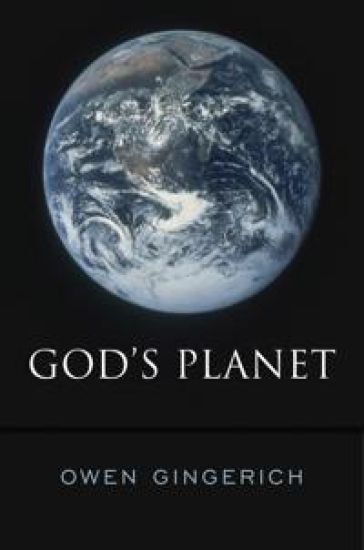
God’s Planet

God’s Planet

Owen Gingerich; Randy Isaac

Harvard University Press
2014
sidottu
With exoplanets being discovered daily, Earth is still the only planet we know of that is home to creatures who seek a coherent explanation for the structure, origins, and fate of the universe, and of humanity’s place within it. Today, science and religion are the two major cultural entities on our planet that share this goal of coherent understanding, though their interpretation of evidence differs dramatically. Many scientists look at the known universe and conclude we are here by chance. The renowned astronomer and historian of science Owen Gingerich looks at the same evidence—along with the fact that the universe is comprehensible to our minds—and sees it as proof for the planning and intentions of a Creator-God. He believes that the idea of a universe without God is an oxymoron, a self-contradiction. God’s Planet exposes the fallacy in thinking that science and religion can be kept apart.Gingerich frames his argument around three questions: Was Copernicus right, in dethroning Earth from its place at the center of the universe? Was Darwin right, in placing humans securely in an evolving animal kingdom? And was Hoyle right, in identifying physical constants in nature that seem singularly tuned to allow the existence of intelligent life on planet Earth? Using these episodes from the history of science, Gingerich demonstrates that cultural attitudes, including religious or antireligious beliefs, play a significant role in what passes as scientific understanding. The more rigorous science becomes over time, the more clearly God’s handiwork can be comprehended.
God’s Universe

God’s Universe

Owen Gingerich; Peter J. Gomes

The Belknap Press
2006
sidottu
The author argues that individuals can be both a creative scientist and a believer in divine design in a critical examination of how it is possible to contemplate a universe in which God plays an interactive role that is not excluded by science.
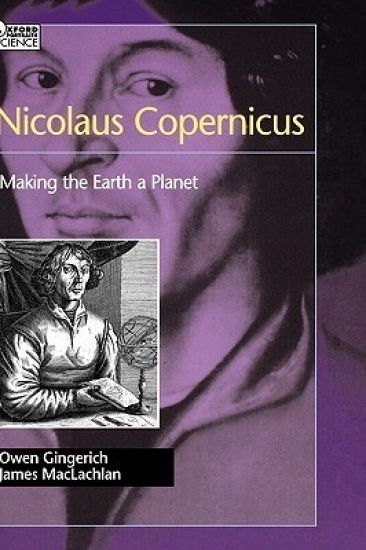
Nicolaus Copernicus

Nicolaus Copernicus

Owen Gingerich; James MacLachlan

Oxford University Press Inc
2005
sidottu
Presents the life and accomplishments of the man considered the "father of the Scientific Revolution" due to his theory that the sun is the center of the solar system and the planets revolve around it.