Kirjojen hintavertailu. Mukana 12 595 353 kirjaa ja 12 kauppaa.

Kirjailija

P. Hobart

Kirjat ja teokset yhdessä paikassa: 2 kirjaa, julkaisuja vuodelta 2017, suosituimpien joukossa Okinawan Martial Traditions. Vertaile teosten hintoja ja tarkista saatavuus suomalaisista kirjakaupoista.

2 kirjaa

Okinawan Martial Traditions

Okinawan Martial Traditions

R.W. Toth; P. Hobart; G. Hopkins; W. Higginbotham; G. Noble; P. Davison

VIA MEDIA PUBLISHING COMPANY,US
2017
nidottu
What would you like to obtain from your research and practice of an Okinawan martial art? For an academic, it would be to obtain historical and cultural facts and details. For a practitioner, it would be to gain expertise in the combative skills. If you're interested in both, this third of a three-volume anthology is assembled for your convenience to facilitate your endeavors. These volumes assemble a wealth of material originally published during the two decades when the Journal of Asian Martial Arts was in print. Hundreds of pages and photographs present the richness of Okinawan martial traditions, from the original combatives to those influenced by Chinese and mainland Japanese martial art styles. The variety of topics shown in the table of contents indicate the depth and breath in the chapters, along with the authors who are well-known for their meticulous research and practical skills in specific arts. These three volumes dive deep into the history and culture of Okinawan martial arts. You'll find coverage of the actual artifacts-the material culture related to weaponry and training methods. Instructions from the masters details both open-hand techniques as well as with weapons. The chapters offer insights into the lives of many masters over the past few centuries, giving the raison d' tre for these unique fighting arts-their reason for being. Many streams of arts have contributed to the martial traditions found on the small island: Naha-te, Shuri-te, Fukien White Crane, Shorin, Goju, Motobu, Shotokan, Isshin, Kyokushin, Pwang Gai Noon, Shito, Uechi, and the list continues. . . Along with the various styles come the associated training methods, such as conditioning exercises with weights and creatively designed apparatus, such as the punching post (makiwara), or stone lever and stone padlock-shaped weights. Some become battle-hardened by active and passive breaking of objects (tameshiwari), including wooden boards, baseball bats, rocks, and ice. The extensive use of weaponry is found in many Okinawan styles, often associated with their farming and fishing occupations. Such a blend of history and culture make the Okinawan fighting traditions a fascinating field of study. Besides being such vital sources of information, these three volumes will prove enjoyable reading and permanent at-hand reference sources in your library.
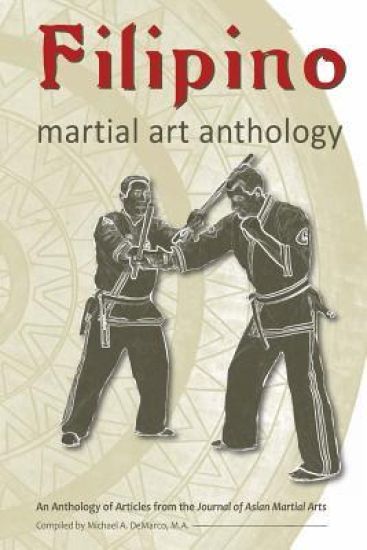
Filipino Martial Art Anthology

Filipino Martial Art Anthology

M. Wiley; S. Dowd; M. Soderholm; P. Hobart; R. Macaraeg; Ken Smith

VIA MEDIA PUBLISHING COMPANY,US
2017
nidottu
There has been a lack of reliable academic studies regarding Filipino martial arts (FMA) that have uniquely developed in the Philippine archipelago. This anthology assembles pioneering scholarly materials valuable for any interested in the Filipino combatives, as well as chapters specifically on the practice. Mark Wiley stands out as a leading scholar/practitioner of the Filipino arts. This book contains three chapters by him. In the first, he conducted linguistic and historical research to present the developmental background of the ancient Filipino kali and European fencing systems, thus illuminating the evolution of classical eskrima. In chapter two, Wiley attempts to classify Filipino martial arts and explore the ethos of Filipino martial culture by deriving information directly from the contemporary grandmasters who have maintained an oral transmission of information concerning the evolution and development of their respective martial systems. Part of Wiley's research also led him to seek out special repositories of artifacts. Museums collections rarely include much on Southeast Asian weapons. University of Pennsylvania Museum of Archaeology and Anthropology has nearly 1,000 martial artifacts in storerooms from the Philippines, including swords, knives, spears, shields, helmets, and armor discussed in Wiley's third chapter. On a practical side, Steven Dowd presents the art of Carlita La ada who studied martial arts as passed down within his own family in the Philippines. He calls his rendition Kuntaw Lima-Lima, an art whose techniques are reminiscent of Okinawan karate styles, with hints of Chinese gongfu. Presented are the underlying principles, and a sayawan (form) with applications. Majia Soderholm's chapter is about Visayan Corto Kadena Eskrima and some of its concepts and training methods with regard to free-sparring with swords. It is a Filipino martial system encompassing empty-hand and non-bladed and bladed weapons. Peter Hobart presents a wonderful tribute to Remy Presas, the founder of Modern Arnis. This retrospective is comprised of the stories and memories of many of those who knew him. Topics include Presas' theory and practice of arnis, such as importance of flow, and memories of his last seminar. The chapter by Ruel Macaraeg dives into the topic of piracy in the Philippines. His study reconstructs the pirates' martial practices through comparative historical analysis of their weapons, costume, and organization in order to draw conclusions about their relationship to martial cultures in the Philippines and across the region. In the final chapter, Ken Smith discusses a few of his favorite techniques from Modern Arnis. His insights-as well as the information found in the previous chapters-contribute to the academic understanding of Filipino martial traditions as well as the actual practice of kali, escrima, and arnis. We hope you'll enjoy the reading.