Kirjojen hintavertailu. Mukana 12 390 323 kirjaa ja 12 kauppaa.
Kirjailija
Pablo Pedregal
Kirjat ja teokset yhdessä paikassa: 11 kirjaa, julkaisuja vuosilta 1997-2024, suosituimpien joukossa Introduction to Optimization. Vertaile teosten hintoja ja tarkista saatavuus suomalaisista kirjakaupoista.
This undergraduate textbook introduces students of science and engineering to the fascinating field of optimization. It is a unique book that brings together the subfields of mathematical programming, variational calculus, and optimal control, thus giving students an overall view of all aspects of optimization in a single reference. As a primer on optimization, its main goal is to provide a succinct and accessible introduction to linear programming, nonlinear programming, numerical optimization algorithms, variational problems, dynamic programming, and optimal control. Prerequisites have been kept to a minimum, although a basic knowledge of calculus, linear algebra, and differential equations is assumed.
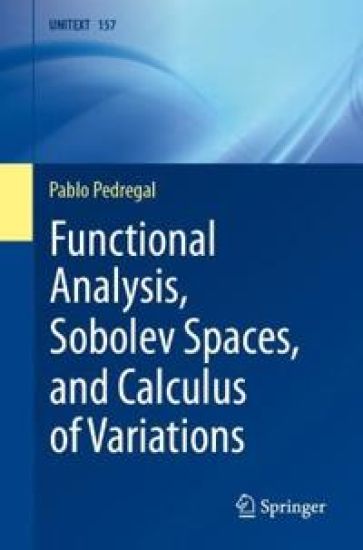
This book aims at introducing students into the modern analytical foundations to treat problems and situations in the Calculus of Variations solidly and rigorously. Since no background is taken for granted or assumed, as the textbook pretends to be self-contained, areas like basic Functional Analysis and Sobolev spaces are studied to the point that chapters devoted to these topics can be utilized by themselves as an introduction to these important parts of Analysis. The material in this regard has been selected to serve the needs of classical variational problems, leaving broader treatments for more advanced and specialized courses in those areas. It should not be forgotten that problems in the Calculus of Variations historically played a crucial role in pushing Functional Analysis as a discipline on its own right. The style is intentionally didactic. After a first general chapter to place optimization problems in infinite-dimensional spaces in perspective, the first part of the book focuses on the initial important concepts in Functional Analysis and introduces Sobolev spaces in dimension one as a preliminary, simpler case (much in the same way as in the successful book of H. Brezis). Once the analytical framework is covered, one-dimensional variational problems are examined in detail including numerous examples and exercises. The second part dwells, again as a first-round, on another important chapter of Functional Analysis that students should be exposed to, and that eventually will find some applications in subsequent chapters. The first chapter of this part examines continuous operators and the important principles associated with mappings between functional spaces; and another one focuses on compact operators and their fundamental and remarkable properties for Analysis. Finally, the third part advances to multi-dimensional Sobolev spaces and the corresponding problems in the Calculus of Variations. In this setting, problems become much more involved and, for this same reason, much more interesting and appealing. In particular, the final chapter dives into a number of advanced topics, some of which reflect a personal taste. Other possibilities stressing other kinds of problems are possible. In summary, the text pretends to help students with their first exposure to the modern calculus of variations and the analytical foundation associated with it. In particular, it covers an extended introduction to basic functional analysis and to Sobolev spaces. The tone of the text and the set of proposed exercises will facilitate progressive understanding until the need for further challenges beyond the topics addressed here will push students to more advanced horizons.
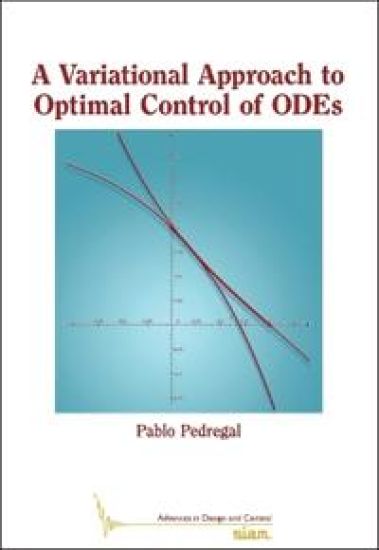
Adopting a variational approach, this self-contained textbook presents the basic principles of optimal control governed by ODEs. Inside, readers will encounterthe fundamental issues of existence of optimal solutions, optimality conditions, and numerical approximation from a variational perspective,academic and real-world examples testing the book's variational approach, anda unified treatment that requires no prior expertise in variational problems or numerical approximation.A Variational Approach to Optimal Control of ODEs is for applied analysts, applied mathematicians, and control engineers. It can be used in courses on Advanced Numerical Analysis, Special Topics on Numerical Analysis, Topics on Data Science, Topics on Numerical Optimization, and Topics on Approximation Theory.
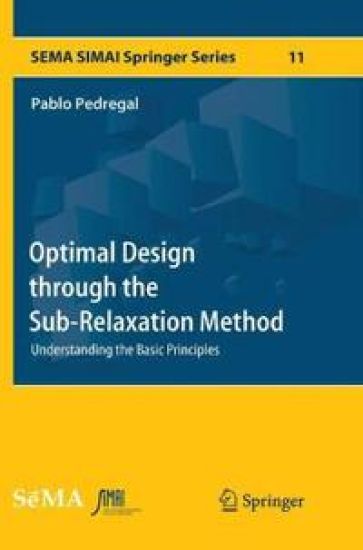
This book provides a comprehensive guide to analyzing and solving optimal design problems in continuous media by means of the so-called sub-relaxation method. Though the underlying ideas are borrowed from other, more classical approaches, here they are used and organized in a novel way, yielding a distinct perspective on how to approach this kind of optimization problems. Starting with a discussion of the background motivation, the book broadly explains the sub-relaxation method in general terms, helping readers to grasp, from the very beginning, the driving idea and where the text is heading. In addition to the analytical content of the method, it examines practical issues like optimality and numerical approximation. Though the primary focus is on the development of the method for the conductivity context, the book’s final two chapters explore several extensions of the method to other problems, as well as formal proofs. The text can be used for a graduate course in optimal design, even if the method would require some familiarity with the main analytical issues associated with this type of problems. This can be addressed with the help of the provided bibliography.
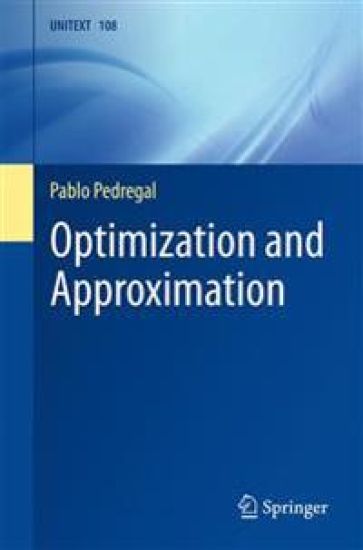
This book provides a basic, initial resource, introducing science and engineering students to the field of optimization. It covers three main areas: mathematical programming, calculus of variations and optimal control, highlighting the ideas and concepts and offering insights into the importance of optimality conditions in each area. It also systematically presents affordable approximation methods. Exercises at various levels have been included to support the learning process.
This book provides a comprehensive guide to analyzing and solving optimal design problems in continuous media by means of the so-called sub-relaxation method. Though the underlying ideas are borrowed from other, more classical approaches, here they are used and organized in a novel way, yielding a distinct perspective on how to approach this kind of optimization problems. Starting with a discussion of the background motivation, the book broadly explains the sub-relaxation method in general terms, helping readers to grasp, from the very beginning, the driving idea and where the text is heading. In addition to the analytical content of the method, it examines practical issues like optimality and numerical approximation. Though the primary focus is on the development of the method for the conductivity context, the book’s final two chapters explore several extensions of the method to other problems, as well as formal proofs. The text can be used for a graduate course in optimal design, even if the method would require some familiarity with the main analytical issues associated with this type of problems. This can be addressed with the help of the provided bibliography.
Weak convergence is a basic tool of modern nonlinear analysis because it enjoys the same compactness properties that finite dimensional spaces do: basically, bounded sequences are weak relatively compact sets. Nonetheless, weak conver gence does not behave as one would desire with respect to nonlinear functionals and operations. This difficulty is what makes nonlinear analysis much harder than would normally be expected. Parametrized measures is a device to under stand weak convergence and its behavior with respect to nonlinear functionals. Under suitable hypotheses, it yields a way of representing through integrals weak limits of compositions with nonlinear functions. It is particularly helpful in comprehending oscillatory phenomena and in keeping track of how oscilla tions change when a nonlinear functional is applied. Weak convergence also plays a fundamental role in the modern treatment of the calculus of variations, again because uniform bounds in norm for se quences allow to have weak convergent subsequences. In order to achieve the existence of minimizers for a particular functional, the property of weak lower semicontinuity should be established first. This is the crucial and most delicate step in the so-called direct method of the calculus of variations. A fairly large amount of work has been devoted to determine under what assumptions we can have this lower semicontinuity with respect to weak topologies for nonlin ear functionals in the form of integrals. The conclusion of all this work is that some type of convexity, understood in a broader sense, is usually involved.
This undergraduate textbook introduces students of science and engineering to the fascinating field of optimization. It is a unique book that brings together the subfields of mathematical programming, variational calculus, and optimal control, thus giving students an overall view of all aspects of optimization in a single reference. As a primer on optimization, its main goal is to provide a succinct and accessible introduction to linear programming, nonlinear programming, numerical optimization algorithms, variational problems, dynamic programming, and optimal control. Prerequisites have been kept to a minimum, although a basic knowledge of calculus, linear algebra, and differential equations is assumed.
Fundamental concepts of mathematical modeling Modeling is one of the most effective, commonly used tools in engineering and the applied sciences. In this book, the authors deal with mathematical programming models both linear and nonlinear and across a wide range of practical applications. Whereas other books concentrate on standard methods of analysis, the authors focus on the power of modeling methods for solving practical problemsclearly showing the connection between physical and mathematical realitieswhile also describing and exploring the main concepts and tools at work. This highly computational coverage includes: *Discussion and implementation of the GAMS programming system *Unique coverage of compatibility *Illustrative examples that showcase the connection between model and reality *Practical problems covering a wide range of scientific disciplines, as well as hundreds of examples and end-of-chapter exercises *Real-world applications to probability and statistics, electrical engineering, transportation systems, and more Building and Solving Mathematical Programming Models in Engineering and Science is practically suited for use as a professional reference for mathematicians, engineers, and applied or industrial scientists, while also tutorial and illustrative enough for advanced students in mathematics or engineering.
In less than 100 pages, this book covers the main vector variational methods developed to solve nonlinear elasticity problems. Presenting a general framework with a tight focus, the author provides a comprehensive exposition of a technically difficult, yet rapidly developing area of modern applied mathematics. The book includes the classical existence theory as well as a brief incursion into problems where nonexistence is fundamental. It also provides self-contained, concise accounts of quasi convexity, polyconvexity, and rank-one convexity, which are used in nonlinear elasticity. Pedregal introduces the reader to Young measures as an important tool in solving vector variational techniques. Readers are encouraged to pursue nonlinear elasticity as one of the best means to apply these techniques. Although there are other books devoted to nonlinear elasticity or variational methods, none are concerned with Young measures as a tool for proving existence results in nonlinear elasticity. In addition, many valuable references are included to direct the reader to other important research.
Weak convergence is a basic tool of modern nonlinear analysis because it enjoys the same compactness properties that finite dimensional spaces do: basically, bounded sequences are weak relatively compact sets. Nonetheless, weak conver gence does not behave as one would desire with respect to nonlinear functionals and operations. This difficulty is what makes nonlinear analysis much harder than would normally be expected. Parametrized measures is a device to under stand weak convergence and its behavior with respect to nonlinear functionals. Under suitable hypotheses, it yields a way of representing through integrals weak limits of compositions with nonlinear functions. It is particularly helpful in comprehending oscillatory phenomena and in keeping track of how oscilla tions change when a nonlinear functional is applied. Weak convergence also plays a fundamental role in the modern treatment of the calculus of variations, again because uniform bounds in norm for se quences allow to have weak convergent subsequences. In order to achieve the existence of minimizers for a particular functional, the property of weak lower semicontinuity should be established first. This is the crucial and most delicate step in the so-called direct method of the calculus of variations. A fairly large amount of work has been devoted to determine under what assumptions we can have this lower semicontinuity with respect to weak topologies for nonlin ear functionals in the form of integrals. The conclusion of all this work is that some type of convexity, understood in a broader sense, is usually involved.