Kirjojen hintavertailu. Mukana 12 507 821 kirjaa ja 12 kauppaa.

Kirjailija

Pamela Colman Smith

Kirjat ja teokset yhdessä paikassa: 34 kirjaa, julkaisuja vuosilta 2002-2025, suosituimpien joukossa A.E. Waite Tarot Standard Blue Edition. Vertaile teosten hintoja ja tarkista saatavuus suomalaisista kirjakaupoista.

34 kirjaa

Kirjojen julkaisuhaarukka 2002-2025.

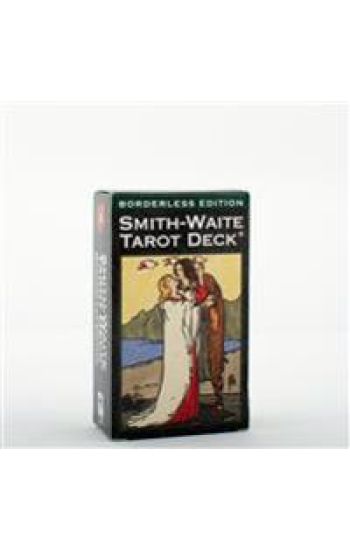
Smith-Waite(r) Tarot Borderless Edition

Smith-Waite(r) Tarot Borderless Edition

Pamela Colman Smith

U.S. Games Systems, Inc.
2017
muu
Pamela Colman Smith's beloved tarot artwork, created in 1909 under the direction of Arthur E. Waite, is now presented in a borderless format for a more immersive reading experience. This 84-card deck includes four extra cards with reproduction samples of Pixie's non-tarot artwork, including two watercolor paintings "Catch Me" and "Duet"; the Lovers illustration from the play Deirdre; and an illustration from the sheet music for "Christmas Carol." The deck comes with an instruction booklet.
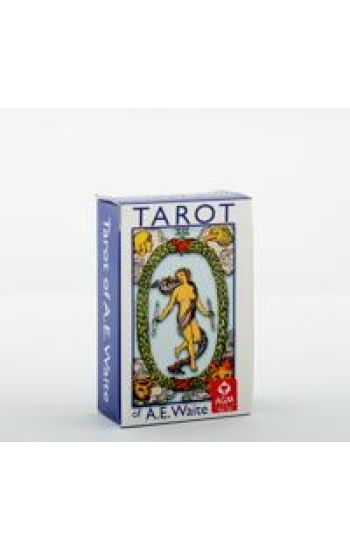
A.E. Waite Tarot Pocket Blue Edition

A.E. Waite Tarot Pocket Blue Edition

Pamela Colman Smith

Cartamundi/AGM-Urania Königsfurt-Urania Verlag GmbH
2017
muu
Colors of the cards according to the first edition from 1909. Backside: Blue Rosy Cross The blue backside and a beautiful rosy-cross refer to the membership of A.E. Waite and Pamela Colman Smith in the rosy crucian order of the Golden Dawn . This edition consists of a folding tuckbox with an instruction booklet of 32 pages in different language editions and three different card sizes: Standard = 70 x 120 mm; English, Spanish & Portuguese Pocket = 57 x 89 mm; English, Spanish & Portuguese Mini = 44 x 74 mm; English This bestselling edition by Koenigsfurt-Urania & AGM-Urania from Germany and Switzerland has been published for more than 20 years now and highly acclaimed for the unsurpassed reprint of the colors of the historic cards of Arthur E. Waite and Pamela Colman Smith. The cards were drawn in 1909 by Pamela Colman Smith under the direction of Arthur Edward Waite. Smith's vibrant drawings transformed the standard tarot deck. Pamela Colman Smith was born February 16, 1878, in Middlesex, England to American parents, Smith's childhood years were spent between London, New York, and Kingston, Jamaica. During her teens, she traveled throughout England with the theatre company of Ellen Terry and Henry Irving. Thereafter, she began formal art training at Pratt Institute of Brooklyn, graduating in 1897. Around 1903, she joined the Order of the Golden Dawn. In 1909, under the guidance of Arthur Edward Waite, she undertook a series of seventy-eight allegorical paintings described by Waite as a rectified tarot pack. The designs, published in the same year by William Rider and Son, exemplify the mysticism, ritual, imagination, fantasy, and deep emotions of the artist.Arthur Edward Waite was born in America in 1857, raised and educated as a Catholic in England. Beginning at the age of 21, Waite pursued research and writing on psychical and esoteric matters. Soon after joining the Hermetic Order of the Golden Dawn, he became the Grand Master, and redirected the focus of the order from magic to mysticism. The Golden Order, whose structural hierarchy was based on the Kabbalah, is considered the single greatest 20th century influence on the occult. Waite was a prolific author of occult texts, works on the Holy Grail, and the body of mystical knowledge, which comprises the basis of modern Tarot.
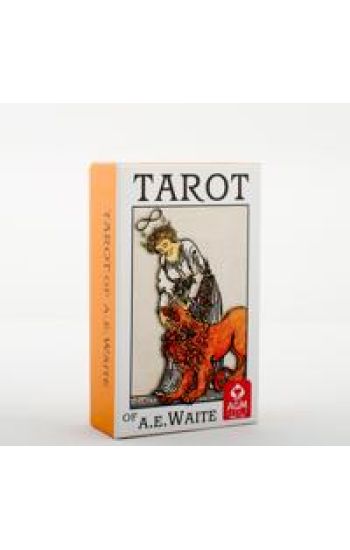
A.E. Waite Tarot Standard Blue Edition

A.E. Waite Tarot Standard Blue Edition

Pamela Colman Smith

Cartamundi/AGM-Urania Königsfurt-Urania Verlag GmbH
2017
muu
Colors of the cards according to the first edition from 1909. Backside: Blue Rosy Cross The blue backside and a beautiful rosy-cross refer to the membership of A.E. Waite and Pamela Colman Smith in the rosy crucian order of the Golden Dawn . This edition consists of a folding tuckbox with an instruction booklet of 32 pages in different language editions and three different card sizes: Standard = 70 x 120 mm; English, Spanish & Portuguese Pocket = 57 x 89 mm; English, Spanish & Portuguese Mini = 44 x 74 mm; English This bestselling edition by Koenigsfurt-Urania & AGM-Urania from Germany and Switzerland has been published for more than 20 years now and highly acclaimed for the unsurpassed reprint of the colors of the historic cards of Arthur E. Waite and Pamela Colman Smith. The cards were drawn in 1909 by Pamela Colman Smith under the direction of Arthur Edward Waite. Smith's vibrant drawings transformed the standard tarot deck. Pamela Colman Smith was born February 16, 1878, in Middlesex, England to American parents, Smith's childhood years were spent between London, New York, and Kingston, Jamaica. During her teens, she traveled throughout England with the theatre company of Ellen Terry and Henry Irving. Thereafter, she began formal art training at Pratt Institute of Brooklyn, graduating in 1897. Around 1903, she joined the Order of the Golden Dawn. In 1909, under the guidance of Arthur Edward Waite, she undertook a series of seventy-eight allegorical paintings described by Waite as a rectified tarot pack. The designs, published in the same year by William Rider and Son, exemplify the mysticism, ritual, imagination, fantasy, and deep emotions of the artist. Arthur Edward Waite was born in America in 1857, raised and educated as a Catholic in England. Beginning at the age of 21, Waite pursued research and writing on psychical and esoteric matters. Soon after joining the Hermetic Order of the Golden Dawn, he became the Grand Master, and redirected the focus of the order from magic to mysticism. The Golden Order, whose structural hierarchy was based on the Kabbalah, is considered the single greatest 20th century influence on the occult. Waite was a prolific author of occult texts, works on the Holy Grail, and the body of mystical knowledge, which comprises the basis of modern Tarot.
A.E. Waite Tarot Pocket Premium Edition

A.E. Waite Tarot Pocket Premium Edition

Pamela Colman Smith

Cartamundi/AGM-Urania Königsfurt-Urania Verlag GmbH
2017
muu
Colors and backside of the cards according to the first edition from 1909. The frontsides of the cards offer the same beautiful reprint of the colors of the historic cards as the blue edition. The back of the cards shows the famous brown pebble back that was the very backside of the first printing. This edition consists of a sturdy bottom lid box with a detailed instruction booklet of 96 pages various language editions and in three different card sizes:Deluxe = 99 x 169 mm; English Standard = 70 x 120 mm; English, Spanish, Portuguese & French Pocket = 57 x 89 mm; English, Spanish & Portuguese The cards were drawn in 1909 by Pamela Colman Smith under the direction of Arthur Edward Waite. Smith's vibrant drawings transformed the standard tarot deck. Pamela Colman Smith was born February 16, 1878, in Middlesex, England to American parents, Smith's childhood years were spent between London, New York, and Kingston, Jamaica. During her teens, she traveled throughout England with the theatre company of Ellen Terry and Henry Irving. Thereafter, she began formal art training at Pratt Institute of Brooklyn, graduating in 1897. Around 1903, she joined the Order of the Golden Dawn. In 1909, under the guidance of Arthur Edward Waite, she undertook a series of seventy-eight allegorical paintings described by Waite as a rectified tarot pack. The designs, published in the same year by William Rider and Son, exemplify the mysticism, ritual, imagination, fantasy, and deep emotions of the artist. Arthur Edward Waite was born in America in 1857, raised and educated as a Catholic in England. Beginning at the age of 21, Waite pursued research and writing on psychical and esoteric matters. Soon after joining the Hermetic Order of the Golden Dawn, he became the Grand Master, and redirected the focus of the order from magic to mysticism. The Golden Order, whose structural hierarchy was based on the Kabbalah, is considered the single greatest 20th century influence on the occult. Waite was a prolific author of occult texts, works on the Holy Grail, and the body of mystical knowledge, which comprises the basis of modern Tarot.
A.E. Waite Tarot Standard Premium Edition

A.E. Waite Tarot Standard Premium Edition

Pamela Colman Smith

Cartamundi/AGM-Urania Königsfurt-Urania Verlag GmbH
2017
muu
Colors and backside of the cards according to the first edition from 1909. The frontsides of the cards offer the same beautiful reprint of the colors of the historic cards as the blue edition. The back of the cards shows the famous brown pebble back that was the very backside of the first printing. This edition consists of a sturdy bottom lid box with a detailed instruction booklet of 96 pages various language editions and in three different card sizes:Deluxe = 99 x 169 mm; English Standard = 70 x 120 mm; English, Spanish, Portuguese & French Pocket = 57 x 89 mm; English, Spanish & Portuguese The cards were drawn in 1909 by Pamela Colman Smith under the direction of Arthur Edward Waite. Smith's vibrant drawings transformed the standard tarot deck. Pamela Colman Smith was born February 16, 1878, in Middlesex, England to American parents, Smith's childhood years were spent between London, New York, and Kingston, Jamaica. During her teens, she traveled throughout England with the theatre company of Ellen Terry and Henry Irving. Thereafter, she began formal art training at Pratt Institute of Brooklyn, graduating in 1897. Around 1903, she joined the Order of the Golden Dawn. In 1909, under the guidance of Arthur Edward Waite, she undertook a series of seventy-eight allegorical paintings described by Waite as a rectified tarot pack. The designs, published in the same year by William Rider and Son, exemplify the mysticism, ritual, imagination, fantasy, and deep emotions of the artist. Arthur Edward Waite was born in America in 1857, raised and educated as a Catholic in England. Beginning at the age of 21, Waite pursued research and writing on psychical and esoteric matters. Soon after joining the Hermetic Order of the Golden Dawn, he became the Grand Master, and redirected the focus of the order from magic to mysticism. The Golden Order, whose structural hierarchy was based on the Kabbalah, is considered the single greatest 20th century influence on the occult. Waite was a prolific author of occult texts, works on the Holy Grail, and the body of mystical knowledge, which comprises the basis of modern Tarot.
In Chimney Corners

In Chimney Corners

Seumas MacManus; Pamela Colman Smith

Hansebooks
2017
pokkari
In Chimney Corners - Merry Tales of Irish Folklore is an unchanged, high-quality reprint of the original edition of 1899. Hansebooks is editor of the literature on different topic areas such as research and science, travel and expeditions, cooking and nutrition, medicine, and other genres. As a publisher we focus on the preservation of historical literature. Many works of historical writers and scientists are available today as antiques only. Hansebooks newly publishes these books and contributes to the preservation of literature which has become rare and historical knowledge for the future.
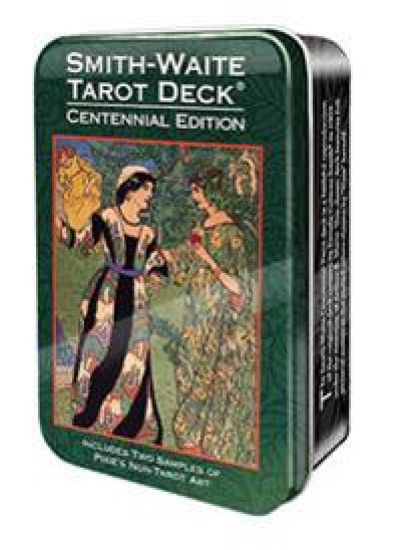
Smith-Waite® Centennial Tarot Deck In A Tin
The Smith-Waite Centennial Tarot Deck in a Tin is a faithful reproduction of the original deck created by Pamela Colman Smith in 1909 under the direction of Arthur E. Waite. This classic tarot deck features full pictorial scenes in the muted colors chosen by “Pixie” herself. The deck was first issued in 2009 by U.S. Games Systems as part of the Pamela Colman Smith Commemorative Set. The 80-card deck includes the standard 78 tarot cards plus 2 samples of Pixie’s non-tarot artwork. Cards in this pocket-sized deck measure 2.25? x 3.75?.
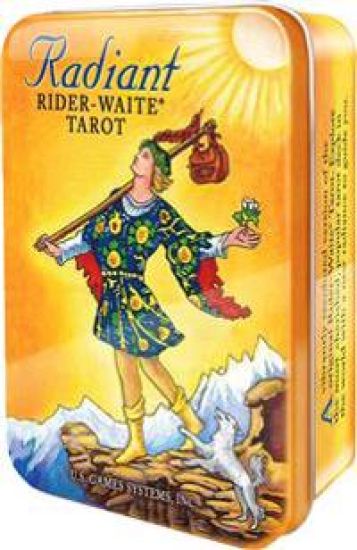
Radiant Rider-Waite Tarot in a Tin

Radiant Rider-Waite Tarot in a Tin

Pamela Colman Smith

U.S. GAMES
2015
muu
The brilliantly colored tarot deck that has been popular for decades is now presented in a charming keepsake tin. For Radiant Rider-Waite, the artwork of Pamela Colman Smith has been updated and enhanced with a vibrant palette of colors, bringing new energy and radiance to the familiar scenes of 78 cards. Radiant Rider-Waite’s brightness and subtle shading highlight the traditional symbolism that readers rely on for insightful readings. The card backs feature a star-filled deep, blue sky. Radiant Rider-Waite® Tarot includes an instruction booklet with an Introduction by Stuart R. Kaplan. 10x14 See also Radiant Rider-Waite TarotSize 2” x 3.5”
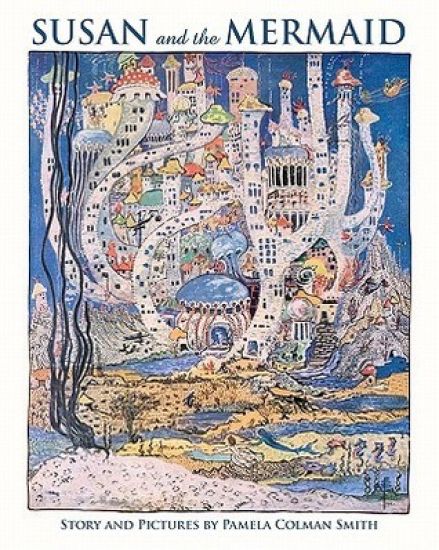
Susan and the Mermaid

Susan and the Mermaid

Corrine Kenner; Pamela Colman Smith

Createspace Independent Publishing Platform
2010
nidottu
Lost for almost a century, "Susan and the Mermaid" is the rediscovered tale of a magic ring, an underwater kingdom, and a wise old woman who knew how to make her granddaughter's dreams come true. It's a tale that rivals "Alice in Wonderland" for imagination ... and it was written and illustrated by Pamela Colman Smith, whose own life story reads like a work of fiction. Smith was an author, artist, and storyteller who divided her time between London, New York, and the island of Jamaica. During the early 1900s, she traveled with some of the world's most famous writers and performers, including poet and playwright William Butler Yeats, popular actress Ellen Terry (the Elizabeth Taylor of her day), and Bram Stoker, the author of "Dracula." Smith published three books by the time she was twenty, and her work won critical acclaim around the world. True fame and fortune eluded her, though, and she died virtually unknown in 1951. Twenty years after her death, however, an old card deck she created was republished, and millions of modern tarot enthusiasts were welcomed into Smith's world of magic, mystery, and metaphysics."Susan and the Mermaid" offers a new and unexpected glimpse into that realm, where the border between reality and fantasy blurs, and ethereal creatures lead ordinary people into extraordinary adventures.This story first appeared in the Christmas 1912 edition of "The Delineator," a magazine for mothers and their children. This version reproduces the original text and images, just as they looked at the time. This book also takes the discovery a step further, by offering a close-up look at the dozens of full-color illustrations Smith painted to accompany the story."Susan and the Mermaid" is a treasure recovered from the vaults of history. It's a gift from the past, from an artist who lives on in the words and pictures she left behind.
Rider-Waite(r) Tarot Premier Edition

Rider-Waite(r) Tarot Premier Edition

Pamela Colman Smith

U.S. Games Systems, Inc.
2005
muu
Once considered revolutionary, the Rider-Waite deck has become the most popular tarot deck in the world, and has set the standard for hundreds of other tarot decks. The cards were drawn in 1909 by Pamela Colman Smith under the direction of Arthur Edward Waite. Smith's vibrant drawings transformed the standard tarot deck."A unique feature of the Rider-Waite deck, and one of the of the principal reasons for its enduring popularity, is that all of the cards, including the Minor Arcana, depict full scenes with figures and symbols. Prior to the Rider-Waite Tarot, the pip cards of almost all tarot decks were marked only with the arrangement of the suit signs -- swords, wands, cups, and coins, or pentacles. The pictorial images on all the cards allow interpretations without the need to repeatedly consult explanatory text. The innovative Minor Arcana, and Pamela Colman Smith's ability to capture the subtleties of emotion and experience have made the Rider-Waite Tarot a model for the designs of many tarot packs." -- (from The Encyclopedia of Tarot, Volume III)Rider-Waite Tarot was named one of the Top Ten Tarot Decks of All Time by Aeclectic Tarot.See all other Rider-Waite decks
Radiant Rider-Waite(r) Tarot

Radiant Rider-Waite(r) Tarot

Pamela Colman Smith

U.S. Games Systems, Inc.
2003
sidottu
Virginijus Poshkus has successfully undertaken the task of re-colorizing an iconic tarot deck and enhancing the beloved artwork created by Pamela Colman Smith. His carefully chosen palette of vibrant color brings new energy and radiance to the 78 cards of the Rider-Waite Tarot. The updated look replaces Smith's thick, black outlines with subtle shading that gives depth to the familiar scenes. Radiant Rider-Waite's enhanced brightness highlights the traditional symbolism that readers rely on for insightful readings. The card backs have also been given the fresh new look of a star-filled deep, blue sky. Radiant Rider-Waite Tarot includes an instruction booklet with an Introduction by Stuart R. Kaplan.
Tarot of New Vision

Tarot of New Vision

Pamela Colman Smith

Lo Scarabeo
2003
muu
Ever wondered what the Magician was looking at? The Tarot of the New Vision is based on the Rider-Waite, but with a fascinating 180 degree change of perspective which reveals new scenes, people and shades of meaning in the familiar imagesDivination using tools such as Tarot Cards, help to bring higher guidance and advice into our lives and brings to the surface information that is hidden or not immediately obvious to us. This deck contains 78 cards and instruction booklet.Cards measure approximately 6.6 x 13 cm (2.75 x 4.75 inches)
Pocket Rider-Waite® Tarot

Pocket Rider-Waite® Tarot

Pamela Colman Smith

U.S. GAMES
2002
muu
With full pictorial scenes on every card of the Major and Minor Arcana, Rider-Waite Tarot set the standard for hundreds of other tarot decks around the world. First created in 1909 by Pamela Colman Smith, under the direction of Arthur Edward Waite, the vibrant drawings of Rider-Waite Tarot hold timeless appeal. The deck’s enduring popularity stems from the universality of the symbolism captured in every card of the 78-card deck. Pocket Rider-Waite Tarot includes an instruction booklet with upright and reversed meanings, keywords, and an introduction by tarot expert, Stuart R. Kaplan. This is a deck that is beloved by tarot beginners and experienced readers alike. Rider-Waite Tarot belongs in every tarot collection.
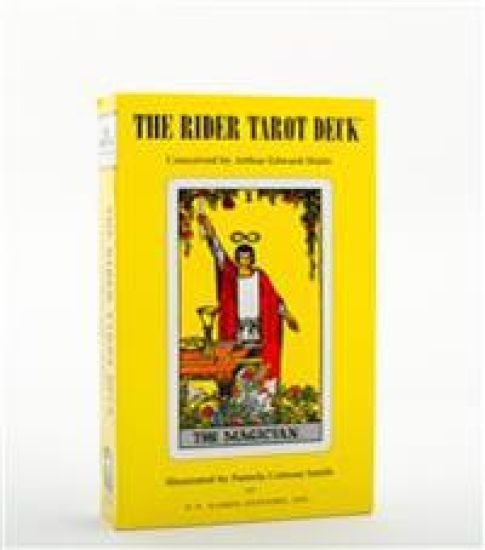
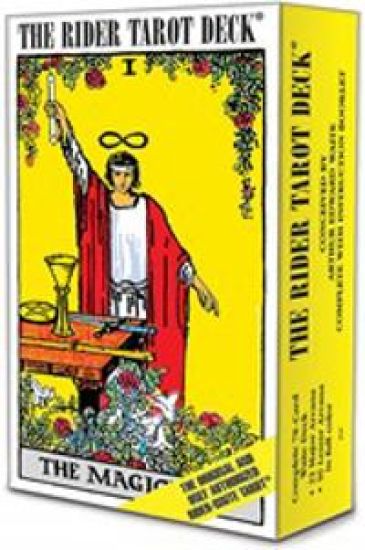
The Rider Tarot Deck®

The Rider Tarot Deck®

Pamela Colman Smith

U.S. GAMES
2002
muu
The cards were drawn in 1909 by Pamela Colman Smith under the direction of Arthur Edward Waite. Smith's vibrant drawings transformed the standard tarot deck."A unique feature of the Rider-Waite deck, and one of the of the principal reasons for its enduring popularity, is that all of the cards, including the Minor Arcana, depict full scenes with figures and symbols. Prior to the Rider-Waite Tarot, the pip cards of almost all tarot decks were marked only with the arrangement of the suit signs -- swords, wands, cups, and coins, or pentacles. The pictorial images on all the cards allow interpretations without the need to repeatedly consult explanatory text. The innovative Minor Arcana, and Pamela Colman Smith's ability to capture the subtleties of emotion and experience have made the Rider-Waite Tarot a model for the designs of many tarot packs." -- (from The Encyclopedia of Tarot, Volume III)Rider-Waite Tarot was named one of the Top Ten Tarot Decks of All Time by Aeclectic Tarot.Pamela Colman SmithBorn February 16, 1878, in Middlesex, England to American parents, Smith's childhood years were spent between London, New York, and Kingston, Jamaica. During her teens, she traveled throughout England with the theatre company of Ellen Terry and Henry Irving. Thereafter, she began formal art training at Pratt Institute of Brooklyn, graduating in 1897.Smith returned to England, where she became a theatrical designer for miniature theatre, and an illustrator -- mainly of books, pamphlets and posters. Around 1903, she joined the Order of the Golden Dawn. In 1909, under the guidance of Arthur Edward Waite, she undertook a series of seventy-eight allegorical paintings described by Waite as a rectified tarot pack. The designs, published in the same year by William Rider and Son, exemplify the mysticism, ritual, imagination, fantasy, and deep emotions of the artist.Arthur Edward WaiteBorn in America in 1857, Waite was raised and educated as a Catholic in England. Beginning at the age of 21, Waite pursued research and writing on psychical and esoteric matters. Soon after joining the Hermetic Order of the Golden Dawn, he became the Grand Master, and redirected the focus of the order from magic to mysticism. The Golden Order, whose structural hierarchy was based on the Kabbalah, is considered the single greatest 20th century influence on the occult. Waite was a prolific author of occult texts, works on the Holy Grail, and the body of mystical knowledge, which comprises the basis of modern Tarot. He is best known as the co-creator of the Rider-Waite Tarot deck and author of its companion volume The Pictorial Key to the Tarot, first published in 1910.