Kirjojen hintavertailu. Mukana 12 390 323 kirjaa ja 12 kauppaa.

Kirjailija

Pamela E. Klassen

Kirjat ja teokset yhdessä paikassa: 8 kirjaa, julkaisuja vuosilta 1994-2018, suosituimpien joukossa Going by the Moon and the Stars. Vertaile teosten hintoja ja tarkista saatavuus suomalaisista kirjakaupoista.

8 kirjaa

Kirjojen julkaisuhaarukka 1994-2018.

Ekklesia

Ekklesia

Paul Christopher Johnson; Pamela E. Klassen; Winnifred Fallers Sullivan

University of Chicago Press
2018
pokkari
Ekklesia: Three Inquiries in Church and State offers a New World rejoinder to the largely Europe-centered academic discourse on church and state. In contrast to what is often assumed, in the Americas the relationship between church and state has not been one of freedom or separation but one of unstable and adaptable collusion. Ekklesia sees in the settler states of North and South America alternative patterns of conjoined religious and political power, patterns resulting from the undertow of other gods, other peoples, and other claims to sovereignty. These local challenges have led to a continuously contested attempt to realize a church-minded state, a state-minded church, and the systems that develop in their concert. The shifting borders of their separation and the episodic conjoining of church and state took new forms in both theory and practice. The first of a closely linked trio of essays is by Paul Johnson, and offers a new interpretation of the Brazilian community gathered at Canudos and its massacre in 1896-97, carried out as a joint church-state mission and spectacle. In the second essay, Pamela Klassen argues that the colonial church-state relationship of Canada came into being through local and national practices that emerged as Indigenous nations responded to and resisted becoming "possessions" of colonial British America. Finally, Winnifred Sullivan's essay begins with reflection on the increased effort within the United States to ban Bibles and scriptural references from death penalty courtrooms and jury rooms; she follows with a consideration of the political theological pressure thereby placed on the jury that decides between life and death. Through these three inquiries, Ekklesia takes up the familiar topos of "church and state" in order to render it strange.
Ekklesia

Ekklesia

Paul Christopher Johnson; Pamela E. Klassen; Winnifred Fallers Sullivan

University of Chicago Press
2018
sidottu
Ekklesia: Three Inquiries in Church and State offers a New World rejoinder to the largely Europe-centered academic discourse on church and state. In contrast to what is often assumed, in the Americas the relationship between church and state has not been one of freedom or separation but one of unstable and adaptable collusion. Ekklesia sees in the settler states of North and South America alternative patterns of conjoined religious and political power, patterns resulting from the undertow of other gods, other peoples, and other claims to sovereignty. These local challenges have led to a continuously contested attempt to realize a church-minded state, a state-minded church, and the systems that develop in their concert. The shifting borders of their separation and the episodic conjoining of church and state took new forms in both theory and practice. The first of a closely linked trio of essays is by Paul Johnson, and offers a new interpretation of the Brazilian community gathered at Canudos and its massacre in 1896-97, carried out as a joint church-state mission and spectacle. In the second essay, Pamela Klassen argues that the colonial church-state relationship of Canada came into being through local and national practices that emerged as Indigenous nations responded to and resisted becoming "possessions" of colonial British America. Finally, Winnifred Sullivan's essay begins with reflection on the increased effort within the United States to ban Bibles and scriptural references from death penalty courtrooms and jury rooms; she follows with a consideration of the political theological pressure thereby placed on the jury that decides between life and death. Through these three inquiries, Ekklesia takes up the familiar topos of "church and state" in order to render it strange.
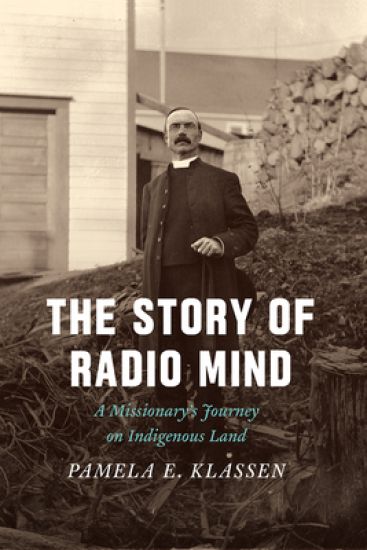
The Story of Radio Mind

The Story of Radio Mind

Pamela E. Klassen

University of Chicago Press
2018
nidottu
At the dawn of the radio age in the 1920s, a settler-mystic living on northwest coast of British Columbia invented radio mind: Frederick Du Vernet—Anglican archbishop and self-declared scientist—announced a psychic channel by which minds could telepathically communicate across distance. Retelling Du Vernet’s imaginative experiment, Pamela Klassen shows us how agents of colonialism built metaphysical traditions on land they claimed to have conquered. Following Du Vernet’s journey westward from Toronto to Ojibwe territory and across the young nation of Canada, Pamela Klassen examines how contests over the mediation of stories—via photography, maps, printing presses, and radio—lucidly reveal the spiritual work of colonial settlement. A city builder who bargained away Indigenous land to make way for the railroad, Du Vernet knew that he lived on the territory of Ts’msyen, Nisga’a, and Haida nations who had never ceded their land to the onrush of Canadian settlers. He condemned the devastating effects on Indigenous families of the residential schools run by his church while still serving that church. Testifying to the power of radio mind with evidence from the apostle Paul and the philosopher Henri Bergson, Du Vernet found a way to explain the world that he, his church and his country made. Expanding approaches to religion and media studies to ask how sovereignty is made through stories, Klassen shows how the spiritual invention of colonial nations takes place at the same time that Indigenous peoples—including Indigenous Christians—resist colonial dispossession through stories and spirits of their own.
The Story of Radio Mind

The Story of Radio Mind

Pamela E. Klassen

University of Chicago Press
2018
sidottu
At the dawn of the radio age in the 1920s, a settler-mystic living on northwest coast of British Columbia invented radio mind: Frederick Du Vernet—Anglican archbishop and self-declared scientist—announced a psychic channel by which minds could telepathically communicate across distance. Retelling Du Vernet’s imaginative experiment, Pamela Klassen shows us how agents of colonialism built metaphysical traditions on land they claimed to have conquered. Following Du Vernet’s journey westward from Toronto to Ojibwe territory and across the young nation of Canada, Pamela Klassen examines how contests over the mediation of stories—via photography, maps, printing presses, and radio—lucidly reveal the spiritual work of colonial settlement. A city builder who bargained away Indigenous land to make way for the railroad, Du Vernet knew that he lived on the territory of Ts’msyen, Nisga’a, and Haida nations who had never ceded their land to the onrush of Canadian settlers. He condemned the devastating effects on Indigenous families of the residential schools run by his church while still serving that church. Testifying to the power of radio mind with evidence from the apostle Paul and the philosopher Henri Bergson, Du Vernet found a way to explain the world that he, his church and his country made. Expanding approaches to religion and media studies to ask how sovereignty is made through stories, Klassen shows how the spiritual invention of colonial nations takes place at the same time that Indigenous peoples—including Indigenous Christians—resist colonial dispossession through stories and spirits of their own.
Spirits of Protestantism

Spirits of Protestantism

Pamela E. Klassen

University of California Press
2011
sidottu
"Spirits of Protestantism" reveals how liberal Protestants went from being early-twentieth-century medical missionaries seeking to convert others through science and scripture, to becoming vocal critics of missionary arrogance who experimented with non-western healing modes such as Yoga and Reiki. Drawing on archival and ethnographic sources, Pamela E. Klassen shows how and why the very notion of healing within North America has been infused with a Protestant "supernatural liberalism." In the course of coming to their changing vision of healing, liberal Protestants became pioneers three times over: in the struggle against the cultural and medical pathologizing of homosexuality; in the critique of Christian missionary triumphalism; and, in the diffusion of an ever-more ubiquitous anthropology of "body, mind, and spirit." At a time when the political and anthropological significance of Christianity is being hotly debated, "Spirits of Protestantism" forcefully argues for a reconsideration of the historical legacies and cultural effects of liberal Protestantism, even for the anthropology of religion itself.
Spirits of Protestantism

Spirits of Protestantism

Pamela E. Klassen

University of California Press
2011
pokkari
"Spirits of Protestantism" reveals how liberal Protestants went from being early-twentieth-century medical missionaries seeking to convert others through science and scripture, to becoming vocal critics of missionary arrogance who experimented with non-western healing modes such as Yoga and Reiki. Drawing on archival and ethnographic sources, Pamela E. Klassen shows how and why the very notion of healing within North America has been infused with a Protestant "supernatural liberalism." In the course of coming to their changing vision of healing, liberal Protestants became pioneers three times over: in the struggle against the cultural and medical pathologizing of homosexuality; in the critique of Christian missionary triumphalism; and, in the diffusion of an ever-more ubiquitous anthropology of "body, mind, and spirit." At a time when the political and anthropological significance of Christianity is being hotly debated, "Spirits of Protestantism" forcefully argues for a reconsideration of the historical legacies and cultural effects of liberal Protestantism, even for the anthropology of religion itself.
Blessed Events

Blessed Events

Pamela E. Klassen

Princeton University Press
2001
pokkari
Blessed Events explores how women who give birth at home use religion to make sense of their births and in turn draw on their birthing experiences to bring meaning to their lives and families. Pamela Klassen introduces a surprisingly diverse group of women, in their own words, while also setting their birth stories within wider social, political, and economic contexts. In doing so, she emerges with a study that disrupts conventional views of both childbirth and religion by blurring assumed divisions between conservative and feminist women and by taking childbirth seriously as a religious act. Most American women who have a choice give birth in a hospital and request pain medication. Yet enough women choose and advocate unmedicated home birth--and do so for carefully articulated reasons, social resistance among them--to constitute a movement. Klassen investigates why women whose religious affiliations range from Old Order Amish to Reform Judaism to goddess-centered spirituality defy majority opinion, the medical establishment, and sometimes the law to have their babies at home. In considering their interpretations--including their critiques of the dominant medical model of childbirth and their views on labor pain--she examines the kinds of agency afforded to or denied women as they derive religious meanings from childbirth. Throughout, she identifies tensions and affinities between feminist and traditionalist appraisals of the symbolic meaning of birth and the power of women. What does home birth--a woman-centered movement working to return birth to women's control--mean in practice for women's gender and religious identities? Is this supreme valuing of procreation and motherhood constraining, or does it open up new realms of cultural and social power for women? By asking these questions while remaining cognizant of religion's significance, Blessed Events challenges both feminist and traditionalist accounts of childbearing while broadening our understanding of how religion is "lived" in contemporary America.
Going by the Moon and the Stars

Going by the Moon and the Stars

Pamela E. Klassen

Wilfrid Laurier University Press
1994
nidottu
So, it was January the 18 and it was the middle of the night. And it was very, very cold. Snow was - we went just about knee deep in snow - And we went on the road going toward Posen, capital of Wartegau. And so we said, ""Let's take that direction."" Just going by the moon and the stars. (Katja Enns) Going by the Moon and the Stars tells the stories of two Russian Mennonite women who emigrated to Canada after fleeing from the Soviet Union during World War II. Based on ethnographic interviews with the author the women recount, in their own words, their memories of their wartime struggle and flight, their resettlement in Canada and their journey into old age. Above all, they tell of the overwhelming importance of religion in their lives. Through these remarkable stories Pamela Klassen challenges conventional understandings of religion. The women's voices, intimate and powerful, testify to the importance of religion in the construction of personal history, as well as to its oppressive and liberating potential. Going by the Moon and the Stars will be of great value to all those interested in the Mennonites and Mennonite history, religion, women's studies, ethnic studies and life history.