Kirjojen hintavertailu. Mukana 12 595 353 kirjaa ja 12 kauppaa.

Kirjailija

Pamela Kyle Crossley

Kirjat ja teokset yhdessä paikassa: 8 kirjaa, julkaisuja vuosilta 1991-2019, suosituimpien joukossa The Wobbling Pivot, China since 1800. Vertaile teosten hintoja ja tarkista saatavuus suomalaisista kirjakaupoista.

8 kirjaa

Kirjojen julkaisuhaarukka 1991-2019.

Hammer and Anvil

Hammer and Anvil

Pamela Kyle Crossley

Rowman Littlefield
2019
sidottu
This groundbreaking book examines the role of rulers with nomadic roots in transforming the great societies of Eurasia, especially from the thirteenth to sixteenth centuries. Distinguished historian Pamela Kyle Crossley, drawing on the long history of nomadic confrontation with Eurasia’s densely populated civilizations, argues that the distinctive changes we associate with modernity were founded on vernacular literature and arts, rising literacy, mercantile and financial economies, religious dissidence, independent learning, and self-legitimating rulership. Crossley finds that political traditions of Central Asia insulated rulers from established religious authority and promoted the objectification of cultural identities marked by language and faith, which created a mutual encouragement of cultural and political change. As religious and social hierarchies weakened, political centralization and militarization advanced. But in the spheres of religion and philosophy, iconoclasm enjoyed a new life. The changes cumulatively defined a threshold of the modern world, beyond which lay early nationalism, imperialism, and the novel divisions of Eurasia into “East” and “West.” Synthesizing new interpretive approaches and grand themes of world history from 1000 to 1500, Crossley reveals the unique importance of Turkic and Mongol regimes in shaping Eurasia’s economic, technological, and political evolution toward our modern world.
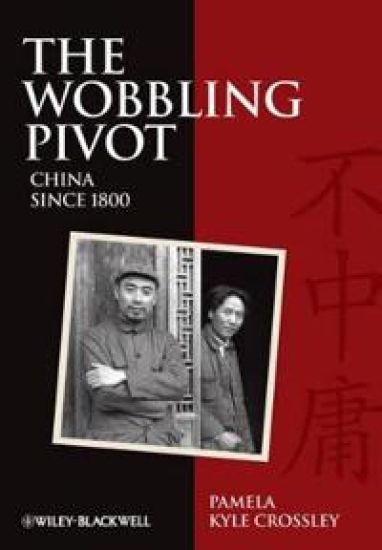
The Wobbling Pivot, China since 1800

The Wobbling Pivot, China since 1800

Pamela Kyle Crossley

Wiley-Blackwell (an imprint of John Wiley Sons Ltd)
2010
sidottu
This comprehensive but concise narrative of China since the eighteenth century builds its story around the delicate relationship between central government and local communities. Rejects the traditional view of China as a wholly harmonious society based on principles of stability – the Unwobbling Pivot of Ezra Pound's translation of the Chinese classic ZhongyongProvides an original interpretation, arguing that developments can be explained through an understanding of China’s surprising swings between centralization and decentralization, between local initiative and central authoritarianismServes as an introduction to the subject, while readers with a background in Chinese history will find the book offers a personal perspective and addresses long-standing interpretive issuesSupported by a variety of timelines, maps, illustrations, and extensive notes for further readingPlaces China’s history within the context of global change
The Wobbling Pivot, China since 1800

The Wobbling Pivot, China since 1800

Pamela Kyle Crossley

Wiley-Blackwell (an imprint of John Wiley Sons Ltd)
2010
nidottu
This comprehensive but concise narrative of China since the eighteenth century builds its story around the delicate relationship between central government and local communities. Rejects the traditional view of China as a wholly harmonious society based on principles of stability – the Unwobbling Pivot of Ezra Pound's translation of the Chinese classic ZhongyongProvides an original interpretation, arguing that developments can be explained through an understanding of China’s surprising swings between centralization and decentralization, between local initiative and central authoritarianismServes as an introduction to the subject, while readers with a background in Chinese history will find the book offers a personal perspective and addresses long-standing interpretive issuesSupported by a variety of timelines, maps, illustrations, and extensive notes for further readingPlaces China’s history within the context of global change
What is Global History?

What is Global History?

Pamela Kyle Crossley

Polity Press
2007
sidottu
Global and world history address the deep structural changes that have shaped human experience. Many are material, related to environmental and climatic alteration, to the domestication of livestock and development of agriculture, to technology, to disease, and to variations in human immunity, reproduction, and physiology. Others are social and cultural, touching upon issues of migration, trade, language development and differentiation, institutions of enslavement and of freedom, traditions of marriage and child-rearing, the emergence of large-scale political organization from early kingdoms to vast empires, republics and federations, and the management of war and peace. To deal with such challenging issues, global historians draw upon new techniques of analysis and comparison. But they also continue venerable traditions, inherited from the earliest civilizations, of narrating the past on the most comprehensive and significant scale possible. This book examines the long search for an integrated human story, and particularly the points at which rapid changes of philosophy and perspective in the twentieth century transformed the historical disciplines. It provides the perfect introduction to global history for students and scholars alike.
What is Global History?

What is Global History?

Pamela Kyle Crossley

Polity Press
2007
nidottu
Global and world history address the deep structural changes that have shaped human experience. Many are material, related to environmental and climatic alteration, to the domestication of livestock and development of agriculture, to technology, to disease, and to variations in human immunity, reproduction, and physiology. Others are social and cultural, touching upon issues of migration, trade, language development and differentiation, institutions of enslavement and of freedom, traditions of marriage and child-rearing, the emergence of large-scale political organization from early kingdoms to vast empires, republics and federations, and the management of war and peace. To deal with such challenging issues, global historians draw upon new techniques of analysis and comparison. But they also continue venerable traditions, inherited from the earliest civilizations, of narrating the past on the most comprehensive and significant scale possible. This book examines the long search for an integrated human story, and particularly the points at which rapid changes of philosophy and perspective in the twentieth century transformed the historical disciplines. It provides the perfect introduction to global history for students and scholars alike.
A Translucent Mirror

A Translucent Mirror

Pamela Kyle Crossley

University of California Press
2002
pokkari
In this landmark exploration of the origins of nationalism and cultural identity in China, Pamela Kyle Crossley traces the ways in which a large, early modern empire of Eurasia, the Qing (1636-1912), incorporated neighboring, but disparate, political traditions into a new style of emperorship. Drawing on a wide variety of primary sources, including Manchu, Korean, and Chinese archival materials, Crossley argues that distortions introduced in seventeenth- and eighteenth-century historical records have blinded scholars to the actual course of events in the early years of the dynasty. This groundbreaking study examines the relationship between the increasingly abstract ideology of the centralizing emperorship of the Qing and the establishment of concepts of identity in the seventeenth and eighteenth centuries, before the advent of nationalism in China. Concluding with a broad-ranging postscript on the implications of her research for studies of nationalism and nation-building throughout modern Chinese history, A Translucent Mirror combines a readable narrative with a sophisticated, revisionary look at China's history. Crossley's book will alter current understandings of the Qing emperorship, the evolution of concepts of ethnicity, and the legacy of Qing rule for modern Chinese nationalism.
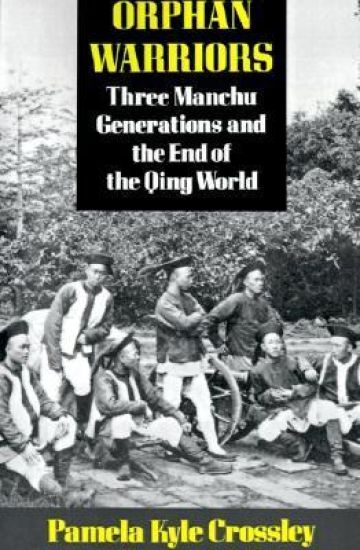
Orphan Warriors

Orphan Warriors

Pamela Kyle Crossley

Princeton University Press
1991
nidottu
In the mid-1600s, Manchu bannermen spearheaded the military force that conquered China and founded the Qing Empire, which endured until 1912. By the end of the Taiping War in 1864, however, the descendants of these conquering people were coming to terms with a loss of legal definition, an ever-steeper decline in living standards, and a sense of abandonment by the Qing court. Focusing on three generations of a Manchu family (from 1750 to the 1930s), Orphan Warriors is the first attempt to understand the social and cultural life of the bannermen within the context of the decay of the Qing regime. The book reveals that the Manchus were not "sinicized," but that they were growing in consciousness of their separate ethnicity in response to changes in their own position and in Chinese attitudes toward them. Pamela Kyle Crossley's treatment of the Suwan Guwalgiya family of Hangzhou is hinged upon Jinliang (1878-1962), who was viewed at various times as a progressive reformer, a promising scholar, a bureaucratic hack, a traitor, and a relic.The author sees reflected in the ambiguities of his persona much of the plight of other Manchus as they were transformed from a conquering caste to an ethnic minority. Throughout Crossley explores the relationships between cultural decline and cultural survival, polity and identity, ethnicity and the disintegration of empires, all of which frame much of our understanding of the origins of the modern world.