Kirjojen hintavertailu. Mukana 12 595 353 kirjaa ja 12 kauppaa.

Kirjailija

Pamela L. Eddy

Kirjat ja teokset yhdessä paikassa: 11 kirjaa, julkaisuja vuosilta 2007-2026, suosituimpien joukossa Rethinking Faculty Development. Vertaile teosten hintoja ja tarkista saatavuus suomalaisista kirjakaupoista.

11 kirjaa

Kirjojen julkaisuhaarukka 2007-2026.

Rethinking Faculty Development

Rethinking Faculty Development

Pamela L. Eddy; Katalin Wargo

EDWARD ELGAR PUBLISHING LTD
2026
sidottu
This state-of-the-art book examines the turbulence of faculty work amid major shifts in society, technology and public expectations. Reflecting on gaps in student preparation, holistic support for well-being and institutional infrastructure, Pamela L. Eddy and Katalin Wargo argue for a reimagining of faculty development that supports faculty members throughout their career to better align with transformative change. The authors introduce the ‘Agile Faculty Development Framework’ in response to this shifting environment. Grounded in principles of organizational learning and shared understanding of student, faculty, and institutional needs, this innovative framework illustrates how faculty development can be redesigned to strengthen well-being, promote inclusive teaching, support technology integration and cultivate both faculty leadership and leaders of faculty development efforts. Drawing on international case studies, this insightful book emphasizes the importance of supporting faculty well-being and sustaining faculty on their career pathway, providing evidence-based approaches for assisting faculty in their complex and ever-changing roles to enhance student learning. Rethinking Faculty Development is a vital resource for scholars and students of higher education policy, particularly those interested in bolstering the roles and functions of faculty. Faculty developers and higher education administrators will similarly benefit from its actionable recommendations.
A Blueprint for Equity-Driven Community College Leadership

A Blueprint for Equity-Driven Community College Leadership

Pamela L. Eddy; Kim E. VanDerLinden

Harvard Educational Publishing Group
2024
nidottu
Expert advice and effective strategies for community college leaders who endeavor to embed equity and social justice in institutional policies, practices, and structures Pamela Eddy and Kim VanDerLinden offer discerning guidance for advancing social justice and addressing persistent opportunity gaps in US higher education in A Blueprint for Equity-Driven Community College Leadership. Eddy and VanDerLinden argue that, given the diverse population of students that community colleges serve, these institutions are uniquely positioned to enact impactful equity-informed agendas that can promote social change, remedy inequitable and unjust structures and systems, and build opportunities for all students to be successful. They encourage presidents, provosts, directors, and faculty at community colleges to seize the chance afforded by COVID-19 upheavals to address urgent issues of equity on campus. Drawing from interviews and surveys of longtime community college leaders as well as literature on community college leadership and social justice initiatives, Eddy and VanDerLinden outline a three-part model that can strengthen collaboration among institutional leaders and create resilient, equitable communities of practice. They advise stakeholders to increase self-awareness through reflective exercises and examination of personal bias. Their model directs leaders to develop contextual competency by evaluating external forces that influence focus in institutions of higher education, including employer and community needs; state and national campaigns and calls for graduates; and backlash against diversity, equity, and inclusion (DEI) measures. This insightful work gives community college leaders across all positions and titles an introduction to strategies to promote organization-level change.
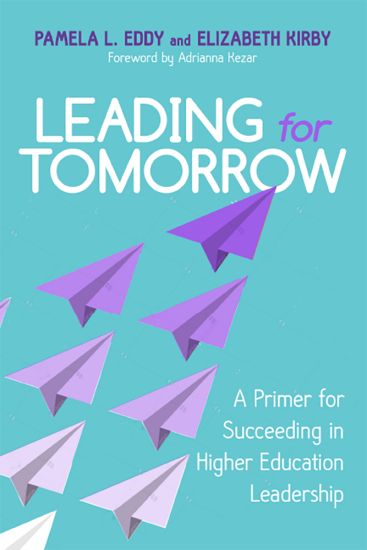
Leading for Tomorrow

Leading for Tomorrow

Pamela L. Eddy; Elizabeth Kirby; Adrianna Kezar

Rutgers University Press
2020
sidottu
When faculty climb the ranks into leadership positions, they come with years of knowledge and experience, yet they are often blindsided by the delicate interpersonal situations and political minefields they must now navigate as university administrators. What are the specific skills that faculty need to acquire when they move into administrative positions, and how can they build upon their existing abilities to excel in these roles? What skills can other mid-level leaders learn to help in their positions? Using an engaging case study approach, Leading for Tomorrow provides readers with real-world examples that will help them reflect on their own management and communication styles. It also shows newly minted administrators how they can follow best practices while still developing a style of leadership that is authentic and uniquely their own. The book’s case studies offer practical solutions for how to deal with emerging trends and persistent problems in the field of higher education, from decreasing state funding to political controversies on campus. Leading for Tomorrow gives readers the tools they need to get the best out of their team, manage conflicts, support student success, and instill a campus culture of innovation that will meet tomorrow’s challenges.
Charting Your Path to Full

Charting Your Path to Full

Vicki L. Baker; Pamela L. Eddy

Rutgers University Press
2020
nidottu
Institutions, faculty, and students benefit when women academics advance in their careers, yet research shows that women academics are more likely to stall at the associate professor stage of their careers than men. Charting Your Path to Full is a data- and literature-informed resource aimed at helping women in the professoriate excel in their careers, regardless of discipline and institution type. Vicki L. Baker draws on human resources, organizational studies, and positive organizational psychology to help women first focus on their joy as the primary driver of career and personal pursuits, and provides action steps, “To Do” lists, and additional tools and resources to lay out a clear step-by-step approach to help women academics reach their goals. Baker’s wealth of consulting and research insights provides a compelling and accessible approach to supporting women as they re-envision their careers.
Charting Your Path to Full

Charting Your Path to Full

Vicki L. Baker; Pamela L. Eddy

Rutgers University Press
2020
sidottu
Institutions, faculty, and students benefit when women academics advance in their careers, yet research shows that women academics are more likely to stall at the associate professor stage of their careers than men. Charting Your Path to Full is a data- and literature-informed resource aimed at helping women in the professoriate excel in their careers, regardless of discipline and institution type. Vicki L. Baker draws on human resources, organizational studies, and positive organizational psychology to help women first focus on their joy as the primary driver of career and personal pursuits, and provides action steps, “To Do” lists, and additional tools and resources to lay out a clear step-by-step approach to help women academics reach their goals. Baker’s wealth of consulting and research insights provides a compelling and accessible approach to supporting women as they re-envision their careers.
Developing Tomorrow's Leaders

Developing Tomorrow's Leaders

Pamela L. Eddy; Debbie L. Sydow; Richard L. Alfred; Regina L. Garza-Mitchell

Rowman Littlefield
2015
nidottu
The contributions of community colleges to society are well-documented. Yet, today’s community colleges are at a cross road. Decreases in funding support, a push for college completion, attention on developmental course work, and a host of other demands create a dynamic context for community college operations. Who leads these colleges matters as they face these demands and how they lead influences outcomes. Pending leadership retirements provide a prime opportunity for thinking about community college leadership in new ways. Entering this environment are prospective and aspiring leaders who are often not adequately prepared for the complexities of managing in a paradoxical organization. The era of accountability puts a fine point on the need for leaders to pay heed to the policy making process and to requirements dictated by state legislative bodies and accreditation bodies. Foundations and grant funders serve as instigators for changes in community colleges, as well and also support research into ways to link employer needs to college curricular changes. This book argues that neo-leaders are required to lead transformational change for today and tomorrow’s community colleges. No longer can we rely on single leaders atop a hierarchy. Talent throughout the institution must be tapped. The authors argue that networked leadership is needed. For networked leadership, we begin to advance thinking about the role of networks and connections among leaders throughout the college and beyond the college’s walls. This volume outlines underlying values critical for neo-leaders and offers questions leaders at various levels can use to jumpstart the type of courageous conversations needed on campus. The tools presented in this book provide current and aspiring leaders with resources to prepare for successfully leading the way and developing new leaders to shape the future. Our community colleges and their students require nothing less.
Developing Tomorrow's Leaders

Developing Tomorrow's Leaders

Pamela L. Eddy; Debbie L. Sydow; Richard L. Alfred; Regina L. Garza-Mitchell

Rowman Littlefield
2015
sidottu
The contributions of community colleges to society are well-documented. Yet, today’s community colleges are at a cross road. Decreases in funding support, a push for college completion, attention on developmental course work, and a host of other demands create a dynamic context for community college operations. Who leads these colleges matters as they face these demands and how they lead influences outcomes. Pending leadership retirements provide a prime opportunity for thinking about community college leadership in new ways. Entering this environment are prospective and aspiring leaders who are often not adequately prepared for the complexities of managing in a paradoxical organization. The era of accountability puts a fine point on the need for leaders to pay heed to the policy making process and to requirements dictated by state legislative bodies and accreditation bodies. Foundations and grant funders serve as instigators for changes in community colleges, as well and also support research into ways to link employer needs to college curricular changes. This book argues that neo-leaders are required to lead transformational change for today and tomorrow’s community colleges. No longer can we rely on single leaders atop a hierarchy. Talent throughout the institution must be tapped. The authors argue that networked leadership is needed. For networked leadership, we begin to advance thinking about the role of networks and connections among leaders throughout the college and beyond the college’s walls. This volume outlines underlying values critical for neo-leaders and offers questions leaders at various levels can use to jumpstart the type of courageous conversations needed on campus. The tools presented in this book provide current and aspiring leaders with resources to prepare for successfully leading the way and developing new leaders to shape the future. Our community colleges and their students require nothing less.
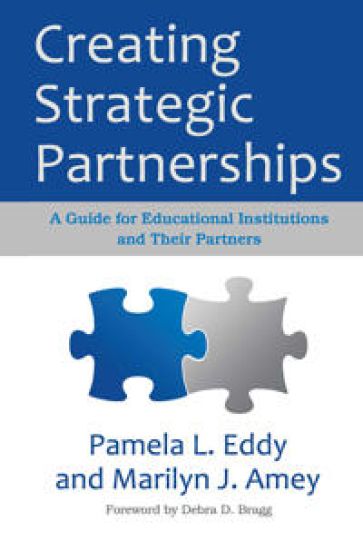
Creating Strategic Partnerships

Creating Strategic Partnerships

Pamela L. Eddy; Marilyn J. Amey

Stylus Publishing
2014
sidottu
What are the characteristics and conditions that lead to successful educational partnerships?What can we learn from partnerships that fail, cannot be sustained over time, or cease to benefit their partners?This book serves as a guide to the successful implementation of partnerships. It provides the context and tools for readers who are responding to the increasing demands of policy makers, funders and institutional leaders to use partnerships to address local, state and federal issues, achieve external mandates, meet public or internal agendas, or pursue international collaborations. This guide provides an evidence-based framework for institutional and organizational leaders to develop the vision, shared values and norms to achieve the “partnership capital” that will sustain an enduring relationship. It offers a three-phase model of the development process of collaboration, together with a tool box for those charged with partnering and leading organizational change, and includes a template for both creating new partnerships and sustaining existing ones.The authors start by differentiating between “traditional,” often ad-hoc, partnerships and “strategic partnerships” that align organizational strategy with partnership actions; and by identifying the importance of moving beyond incremental or surface “first order” change to develop deep “second order change” through which underlying structures and operations are questioned and new processes emerge due to the partnership. They offer analyses and understandings of seven key components for success: exploring motivations; developing partner relationships; communicating and framing purpose; creating collaborative structures and resources; leading various partnership stages; generating partnership capital; and implementing strategies for sustaining partnerships. Each chapter concludes with a case study to provide more understanding of the ideas presented, and for use in training or classes. This guide is addressed to policy makers and educational leaders, college administrators, and their non-profit and business partners, to enable them to lead and create strategic partnerships and facilitate organizational change.
Creating Strategic Partnerships

Creating Strategic Partnerships

Pamela L. Eddy; Marilyn J. Amey

Stylus Publishing
2014
nidottu
What are the characteristics and conditions that lead to successful educational partnerships?What can we learn from partnerships that fail, cannot be sustained over time, or cease to benefit their partners?This book serves as a guide to the successful implementation of partnerships. It provides the context and tools for readers who are responding to the increasing demands of policy makers, funders and institutional leaders to use partnerships to address local, state and federal issues, achieve external mandates, meet public or internal agendas, or pursue international collaborations. This guide provides an evidence-based framework for institutional and organizational leaders to develop the vision, shared values and norms to achieve the “partnership capital” that will sustain an enduring relationship. It offers a three-phase model of the development process of collaboration, together with a tool box for those charged with partnering and leading organizational change, and includes a template for both creating new partnerships and sustaining existing ones.The authors start by differentiating between “traditional,” often ad-hoc, partnerships and “strategic partnerships” that align organizational strategy with partnership actions; and by identifying the importance of moving beyond incremental or surface “first order” change to develop deep “second order change” through which underlying structures and operations are questioned and new processes emerge due to the partnership. They offer analyses and understandings of seven key components for success: exploring motivations; developing partner relationships; communicating and framing purpose; creating collaborative structures and resources; leading various partnership stages; generating partnership capital; and implementing strategies for sustaining partnerships. Each chapter concludes with a case study to provide more understanding of the ideas presented, and for use in training or classes. This guide is addressed to policy makers and educational leaders, college administrators, and their non-profit and business partners, to enable them to lead and create strategic partnerships and facilitate organizational change.
Community College Leadership

Community College Leadership

Pamela L. Eddy

Stylus Publishing
2010
nidottu
Two-year colleges are facing major change. The majority will undergo a turnover in college presidencies in the next ten years, at a time when they are being asked to be engines for economic growth, enable more students – and a greater diversity of students – to gain 21st century qualifications, and provide a pathway to higher degrees, all with reduced state and local funding. Recognizing that future community college leaders – at all levels– will manage increasingly complex organizations, and face very different challenges than their predecessors, this book provides a multidimensional model of leadership suited to these new demands and environments. The model addresses issues of leader cognition, race and gender, the importance of culture, and the need for more collaborative modes of communication and decision making to frame and implement change. It recognizes that there is no longer any one way to lead, and that the next generation of leaders will be more diverse, possess experience and qualifications from a wider variety of careers, and follow new pathways to their positions. Leaders in the future will possess a cultural competency that is fostered by being lifelong learners.Through over 75 individual interviews with leaders and campus members, Eddy is able to provide examples of the model’s components in practice and to illuminate which experiences proved the most relevant for these leaders on their route to upper administration. She shows how her model intersects with the leadership competencies defined by the American Association of Community Colleges, and proposes strategies for future leadership development. This book is intended for anyone considering a leadership position, at any level, in a community college; for college administrators and boards responsible for leadership development programs; and for individuals in corresponding organizations who conduct training programs for aspiring leaders. Likewise, those employed at four-year universities may find value in the model as a developmental tool.
Creating the Future of Faculty Development

Creating the Future of Faculty Development

Mary Deane Sorcinelli; Ann E. Austin; Pamela L. Eddy; Andrea L. Beach

Anker Publishing Co
2007
sidottu
In recent years, new expectations of higher education from parents, employers, trustees, and government leaders have contributed to broad institutional changes. Recognizing that the quality of a university or college is closely related to that of its faculty members, many institutions have increased their efforts to support and enrich faculty work. Creating the Future of Faculty Development addresses this growing need for faculty development by exploring how faculty development has evolved and envisioning its future. Based on a study of nearly 500 faculty developers from all institution types, the book examines core issues such as the structural variations among faculty development programs; the goals, purposes, and models that guide and influence faculty program developments; and the top challenges facing faculty members, institutions, and their programs. Several key questions are addressed, including What are the structural variations among faculty development programs?What goals, purposes, and models guide and influence program development?What are the top challenges facing faculty members, institutions, and faculty development programs?What are potential new directions and visions for the field of faculty development? Creating the Future of Faculty Development summarizes the challenges and pressures now facing developers and higher education as a whole. In this book, readers will find reason to rethink how they approach, organize, and support faculty development as they engage in institutional planning for the future.