Kirjojen hintavertailu. Mukana 12 390 323 kirjaa ja 12 kauppaa.

Kirjailija

Panos J. Antsaklis

Kirjat ja teokset yhdessä paikassa: 7 kirjaa, julkaisuja vuosilta 1998-2021, suosituimpien joukossa Hybrid Dynamical Systems. Vertaile teosten hintoja ja tarkista saatavuus suomalaisista kirjakaupoista.

7 kirjaa

Kirjojen julkaisuhaarukka 1998-2021.

Hybrid Dynamical Systems

Hybrid Dynamical Systems

Hai Lin; Panos J. Antsaklis

Springer Nature Switzerland AG
2021
sidottu
A graduate-level textbook, Hybrid Dynamical Systems provides an accessible and comprehensive introduction to the theory of hybrid systems. It emphasizes results that are central to a good understanding of the importance and role of such systems. The authors have developed the materials in this book while teaching courses on hybrid systems, cyber-physical systems, and formal methods.This textbook helps students to become familiar with both the major approaches coloring the study of hybrid dynamical systems. The computer science and control systems points of view – emphasizing discrete dynamics and real time, and continuous dynamics with switching, respectively – are each covered in detail.The book shows how the behavior of a system with tightly coupled cyber- (discrete) and physical (continuous) elements can best be understood by a model simultaneously encompassing all the dynamics and their interconnections. The theory presented is of fundamental importance in a wide range of emerging fields from next-generation transportation systems to smart manufacturing.Features of the text include:extensive use of examples to illustrate the main concepts and to provide insights additional to those acquired from the main text;chapter summaries enabling students to assess their progress;end-of-chapter exercises, which test learning as a course proceeds;an instructor’s guide showing how different parts of the book can be exploited for different course requirements; anda solutions manual, freely available for download by instructors adopting the book for their teaching.Access to MATLAB and Stateflow is not required but would be beneficial, especially for exercises in which simulations are a key tool.
Hybrid Dynamical Systems

Hybrid Dynamical Systems

Hai Lin; Panos J. Antsaklis

now publishers Inc
2014
nidottu
The methods for hybrid systems are distributed across a wide spectrum, ranging from methods known in the discrete (cyber-)domain at one end, to traditional approaches for the continuous physical systems at the other. Rooted at opposite ends, both computer scientists and control theorists have made significant contributions to the field of hybrid systems by extending traditional methods from the traditional discrete or continuous domain to deal with hybrid systems. However, in general, there has been little work on integrating methods from these two domains. This is possibly because the formal methods pursued in computer science traditionally lie in the realm of discrete mathematics, while control theory approaches lie mainly in the realm of continuous mathematics.A noticeable trend in the recent hybrid system literature emphasizes the synthesis of hybrid controllers for continuous or hybrid dynamical systems to satisfy complicated temporal logic specifications. This is known as symbolic control or hybrid supervisory control, which can be seen as a crosstalk between these two schools of thoughts. Hybrid Dynamical Systems balances the emphasis on methods from both computer science and control theory, and gives the readers a complete picture of the whole field of hybrid dynamical systems. As well as providing a concise overview for a researcher in the field, the tutorial style makes it suitable for use in a course and by students.
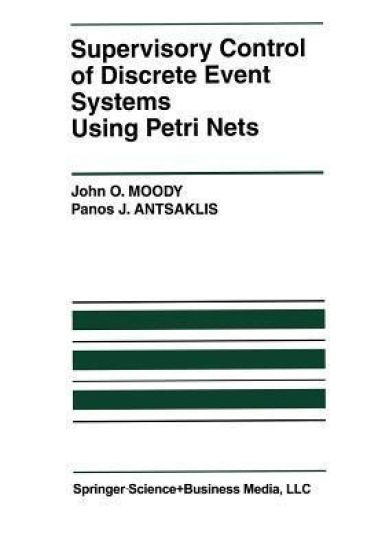
Supervisory Control of Discrete Event Systems Using Petri Nets

Supervisory Control of Discrete Event Systems Using Petri Nets

John O. Moody; Panos J. Antsaklis

Springer-Verlag New York Inc.
2012
nidottu
Supervisory Control of Discrete Event Systems Using Petri Nets presents a novel approach to its subject. The concepts of supervisory control and discrete event systems are explained, and the background material on general Petri net theory necessary for using the book's control techniques is provided. A large number of examples is used to illustrate the concepts and techniques presented in the text, and there are plenty of references for those interested in additional study or more information on a particular topic. Supervisory Control of Discrete Event Systems Using Petri Nets is intended for graduate students, advanced undergraduates, and practicing engineers who are interested in the control problems of manufacturing, communication and computer networks, chemical process plants, and other high-level control applications. The text is written from an engineering perspective, but it is also appropriate for students of computer science, applied mathematics, or economics. The book contains enough background material to stand alone as an introduction to supervisory control with Petri nets, but it may also be used as a supplemental text in a course on discrete event systems or intelligent autonomous control.
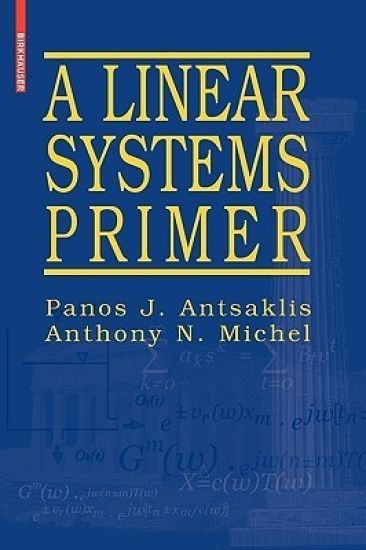
A Linear Systems Primer

A Linear Systems Primer

Panos J. Antsaklis; Anthony N. Michel

Birkhauser Boston Inc
2007
nidottu
Based on a streamlined presentation of the authors' successful work Linear Systems, this textbook provides an introduction to systems theory with an emphasis on control. Fundamental results and topics essential to linear systems theory are emphasized. Key features and topics: * Notes, references, exercises, and a summary and highlights section at the end of each chapter. * Comprehensive index and answers to selected exercises at the end of the book. * Three core chapters guiding the reader to an excellent understanding of the dynamical behavior of systems. * Detailed coverage of internal and external system descriptions, including state variable, impulse response and transfer function, polynomial matrix, and fractional representations. * Explanation of stability, controllability, observability, and realizations with an emphasis on fundamental results. * Detailed discussion of state-feedback, state-estimation, and eigenvalue assignment. * Emphasis on time-invariant systems, both continuous- and discrete-time. For full coverage of time-variant systems, the reader is encouraged to refer to the companion book Linear Systems, which contains more detailed descriptions and additional material, including all the proofs of the results presented here. * Solutions manual available to instructors upon adoption of the text. A Linear Systems Primer is geared towards first-year graduate and senior undergraduate students in a typical one-semester introductory course on systems and control. It may also serve as an excellent reference or self-study guide for electrical, mechanical, chemical, and aerospace engineers, applied mathematicians, and researchers working in control, communications, and signal processing. Also by the authors: Linear Systems, ISBN 978-0-8176-4434-5.
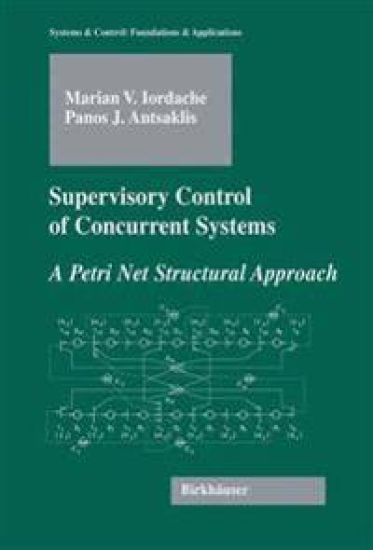
Supervisory Control of Concurrent Systems

Supervisory Control of Concurrent Systems

Marian Iordache; Panos J. Antsaklis

Birkhauser Boston Inc
2006
sidottu
Increasing complexity in engineering projects raises difficult challenges in industry and requires effective tools for correct-by-construction design or design verification. This book addresses the design of such tools for correct-by-construction synthesis of supervisors for systems and specifications represented in the discrete-event framework. The approach employed uses Petri nets as discrete-event models and structural methods for the synthesis of supervisors, and may lead to significant computational benefits. Highlighting recent progress in the design of supervisors by structural methods, the book represents a novel contribution to the field. One of the main features of the presentation is the demonstration that structural methods can address a variety of supervisor specifications under diverse supervision settings. The work is self-contained and includes necessary background on Petri nets and supervision. Requiring only basic knowledge of undergraduate-level discrete mathematics, the text is accessible to a broad audience. Researchers and developers from various engineering fields may find effective means to reduce the complexity of design problems in the discrete-event setting. Graduate students may use the work as a self-study reference, and portions of the text may be used in advanced courses on discrete-event systems.
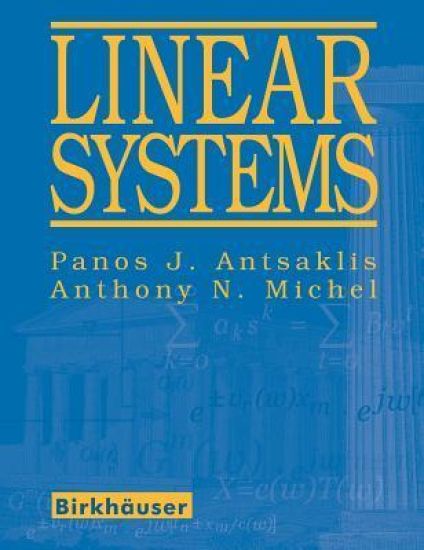
Linear Systems

Linear Systems

Panos J. Antsaklis; Anthony N. Michel

Birkhauser Boston Inc
2005
sidottu
"...A comprehensive, complete and clear exposition that serves as an excellent foundation for more advanced topics in system theory and control." - IEEE Transactions on Automatic Control "[The authors] have contributed an expertly written and high quality textbook...and are to be congratulated.... Because of its mathematical sophistication and completeness the present book is highly recommended for use, both as a textbook as well as a reference." - Automatica Linear systems theory plays a broad and fundamental role in electrical, mechanical, chemical and aerospace engineering, communications, and signal processing. A thorough introduction to systems theory with emphasis on control is presented in this self-contained textbook. The book examines the fundamental properties that govern the behavior of systems by developing their mathematical descriptions. Linear time-invariant, time-varying, continuous-time, and discrete-time systems are covered. Rigorous development of classic and contemporary topics in linear systems, as well as extensive coverage of stability and polynomial matrix/fractional representation, provide the necessary foundation for further study of systems and control. Linear Systems is written as a textbook for a challenging one-semester graduate course; a solutions manual is available to instructors upon adoption of the text. The book’s flexible coverage and self-contained presentation also make it an excellent reference guide or self-study manual. For a treatment of linear systems that focuses primarily on the time-invariant case using streamlined presentation of the material with less formal and more intuitive proofs, see the authors’ companion book entitled A Linear Systems Primer.
Supervisory Control of Discrete Event Systems Using Petri Nets

Supervisory Control of Discrete Event Systems Using Petri Nets

John O. Moody; Panos J. Antsaklis

Springer
1998
sidottu
Supervisory Control of Discrete Event Systems Using Petri Nets presents a novel approach to its subject. The concepts of supervisory control and discrete event systems are explained, and the background material on general Petri net theory necessary for using the book's control techniques is provided. A large number of examples is used to illustrate the concepts and techniques presented in the text, and there are plenty of references for those interested in additional study or more information on a particular topic. Supervisory Control of Discrete Event Systems Using Petri Nets is intended for graduate students, advanced undergraduates, and practicing engineers who are interested in the control problems of manufacturing, communication and computer networks, chemical process plants, and other high-level control applications. The text is written from an engineering perspective, but it is also appropriate for students of computer science, applied mathematics, or economics. The book contains enough background material to stand alone as an introduction to supervisory control with Petri nets, but it may also be used as a supplemental text in a course on discrete event systems or intelligent autonomous control.