Kirjojen hintavertailu. Mukana 12 390 323 kirjaa ja 12 kauppaa.

Kirjailija

Paolo Ricci

Kirjat ja teokset yhdessä paikassa: 6 kirjaa, julkaisuja vuosilta 2005-2026, suosituimpien joukossa Overcoming Gangsterism and Geo-Political Anarchy. Vertaile teosten hintoja ja tarkista saatavuus suomalaisista kirjakaupoista.

6 kirjaa

Kirjojen julkaisuhaarukka 2005-2026.

The Meaning of Shared Value

The Meaning of Shared Value

Paolo Ricci; Patrick O'Sullivan; Floriana Fusco

TAYLOR FRANCIS LTD
2024
nidottu
The concept of Creating Shared Value (CSV) – creating 'economic' value in a way that also creates value for the whole of society – has risen in prominence as a corporate policy and a strategy in recent years, mainly for third sector or development organisations. However, while it has received considerable interest among business leaders and practitioners, it has also sparked a bitter debate among academics, proponents and sceptics of the idea. Starting from this argument, the book develops a meta-critical examination of the hidden presuppositions of both supporters and critics of Creating Shared Value, particular in relation to the concept of value. It is argued that there are not two separate types of value, i.e. an economic value and a social value, but only a unique one: which essentially means the creation of well-being. If anything, the distinction that is drawn relates to the value capture (how the value created is distributed among different staekholders) and not to value creation (additions to potential well-being) since the notion of value itself is univocal. Behind the debate are two implicit opposed viewpoints on the philosophy of history: an antagonistic (pessimistic) and a cooperative (optimistic) view. The authors are thus led to a discussion of which of the two visions appears to be the most rational in today's world. The book is addressed to readers with an interest in the core concept of value, primarily in economics, strategic management, and philosophy.
The Political Economy and Ethics of Debt Financing

The Political Economy and Ethics of Debt Financing

Patrick O'Sullivan; Paolo Ricci

TAYLOR FRANCIS LTD
2024
sidottu
This book takes a fresh look at an age-old controversy in ethics and political economy that stretches right back to Aristotle: the morality and the economics of debt financing, or the charging of interest on loans. It endeavours to show the immense relevance of those ancient debates in the contemporary economy.Outside of countries which practise Islam and Islamic finance, the charging of interest is taken completely for granted today and little or no thought is devoted to its morality or economic and social impacts. This book argues that in fact the question of the morality of charging interest is still debatable and deserves to be considered anew in the 21st century for the light it can shine on certain salient contemporary sources of economic malaise. This book will first of all review the ancient debates on these questions stretching back to Aristotle seeking to restate the concerns in terms of contemporary economic theories and realities. It will also then delve into the current practices in respect of lending of all kinds that can be found in those Islamic countries and financial institutions which endeavour to follow the prohibition of riba (charging of any kind of interest). This will be contrasted with the impact of interest and debt financing in the contemporary non-Islamic economies arguing that debt financing of businesses promotes greater rates of bankruptcy over the business cycle and that the charging of interest on loans for current consumption purposes will over time increase inequality and inequitable concentration of wealth in societies where it is practised. It will also be shown how in a system without predetermined interest charges problems of exponentially exploding government debt could largely and neatly be avoided by linking bondholder rewards to levels of fiscal proceeds of states.This book will be of significant interest to readers in ethics, moral philosophy and political economy as well as to policymakers and thinkers grappling with issues around debt burdens (public and private), inequality and fairness.
The Meaning of Shared Value

The Meaning of Shared Value

Paolo Ricci; Patrick O'Sullivan; Floriana Fusco

TAYLOR FRANCIS LTD
2023
sidottu
The concept of Creating Shared Value (CSV) – creating 'economic' value in a way that also creates value for the whole of society – has risen in prominence as a corporate policy and a strategy in recent years, mainly for third sector or development organisations. However, while it has received considerable interest among business leaders and practitioners, it has also sparked a bitter debate among academics, proponents and sceptics of the idea. Starting from this argument, the book develops a meta-critical examination of the hidden presuppositions of both supporters and critics of Creating Shared Value, particular in relation to the concept of value. It is argued that there are not two separate types of value, i.e. an economic value and a social value, but only a unique one: which essentially means the creation of well-being. If anything, the distinction that is drawn relates to the value capture (how the value created is distributed among different staekholders) and not to value creation (additions to potential well-being) since the notion of value itself is univocal. Behind the debate are two implicit opposed viewpoints on the philosophy of history: an antagonistic (pessimistic) and a cooperative (optimistic) view. The authors are thus led to a discussion of which of the two visions appears to be the most rational in today's world. The book is addressed to readers with an interest in the core concept of value, primarily in economics, strategic management, and philosophy.
Environmental and Health Risk Assessment and Management
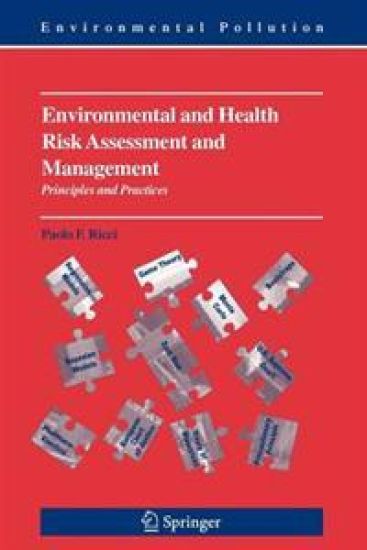
This textbook is about the law, economics, practical assessment, and the management of risky activities arising from routine, catastrophic environmental and occupational exposures to hazardous agents. The textbook begins where emission and exposure analysis end by providing estimates or predictions of deleterious exposures. Thus, we deal with determining the nature and form of relations between exposure and response, damage functions, and with the principles and methods used to determine the costs and benefits of risk management actions from the vantage point of single and multiple decision-makers. Today, national and international laws, conventions and protocols are increasingly concerned with reducing environmental and health risks through minimizing exposure to toxic substances, bacteria, viruses and other noxious agents. They do so through risk methods. The reason for the now worldwide use of risk assessment and management is that individuals and society must decide when, and at what cost, past and future hazardous conditions can either be avoided or minimized. In this process, society must account for the limited resources it can spend to remain sustainable. Risk-based methods play a pivotal role in identifying and ranking alternative, sustainable choices, while accounting for uncertainty and variability. Specifically, most reductions in risks require a balancing of the costs and benefits associated with the action to reduce exposure to a hazard and thus risk. This balancing necessarily involves linking exposure and response through causation. This essential aspect of risk assessment and management, if done incorrectly, can be costly to society.
Environmental and Health Risk Assessment and Management

Environmental and Health Risk Assessment and Management

Paolo Ricci

Springer-Verlag New York Inc.
2005
sidottu
This textbook is about the law, economics, practical assessment, and the management of risky activities arising from routine, catastrophic environmental and occupational exposures to hazardous agents. The textbook begins where emission and exposure analysis end by providing estimates or predictions of deleterious exposures. Thus, we deal with determining the nature and form of relations between exposure and response, damage functions, and with the principles and methods used to determine the costs and benefits of risk management actions from the vantage point of single and multiple decision-makers. Today, national and international laws, conventions and protocols are increasingly concerned with reducing environmental and health risks through minimizing exposure to toxic substances, bacteria, viruses and other noxious agents. They do so through risk methods. The reason for the now worldwide use of risk assessment and management is that individuals and society must decide when, and at what cost, past and future hazardous conditions can either be avoided or minimized. In this process, society must account for the limited resources it can spend to remain sustainable. Risk-based methods play a pivotal role in identifying and ranking alternative, sustainable choices, while accounting for uncertainty and variability. Specifically, most reductions in risks require a balancing of the costs and benefits associated with the action to reduce exposure to a hazard and thus risk. This balancing necessarily involves linking exposure and response through causation. This essential aspect of risk assessment and management, if done incorrectly, can be costly to society.