Kirjojen hintavertailu. Mukana 12 390 323 kirjaa ja 12 kauppaa.

Kirjailija

Paolo Virno

Kirjat ja teokset yhdessä paikassa: 12 kirjaa, julkaisuja vuosilta 2008-2026, suosituimpien joukossa On Impotence. Vertaile teosten hintoja ja tarkista saatavuus suomalaisista kirjakaupoista.

12 kirjaa

Kirjojen julkaisuhaarukka 2008-2026.

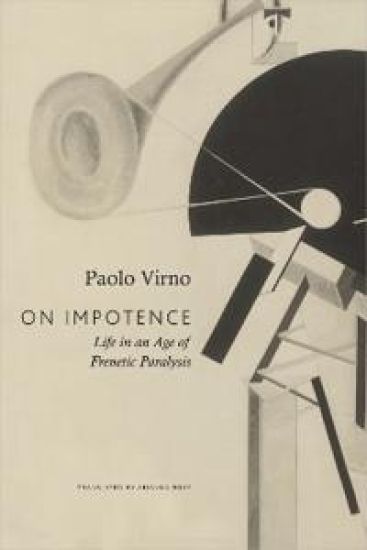
On Impotence

On Impotence

Paolo Virno

SEAGULL BOOKS LONDON LTD
2026
nidottu
An incisive and urgent book that explores the hidden roots of our contemporary powerlessness. Contemporary life is marked by a paradoxical form of impotence. Whether in love, labor, or political struggle, we often find ourselves locked in a state of frenetic paralysis—unable to act as we wish or to endure what confronts us. This impotence is not born of lack, but of excess: an abundance of skills, capacities, and opportunities that, instead of taking form as coherent actions or speech, stagnate and turn in on themselves. In this thought-provoking meditation, philosopher Paolo Virno examines this strange impotence through the lens of classical thought, drawing especially on Aristotle and Marx. To overcome this troubling state, Virno calls for a collective search for a shared spiritual and practical exercise aimed at reclaiming agency. He argues that only by learning to renounce renunciation can we cultivate deliberate words and timely decisions.
On Impotence

On Impotence

Paolo Virno

SEAGULL BOOKS LONDON LTD
2026
sidottu
An incisive and urgent book that explores the hidden roots of our contemporary powerlessness. Contemporary life is marked by a paradoxical form of impotence. Whether in love, labor, or political struggle, we often find ourselves locked in a state of frenetic paralysis—unable to act as we wish or to endure what confronts us. This impotence is not born of lack, but of excess: an abundance of skills, capacities, and opportunities that, instead of taking form as coherent actions or speech, stagnate and turn in on themselves. In this thought-provoking meditation, philosopher Paolo Virno examines this strange impotence through the lens of classical thought, drawing especially on Aristotle and Marx. To overcome this troubling state, Virno calls for a collective search for a shared spiritual and practical exercise aimed at reclaiming agency. He argues that only by learning to renounce renunciation can we cultivate deliberate words and timely decisions.
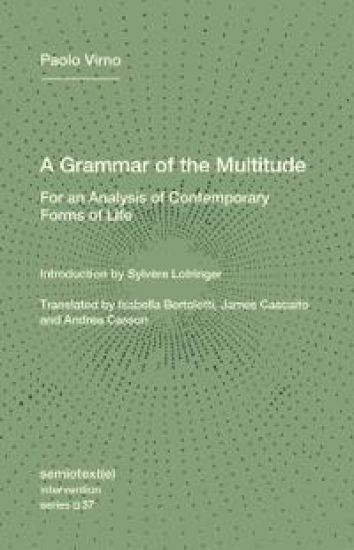
A Grammar of the Multitude

A Grammar of the Multitude

Paolo Virno; Sylvere Lotringer

Semiotext (E)
2025
nidottu
Paolo Virno's on the rich concept of the "multitude" as crucial to understanding contemporary life. Paolo Virno's A Grammar of the Multitude became the Italian theorist's best-known work in English, influencing a generation of activists and performance artists, when it was first published by Semiotext(e) in 2004. Two decades later, this new edition proves Virno's conception of contemporary life--as a cartography of virtualities made possible by post-Fordism--to have been strikingly prescient. At the start of the twenty-first century, globalization forced a rethinking of some of the categories--such as "the people"--that had been traditionally associated with the now-eroding state. Virno argues that the category of "multitude," elaborated by Spinoza and for the most part left fallow since the seventeenth century, is a far better tool to analyze contemporary issues than the Hobbesian concept of "people" favored by classical political philosophy. Hobbes, who detested the notion of multitude, defined it as shunning political unity, resisting authority, and never entering into lasting agreements. "When they rebel against the state," Hobbes wrote, "the citizens are the multitude against the people." But the multitude isn't just a negative notion; it is a rich concept that allows us to examine anew plural experiences and forms of nonrepresentative democracy. Drawing from philosophy of language, political economics, and ethics, Virno shows that being foreign, "not-feeling-at-home-anywhere," is a condition that forces the multitude to place its trust in the intellect. In conclusion, Virno suggests that the metamorphosis of the social systems in the West during the 1980s and 1990s precipitated a paradoxical "Communism of the Capital."
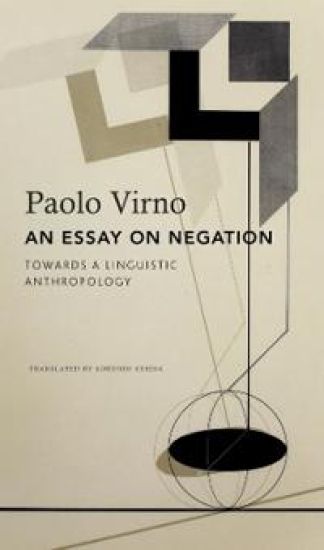
An Essay on Negation

An Essay on Negation

Paolo Virno

SEAGULL BOOKS LONDON LTD
2024
nidottu
A vital addition to Seagull’s growing Italian List that focuses on leftist Italian thought, bringing famous as well as little-known yet crucial voices into the English language. As speaking animals, we continuously make use of an unassuming grammatical particle, without suspecting that what is at work in its inconspicuousness is a powerful apparatus, which orchestrates language, signification, and the world at large. What particle might this be? The word not. In Essay on Negation, Paolo Virno argues that the importance of the not is perhaps comparable only to that of money—that is, the universality of exchange. Negation is what separates verbal thought from silent cognitive operations, such as feelings and mental images. Speaking about what is not happening here and now, or about properties that are not referable to a given object, the human animal deactivates its original neuronal empathy, which is prelinguistic; it distances itself from the prescriptions of its own instinctual endowment and accesses a higher sociality, negotiated and unstable, which establishes the public sphere. In fact, the speaking animal soon learns that the negative statement does not amount to the linguistic double of unpleasant realities or destructive emotions: while it rejects them, negation also names them and thus includes them in social life. Virno sees negation as a crucial effect of civilization, one that is, however, also always exposed to further regressions. Taking his cue from a humble word, the author is capable of unfolding the unexpected phenomenology of the negating consciousness.
The Idea of World

The Idea of World

Paolo Virno

SEAGULL BOOKS LONDON LTD
2022
nidottu
A philosophical exploration of what capitalistic societies truly mean for the individual. A short vade mecum for unrepentant materialism, The Idea of World collects three essays by Italian philosopher Paulo Virno that are intricately wrapped around one another. The first essay, "Mundanity," tries to clarify what the term "world," as referred to as the perceptual and historical context of our existence, means-both with and against Kant and Wittgenstein. How should we understand expressions such as "worldly people," "the course of the world," or "getting by in this world"? The second, "Virtuosity and Revolution," is a minor political treatise. Virno puts forward a set of concepts capable of confronting the magnetic storm that has knocked out the compasses that every reflection on the public sphere has relied on since the seventeenth century. The third, "The Use of Life", is the shorthand delineation of a research program on the notion of use. What exactly are we doing when we use a hammer, a time span, or an ironic sentence? And, above all, what does the use of the self-of one's own life, which lies at the basis of all uses-amount to in human existence? Presenting his ideas in three distinct vignettes, Virno examines how the philosophy of language, anthropology, and political theory are inextricably linked.
Kun sana tulee lihaksi

Kun sana tulee lihaksi

Paolo Virno

TUTKIJALIITTO
2022
nidottu
Teoksessaan Kun sana tulee lihaksi - Kieli ja ihmisluonto italialainen filosofi Paolo Virno (s. 1952) pohtii Aristoteleen määritelmiä ihmisestä kielellisenä ja poliittisena eläimenä. Kirjan keskeinen ajatus on, että ihmisen kielellisyyttä, erityisesti puhetta, tulisi tarkastella aina jo itsessään poliittisena, ja pohjimmiltaan julkisena toimintana. Puheaktit ovat Virnon mukaan poliittisia käytäntöjä, jotka määrittävät ihmisen biologisten piirteiden ja historiallisten olosuhteiden välisiä kytkentöjä; suhdettamme ihmisluontoon, kieleen sekä sosiaalisiin kokemuksiin.Tarkastellessaan puhetta tekona ja toimena, Virno päätyy esittämään teesin mielen julkisesta luonteesta. Puheen ja mielen julkinen luonne on Virnolle osoitus kokemuksellisista mahdollisuuksista, joiden kautta voidaan lähestyä aikamme poliittisia haasteita.
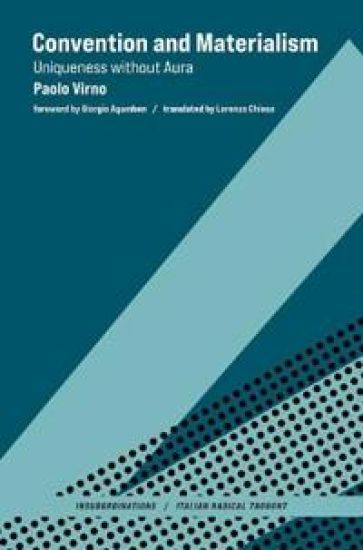
Convention and Materialism

Convention and Materialism

Paolo Virno; Giorgio Agamben

MIT Press
2021
sidottu
The first English translation of the book that established Paolo Virno as one of the most influential Italian thinkers of his generation. With the 1986 publication of this book in Italy, Paolo Virno established himself as one of the most influential Italian thinkers of his generation. Astonishingly, this crucial work has never before been published in an English translation. This MIT Press edition, translated by Italian philosopher and Insubordinations series editor Lorenzo Chiesa, is its first English-language version. Virno here engages, in an innovative and iconoclastic way, with some classical issues of philosophy involving experience, singularity, and the relation between ethics and language, while also offering a profoundly transformative political perspective that revolves around the Marxian notion of the general intellect. Virno reconsiders Walter Benjamin's idea of a loss of the aura (brought on, Benjamin argued, by technical reproducibility), and postulates instead the existence of a new experience of uniqueness that, although deprived of every metaphysical aura, resides in the very process of late-capitalist serial reproduction. Writing after the defeat of contemporary leftist revolutionary movements in the West, Virno argues for the possibility of a good life originating immanently from existential and political crises. With speculative detours through the thought of philosophers ranging from Aquinas and Berkeley to Heidegger and Wittgenstein, with a specific focus on Kant and Hegel, Virno shows how a renewed reflection on basic theoretical problems helps us to better grasp what is happening now. This edition features a preface written by Virno in 2011.
Essay on Negation

Essay on Negation

Paolo Virno

Seagull Books London Ltd
2018
sidottu
As speaking animals, we continuously make use of an unassuming grammatical particle, without suspecting that what is at work in its inconspicuousness is a powerful apparatus, which orchestrates language, signification, and the world at large. What particle might this be? The word not. In Essay on Negation, Paol Virno argues that not's importance is perhaps comparable only to that of money that is, the universality of exchange. Negation is what separates verbal thought from silent cognitive operations, such as feelings and mental images. Speaking about what is not happening here and now, or about properties that are not referable to a given object, the human animal deactivates its original neuronal empathy, which is prelinguistic; it distances itself from the prescriptions of its own instinctual endowment and accesses a higher sociality, negotiated and unstable, which establishes the public sphere. In fact, the speaking animal soon learns that the negative statement does not amount to the linguistic double of unpleasant realities or destructive emotions: while it rejects them, negation also names them and thus includes them in social life. Virno sees negation as a crucial effect of civilization, one that is, however, also always exposed to further regressions. Taking his cue from a humble word, the author is capable of unfolding the unexpected phenomenology of the negating consciousness.
When the Word Becomes Flesh

When the Word Becomes Flesh

Paolo Virno

Semiotext (E)
2015
pokkari
Virno's meditation on speech as an intrinsically political practice mediating between biological invariants and changing historical determinations.Originally published in Italian in 2002, When the Word Becomes Flesh provides a compelling contribution to the understanding of language and its relation to human nature and social relationships. Adopting Aristotle's definition of the human being as a linguistic and political animal, Paolo Virno frames the act of speech as a foundational philosophical issue-an act that in its purely performative essence ultimately determines our ability to pass from the state of possibility to one of actuality: that is, from the power to act to action itself. As the ultimate public act, speech reveals itself to be an intrinsically political practice mediating between biological invariants and changing historical determinations. In his most complete reflection on the topic to date, Virno shows how language directly expresses the conditions of possibility for our experience, from both a transcendental and a biological point of view. Drawing on the work of such twentieth-century giants as Ferdinand de Saussure, Ludwig Wittgenstein, Edmund Husserl, and Gottlob Frege, Virno constructs a powerful linguistic meditation on the political challenges faced by the human species in the twenty-first century. It is in language that human nature and our historical potentialities are fully revealed, and it is language that can guide us toward a more aware and purposeful realization of them.
Déjà Vu and the End of History

Déjà Vu and the End of History

Paolo Virno

Verso Books
2015
nidottu
This book places two key notions up against each other to imagine a new way of conceptualizing historical time. How do the experience of déjà vu and the idea 'End of History' relate to one another? Through thinkers like Bergson, Kojève and Nietzsche, Virno explores these constructs of memory and the passage of time. In showing how the experience of time becomes historical, Virno considers two fundamental concepts from Western philosophy: Power and The Act, reinterpreting these with respect to time. Through these, he elegantly constructs a radical new theory of historical temporality.
Multitudens grammatik

Multitudens grammatik

Paolo Virno

Tankekraft Förlag
2011
nidottu
Multitudens grammatik är den italienske filosofen Paolo Virnos internationellt mest kända bok. Denna tunna skrift har använts av och påverkat alltifrån samhällsvetare och ekonomer till aktivister och konstnärer. Multitudens grammatik handlar om vad som händer när hela livet underställs lönearbetets logik, när våra kroppar, språk och känslor har blivit produktiva. Vårt arbetssamhälle arbetslinjens värld grundar sig idag på det rörliga, flexibla och tillfälliga låglönearbetet. Detta arbetsliv utmärks av otrygga anställningar, höga kunskapskrav, krav på en säljande personlighet samt språkliga och sociala förmågor. Den främsta tillgången idag består därför inte längre av råvaror, mark eller fastigheter utan av det levande arbetet människor som delar kunskap, idéer och känslor. Varje aspekt av det mänskliga utgör råvaran för materiell produktion. För att analysera sammansättningen av den samtida arbetskraften återvänder Virno till modernitetens gryning, då folket och multituden representerade två olika sätt att förstå de politiska kategorierna i den framväxande statscentrerade ordningen. Under hela den moderna eran var det folket som drog det längsta strået. Idag är det istället multituden, kollektivet som bibehåller sin mångfald utan att smälta samman till en reducerande enhet, som erbjuder den bästa utgångspunkten för att förstå de rådande livsformerna och interaktionsmönstren i dagens postfordistiska värld. Paolo Virno är filosof och undervisar vid Roms universitet. Under 1960- och 1970-talen var han politiskt aktiv som medlem av den politiska grupperingen Potere Operaio (Arbetarmakt), som senare kom att utvecklas i den bredare autonoma rörelsen. Han är författare till ett flertal böcker i politisk filosofi och språkfilosofi.
Multitude between Innovation and Negation
The influential Italian thinker offers three essays in the political philosophy of language.Multitude between Innovation and Negation by Paolo Virno translated by James Cascaito. The publication of Paolo Virno's first book in English, Grammar of the Multitude, by Semiotext(e) in 2004 was an event within the field of radical political thought and introduced post-'68 currents in Italy to American readers. Multitude between Innovation and Negation, written several years later, offers three essays that take the reader on a journey through the political philosophy of language. "Wit and Innovative Action" explores the ambivalence inevitably arising when the semiotic and the semantic, grammar and experience, rule and regularity, and right and fact intersect. Virno unravels the infinite potential and wonders of everyday linguistic praxis and ambiguity. Wit, he argues, is a public performance, and its modus operandi characterizes human action in a state of emergency; it is a reaction, an articulate response, and a possible solution to a state of crisis. "Mirror Neurons, Linguistic Negation, and Mutual Recognition" examines the relationship of language and intersubjective empathy: without language, would human beings be able to recognize other members of their species? And finally, in "Multitude and Evil," Virno challenges the distinction between the state of nature and civil society and argues for a political institution that resembles language in its ability to be at once nature and history. Few thinkers take the risks required by innovation. Like a philosophical entrepreneur, Virno is engaged in no less than rewriting the dictionary of political theory, an urgent and ambitious project when language, caught in a permanent state of emergency impossible to sustain, desperately needs to articulate and enact new practices of freedom for the multitude. Paolo Virno is the author of several books, including A Grammar of the Multitude (Semiotext(e), 2004).