Kirjojen hintavertailu. Mukana 12 390 323 kirjaa ja 12 kauppaa.

Kirjailija

Pat Hudson

Kirjat ja teokset yhdessä paikassa: 7 kirjaa, julkaisuja vuosilta 1992-2025, suosituimpien joukossa History by Numbers. Vertaile teosten hintoja ja tarkista saatavuus suomalaisista kirjakaupoista.

7 kirjaa

Kirjojen julkaisuhaarukka 1992-2025.

Slavery, Capitalism and the Industrial Revolution

Slavery, Capitalism and the Industrial Revolution

Maxine Berg; Pat Hudson

JOHN WILEY AND SONS LTD
2025
nidottu
The role of slavery in driving Britain's economic development is often debated, but seldom given a central place. In their remarkable new book, Maxine Berg and Pat Hudson 'follow the money' to document in revealing detail the role of slavery in the making of Britain’s industrial revolution. Slavery was not just a source of wealth for a narrow circle of slave owners who built grand country houses and filled them with luxuries. The forces set in motion by the slave and plantation trades seeped into almost every aspect of the economy and society. In textile mills, iron and copper smelting, steam power, and financial institutions, slavery played a crucial part. Things we might think far removed from the taint of slavery, such as eighteenth-century fashions for indigo-patterned cloth, sweet tea, snuff boxes, mahogany furniture, ceramics and silverware, were intimately connected. Even London’s role as a centre for global finance was partly determined by the slave trade as insurance, financial trading and mortgage markets were developed in the City to promote distant and risky investments in enslaved people. The result is a bold and unflinching account of how Britain became a global superpower, and how the legacy of slavery persists. Acknowledging Britain's role in slavery is not just about toppling statues and renaming streets. We urgently need to come to terms with slavery's inextricable links with Western capitalism, and the ways in which many of us continue to benefit from slavery to this day.
Slavery, Capitalism and the Industrial Revolution

Slavery, Capitalism and the Industrial Revolution

Maxine Berg; Pat Hudson

JOHN WILEY AND SONS LTD
2023
sidottu
The role of slavery in driving Britain's economic development is often debated, but seldom given a central place. In their remarkable new book, Maxine Berg and Pat Hudson 'follow the money' to document in revealing detail the role of slavery in the making of Britain’s industrial revolution. Slavery was not just a source of wealth for a narrow circle of slave owners who built grand country houses and filled them with luxuries. The forces set in motion by the slave and plantation trades seeped into almost every aspect of the economy and society. In textile mills, iron and copper smelting, steam power, and financial institutions, slavery played a crucial part. Things we might think far removed from the taint of slavery, such as eighteenth-century fashions for indigo-patterned cloth, sweet tea, snuff boxes, mahogany furniture, ceramics and silverware, were intimately connected. Even London’s role as a centre for global finance was partly determined by the slave trade as insurance, financial trading and mortgage markets were developed in the City to promote distant and risky investments in enslaved people. The result is a bold and unflinching account of how Britain became a global superpower, and how the legacy of slavery persists. Acknowledging Britain's role in slavery is not just about toppling statues and renaming streets. We urgently need to come to terms with slavery's inextricable links with Western capitalism, and the ways in which many of us continue to benefit from slavery to this day.
History by Numbers

History by Numbers

Pat Hudson; Mina Ishizu

Bloomsbury Academic
2016
sidottu
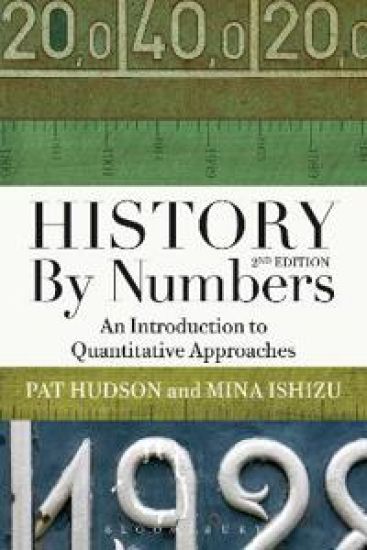
Fully updated and carefully revised, this new 2nd edition of History by Numbers stands alone as the only textbook on quantitative methods suitable for students of history. Even the numerically challenged will find inspiration.Taking a problem-solving approach and using authentic historical data, it describes each method in turn, including its origin, purpose, usefulness and associated pitfalls. The problems are developed gradually and with narrative skill, allowing readers to experience the moment of discovery for each of the interpretative outcomes. Quantitative methods are essential for the modern historian, and this lively and accessible text will prove an invaluable guide for anyone entering the discipline.
History by Numbers

History by Numbers

Pat Hudson; Mina Ishizu

Bloomsbury Academic
2016
nidottu
Fully updated and carefully revised, this new 2nd edition of History by Numbers stands alone as the only textbook on quantitative methods suitable for students of history. Even the numerically challenged will find inspiration.Taking a problem-solving approach and using authentic historical data, it describes each method in turn, including its origin, purpose, usefulness and associated pitfalls. The problems are developed gradually and with narrative skill, allowing readers to experience the moment of discovery for each of the interpretative outcomes. Quantitative methods are essential for the modern historian, and this lively and accessible text will prove an invaluable guide for anyone entering the discipline.
The Genesis of Industrial Capital

The Genesis of Industrial Capital

Pat Hudson

Cambridge University Press
2002
pokkari
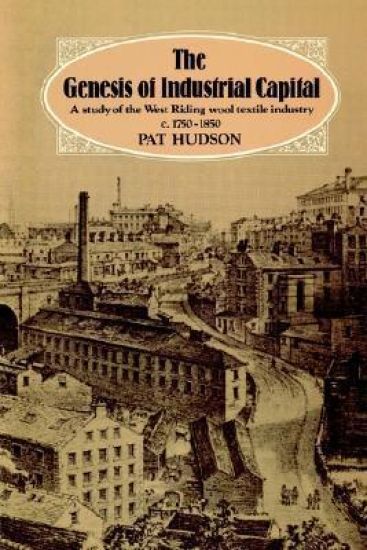
This book analyses the sources of finance used in the Yorkshire wool textile sector during a period of rapid expansion, considerable technical change and the gradual transformation from domestic and workshop production to factory industry. Although there has been much recent debate about capital investment proportions and their sources nationally, there is no other study of a region or section capable of testing various hypotheses current in the general literature of the British ‘industrial revolution’. How was capital amassed in proto-industry? How important were merchants in building factories? What role did landowners and the local banking sector? What influence did trade credit and fluctuations in trade credit have on the expansion of productive enterprise? How important was reinvestment and what determined both profitability and the extent to which it was ploughed back into business? The answers to these questions have value for all students of the industrialisation process, whilst the detailed material on Yorkshire is of interest for local study and provides a model of the questions which could be asked in other similar regional studies of the future.
History by Numbers

History by Numbers

Pat Hudson

Hodder Arnold
2000
nidottu
"History by Numbers" stands alone as the only textbook on quantitative methods suitable for students of history encountering the field for the first time. It is an exceptional book - even the numerically challenged will find inspiration. Taking a problem-solving approach and using authentic historical data, it describes each method in turn, including its origin, purpose, usefulness, and associated pitfalls. The problems are developed gradually and with narrative skill, allowing readers to experience the moment of discovery for each of the interpretative outcomes. Quantitative methods are now essential for the modern historian, and this lively and readable text will prove an invaluable guide for anyone entering the discipline.
The Industrial Revolution

The Industrial Revolution

Pat Hudson

Hodder Arnold
1992
nidottu
This is an introduction to the Industrial Revolution which offers an integrated account of the economic and social aspects of change during the period. Recent revisionist thinking has implied that fundamental change in economic, social and political life at the time of the Industrial Revolution was minimal or non-existent. The author challenges this interpretation, arguing that the process of revision has gone too far; emphasizing continuity at the expense of change and neglecting many historically unique features of the economy and society. Elements given short shrift in many current interpretations are reassigned their central roles.