Kirjojen hintavertailu. Mukana 12 595 353 kirjaa ja 12 kauppaa.

Kirjailija

Patricia Hanna

Kirjat ja teokset yhdessä paikassa: 3 kirjaa, julkaisuja vuosilta 1980-2003, suosituimpien joukossa Word and World. Vertaile teosten hintoja ja tarkista saatavuus suomalaisista kirjakaupoista.

3 kirjaa

Kirjojen julkaisuhaarukka 1980-2003.

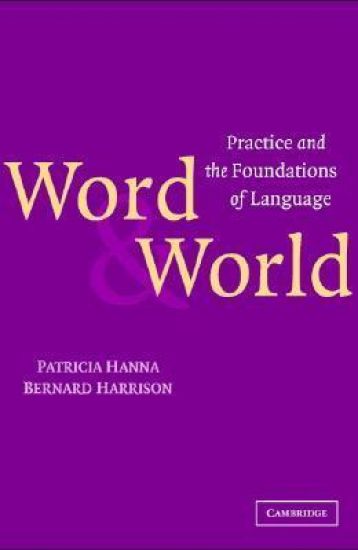
Word and World

Word and World

Patricia Hanna; Bernard Harrison

Cambridge University Press
2003
pokkari
This important book proposes a new account of the nature of language, founded upon an original interpretation of Wittgenstein. The authors deny the existence of a direct referential relationship between words and things. Rather, the link between language and world is a two-stage one, in which meaning is used and in which a natural language should be understood as fundamentally a collection of socially devised and maintained practices. Arguing against the philosophical mainstream descending from Frege and Russell to Quine, Davidson, Dummett, McDowell, Evans, Putnam, Kripke and others, the authors demonstrate that discarding the notion of reference does not entail relativism or semantic nihilism. A provocative re-examination of the interrelations of language and social practice, this book will interest not only philosophers of language but also linguists, psycholinguists, students of communication and all those concerned with the nature and acquisition of human linguistic capacities.
Word and World

Word and World

Patricia Hanna; Bernard Harrison

Cambridge University Press
2003
sidottu
This important book proposes a new account of the nature of language, founded upon an original interpretation of Wittgenstein. The authors deny the existence of a direct referential relationship between words and things. Rather, the link between language and world is a two-stage one, in which meaning is used and in which a natural language should be understood as fundamentally a collection of socially devised and maintained practices. Arguing against the philosophical mainstream descending from Frege and Russell to Quine, Davidson, Dummett, McDowell, Evans, Putnam, Kripke and others, the authors demonstrate that discarding the notion of reference does not entail relativism or semantic nihilism. A provocative re-examination of the interrelations of language and social practice, this book will interest not only philosophers of language but also linguists, psycholinguists, students of communication and all those concerned with the nature and acquisition of human linguistic capacities.