Kirjojen hintavertailu. Mukana 12 390 323 kirjaa ja 12 kauppaa.

Kirjailija

Patricia L. Marshall

Kirjat ja teokset yhdessä paikassa: 5 kirjaa, julkaisuja vuosilta 2015-2026, suosituimpien joukossa Critical Multicultural and Environmental Justice Education. Vertaile teosten hintoja ja tarkista saatavuus suomalaisista kirjakaupoista.

5 kirjaa

Kirjojen julkaisuhaarukka 2015-2026.

Critical Multicultural and Environmental Justice Education

Critical Multicultural and Environmental Justice Education

Patricia L. Marshall

TAYLOR FRANCIS LTD
2026
sidottu
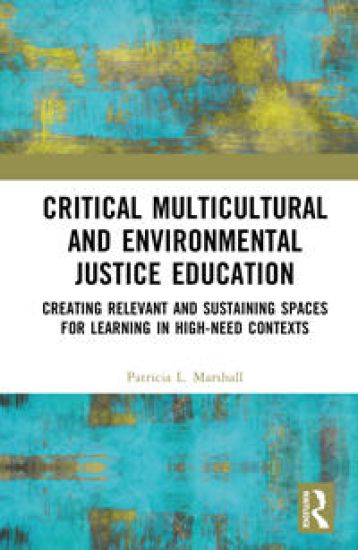
This book presents a clear, concise, and engaging discussion of critical multicultural and environmental justice education (CMEJE), elucidating what it is; why it is urgent for teaching professionals who work in urban and rural high-need contexts; and how to implement it. Written for researchers, teachers, and environmental educators working in a range of settings, this book unpacks CMEJE by describing its foundation in three movements (multiculturalism, environmentalism, and environmental justice) that heretofore have not been combined in discourses about high-quality education. It details various ways in which cultural and environmental phenomena define and shape teaching and learning. Critical concepts such as geography of opportunity, sustainability, and space/place identity are deftly integrated into discussions that explain how belonging, relevance, and responsiveness are central to academic success. At its heart, this book serves as an urgent reminder that educators must acknowledge and respond to the cultural and environmental realities that shape where and how young people live, learn, and grow. Timely and discursive, this is an essential read for scholars and researchers with interests in multicultural education, environmental education, urban education, social justice, environmental justice, and diversity in education.
The Stories We Tell

The Stories We Tell

Valerie N. Faulkner; Patricia L. Marshall; Lee V. Stiff

Rowman Littlefield
2019
nidottu
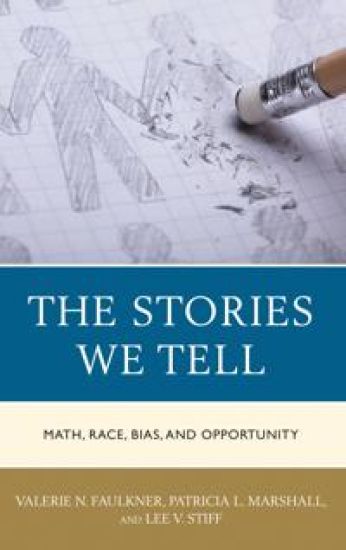
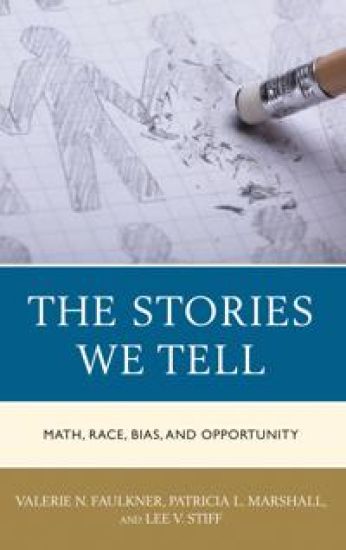
The Stories We Tell: Math, Race, Bias, & Opportunity positions educators as professional decision-makers whose every day choices are deeply consequential. After exploring topics ranging from the early identification of talent, the use of demographic characteristics to make academic decisions, and the problematic casting of a ‘gap’ in mathematical performance as about the students themselves, the book explores how professional decision making, and a more precise use of data, can impact mathematical performance outcomes. With gentle precision, the book analyzes the patterns of practice in place as educators sort children according to perceived needs. Through case studies, the authors reconfigure the mathematics achievement gap as being about opportunity provided or denied at both the classroom and systemic levels. The book has implications for school personnel as well as others curious about how opportunity impacts outcomes and how data is (or is not) used to make decisions about children. Educators who challenge themselves to engage with the possibility of bias, and then face the stories we tell ourselves about the race/talent development/student merit relationship, will have the opportunity to write a powerful and equitable story going forward.
The Stories We Tell

The Stories We Tell

Valerie N. Faulkner; Patricia L. Marshall; Lee V. Stiff

Rowman Littlefield
2019
sidottu
The Stories We Tell: Math, Race, Bias, & Opportunity positions educators as professional decision-makers whose every day choices are deeply consequential. After exploring topics ranging from the early identification of talent, the use of demographic characteristics to make academic decisions, and the problematic casting of a ‘gap’ in mathematical performance as about the students themselves, the book explores how professional decision making, and a more precise use of data, can impact mathematical performance outcomes. With gentle precision, the book analyzes the patterns of practice in place as educators sort children according to perceived needs. Through case studies, the authors reconfigure the mathematics achievement gap as being about opportunity provided or denied at both the classroom and systemic levels. The book has implications for school personnel as well as others curious about how opportunity impacts outcomes and how data is (or is not) used to make decisions about children. Educators who challenge themselves to engage with the possibility of bias, and then face the stories we tell ourselves about the race/talent development/student merit relationship, will have the opportunity to write a powerful and equitable story going forward.
When Critical Multiculturalism Meets Mathematics

When Critical Multiculturalism Meets Mathematics

Patricia L. Marshall; Jessica T. DeCuir-Gunby; Allison W. McCulloch

Rowman Littlefield
2015
sidottu
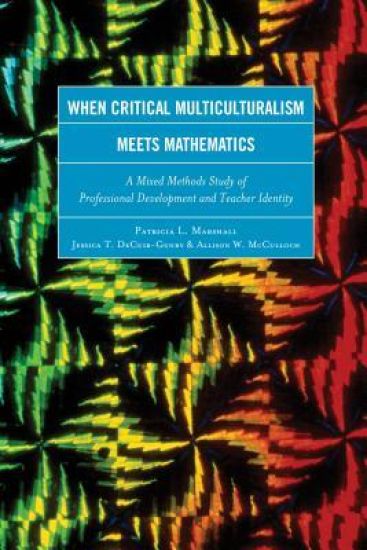
When Critical Multiculturalism Meets Mathematics details the development and outcomes of a teacher professional development project that merged multiculturalism and mathematics. In six compact chapters the authors describe the impetus for their multi-year project and present rich case studies of nine teacher participants. The cases stand alone as compelling reading, yet Marshall et al. extend beyond their distinctiveness to explain the statistical data related to the project’s broader impact. Emphasizing both qualitative and quantitative findings makes this book ideal for novice researchers interested in mixed method study. Likewise, the authors unveil the anatomy and a few complexities of conducting research in the real world contexts of schools including participant recruitment and resolution of unanticipated matters that can arise within research teams. A unique twist in the final chapter is Marshall et al.’s critique of their own missteps as researchers, which are used skillfully and unobtrusively to proffer tips for future studies. They conclude by theorizing affirmed intersectionality, identified as the critical element that facilitated teachers’ recognition and acceptance of the compatibility between the study’s two components.
When Critical Multiculturalism Meets Mathematics

When Critical Multiculturalism Meets Mathematics

Patricia L. Marshall; Jessica T. DeCuir-Gunby; Allison W. McCulloch

Rowman Littlefield
2015
nidottu
When Critical Multiculturalism Meets Mathematics details the development and outcomes of a teacher professional development project that merged multiculturalism and mathematics. In six compact chapters the authors describe the impetus for their multi-year project and present rich case studies of nine teacher participants. The cases stand alone as compelling reading, yet Marshall et al. extend beyond their distinctiveness to explain the statistical data related to the project’s broader impact. Emphasizing both qualitative and quantitative findings makes this book ideal for novice researchers interested in mixed method study. Likewise, the authors unveil the anatomy and a few complexities of conducting research in the real world contexts of schools including participant recruitment and resolution of unanticipated matters that can arise within research teams. A unique twist in the final chapter is Marshall et al.’s critique of their own missteps as researchers, which are used skillfully and unobtrusively to proffer tips for future studies. They conclude by theorizing affirmed intersectionality, identified as the critical element that facilitated teachers’ recognition and acceptance of the compatibility between the study’s two components.