Kirjojen hintavertailu. Mukana 12 294 805 kirjaa ja 12 kauppaa.

Kirjailija

Patricia Popelier

Kirjat ja teokset yhdessä paikassa: 3 kirjaa, julkaisuja vuosilta 2015-2022, suosituimpien joukossa Dynamic Federalism. Vertaile teosten hintoja ja tarkista saatavuus suomalaisista kirjakaupoista.

3 kirjaa

Kirjojen julkaisuhaarukka 2015-2022.

Dynamic Federalism

Dynamic Federalism

Patricia Popelier

TAYLOR FRANCIS LTD
2022
nidottu
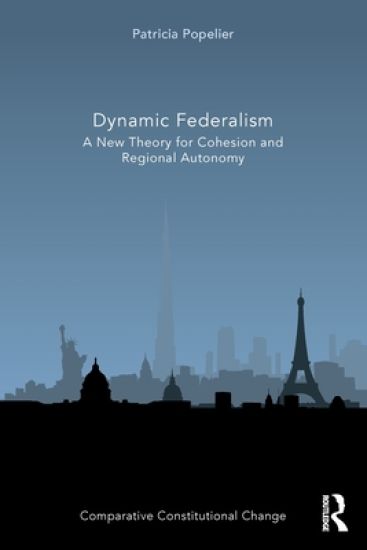
This book offers a new theory of federalism. The work critically discusses traditional federal theories and builds on theories that focus on the dynamics of federalism. It offers a definition of federalism and federal organizations that encompasses both new and old types of multi-tiered system. Unlike traditional federal theory, it is well-suited to research both multinational and mononational systems. It also takes into account the complexity of these systems, with bodies of governance at the local, regional, national, and supranational level. The book is divided into three parts: the first part outlines the contours of dynamic federalism, based on a critical overview of traditional federal theory; the second part develops comprehensive indexes to measure autonomy and cohesion of multi-tiered systems; and the third part focuses on the dynamics of federal organizations, with a special focus on institutional hubs for change. Dynamic Federalism will be an essential resource for legal, social, economic, and political scholars interested in federalism, regionalism, and de/centralization.
Dynamic Federalism

Dynamic Federalism

Patricia Popelier

Routledge
2021
sidottu
This book offers a new theory of federalism. The work critically discusses traditional federal theories and builds on theories that focus on the dynamics of federalism. It offers a definition of federalism and federal organizations that encompasses both new and old types of multi-tiered system. Unlike traditional federal theory, it is well-suited to research both multinational and mononational systems. It also takes into account the complexity of these systems, with bodies of governance at the local, regional, national, and supranational level. The book is divided into three parts: the first part outlines the contours of dynamic federalism, based on a critical overview of traditional federal theory; the second part develops comprehensive indexes to measure autonomy and cohesion of multi-tiered systems; and the third part focuses on the dynamics of federal organizations, with a special focus on institutional hubs for change. Dynamic Federalism will be an essential resource for legal, social, economic, and political scholars interested in federalism, regionalism, and de/centralization.

The Constitution of Belgium

The Constitution of Belgium

Patricia Popelier; Koen Lemmens

Hart Publishing
2015
nidottu
The Belgian Constitution, once described as a model of consensus democracy, has now become an enigma in comparative federalism. On the one hand, it demonstrates features which suggest institutional instability as well as elements that enhance the probability of secession. On the other hand, Belgium continues to exist as a federal system, based upon linguistic bipolarity. This linguistic bipolarity dominates Belgian politics and has shaped the design of Belgium’s institutions as well as the Constitution’s fundamental organising principles: concepts of federalism, democracy, separation of powers, constitutionalism and the rule of law. In this book, the institutional structure and the principles governing the Belgian constitutional system are explained in the light of its historical, demographic and political context. Linguistic bipolarity and its historical evolution explain the establishment of the Belgian State structure as a dual federalism, with exclusive powers, instruments for consensus making and obstruction, and elements of confederal decision making. It also explains the evolution in the concept of principles of democracy and the rule of law. Besides describing the devolutionary process, the book also incorporates two other elements that have shaped the Belgian constitutional landscape: fundamental rights and Europeanisation.