Kirjojen hintavertailu. Mukana 12 657 676 kirjaa ja 12 kauppaa.

Kirjailija

Patrick Suppes

Kirjat ja teokset yhdessä paikassa: 22 kirjaa, julkaisuja vuosilta 1969-2017, suosituimpien joukossa New Ways in Statistical Methodology. Vertaile teosten hintoja ja tarkista saatavuus suomalaisista kirjakaupoista.

22 kirjaa

Kirjojen julkaisuhaarukka 1969-2017.

Logic and Pragmatism

Logic and Pragmatism

Claudia Arrighi; Paola Cantu; Mauro de Zan; Patrick Suppes

Centre for the Study of Language Information
2010
sidottu
"Logic and Pragmatism" features a number of the key writings of Giovanni Vailati (1863-1909), the Italian mathematician and philosopher renowned for his work in mechanics, geometry, logic, and epistemology. The selections in this book - many of which are available here for the first time in English - focus on Vailati's significant contributions to the field of pragmatism. Accompanying these pieces are introductory essays by the volume's editors that outline the traits of Vailati's pragmatism and provide insights into the scholar's life.
Logic and Pragmatism

Logic and Pragmatism

Claudia Arrighi; Paola Cantu; Mauro de Zan; Patrick Suppes

Centre for the Study of Language Information
2010
nidottu
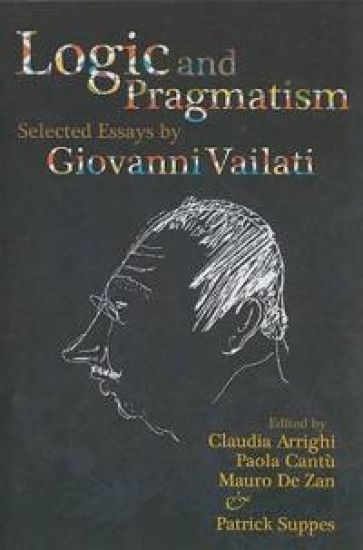
"Logic and Pragmatism" features a number of the key writings of Giovanni Vailati (1863-1909), the Italian mathematician and philosopher renowned for his work in mechanics, geometry, logic, and epistemology. The selections in this book - many of which are available here for the first time in English - focus on Vailati's significant contributions to the field of pragmatism. Accompanying these pieces are introductory essays by the volume's editors that outline the traits of Vailati's pragmatism and provide insights into the scholar's life.
New Ways in Statistical Methodology

New Ways in Statistical Methodology

Henry Rouanet; Jean-Marc Bernard; Marie-Claude Bert; Bruno Lecoutre; Patrick Suppes

Verlag Peter Lang
2000
nidottu
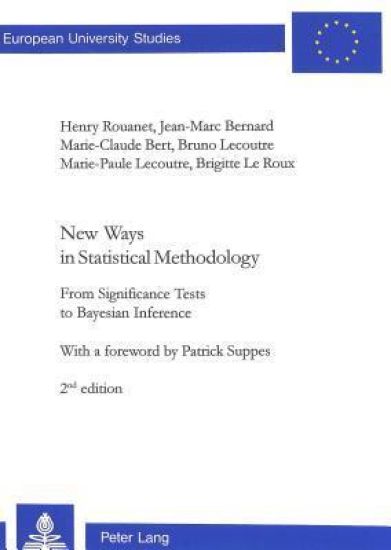
This book, with a foreword by the outstanding philosopher of science and mathematical psychologist Patrick Suppes of Stanford University, is the outgrowth of the work developed within the Groupe Math matiques et Psychologie, a research unit of the University Ren Descartes and CNRS (the French National Center for Scientific Research). New ways in statistical methodology are presented, which complement the familiar significance tests by new methods better suited to the researchers' objectives, in the first place, Bayesian methods. In mathematical statistics, Bayesian methods have made a breakthrough in the last few years, but those developments are still ignored by the current statistical methodology and practice. The present book is really the first one to fill this gap. This book is written for a large audience of researchers, statisticians and users of statistics in behavioral and social sciences, and contains both an analysis of the attitude of researchers toward statistical inference, and concrete proposals for improving statistical practice. The statistical consulting experience of the authors is centered around psychology and covers a broad range of subjects from social sciences to biostatistics. All methods developed by the authors are implemented in software.
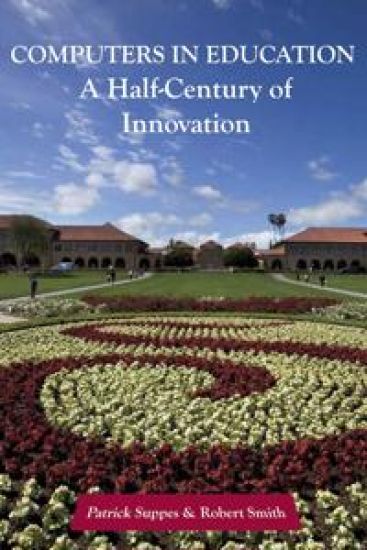
Computers in Education

Computers in Education

Patrick Suppes; Robert Smith

Centre for the Study of Language Information
2017
nidottu
Described by the New York Times as a visionary "pioneer in computerized learning," Patrick Suppes (1922?2014) and his many collaborators at Stanford University conducted research on the development, commercialization, and use of computers in education from 1963 to 2013. Computers in Education synthesizes this wealth of scholarship into a single succinct volume that highlights the profound interconnections of technology in education. By capturing the great breadth and depth of this research, this book offers an accessible introduction to Suppes's striking work.
Space, Time and Geometry

Space, Time and Geometry

Patrick Suppes

Springer
2013
nidottu
The articles in this volume have been stimulated in two different ways. More than two years ago the editor of Synthese, laakko Hintikka, an­ nounced a special issue devoted to space and time, and articles were solicited. Part of the reason for that announcement was also the second source of papers. Several years ago I gave a seminar on special relativity at Stanford, and the papers by Domotor, Harrison, Hudgin, Latzer and myself partially arose out of discussion in that seminar. All of the papers except those of Griinbaum, Fine, the second paper of Friedman, and the paper of Adams appeared in a special double issue of Synthese (24 (1972), Nos. 1-2). I am pleased to have been able to add the four additional papers mentioned in making the special issue a volume in the Synthese Library. Of these four additional articles, only the one by Fine has pre­ viously appeared in print (Synthese 22 (1971), 448-481); its relevance to the present volume is apparent. In preparing the papers for publication and in carrying out the various editonal chores of such a task, I am very much indebted to Mrs. Lillian O'Toole for her extensive assistance. INTRODUCTION The philosophy of space and time has been of permanent importance in philosophy, and most of the major historical figures in philosophy, such as Aristotle, Descartes and Kant, have had a good deal to say about the nature of space and time.
Individual Differences in Online Computer-based Learning

Individual Differences in Online Computer-based Learning

Patrick Suppes

Centre for the Study of Language Information
2013
nidottu
In 1894 John Dewey established his experimental laboratory school at the University of Chicago, with a focus on teaching each student according to their individual differences. This concept indicated a shift away from the emphasis on communal, classroom teaching, which marked educational practices during the advent of widely available public education in the nineteenth century. With the introduction of computer-based online instruction in schools, curricula are able to be fully informed by individual difference, subtly and quickly tracking students' progress. In these courses, teachers play the role of troubleshooters instead of lecturers. "Individual Differences" examines a large number of studies of computer-based and online instruction, with special attention paid to gifted students in the fields of mathematics, science, technology, and engineering. Other chapters also focus on a wide variety of student populations: deaf students, American Indian rural students, and underachieving, impoverished students.
Introduction to Logic

Introduction to Logic

Patrick Suppes

Literary Licensing, LLC
2012
nidottu
Coherent, well-organized text familiarizes readers with complete theory of logical inference and its applications to math and the empirical sciences. Part I deals with formal principles of inference and definition. Part II explores elementary intuitive set theory, with separate chapters on sets, relations, and functions. Last section introduces numerous examples of axiomatically formulated theories.
Introduction to Logic

Introduction to Logic

Patrick Suppes

Literary Licensing, LLC
2012
sidottu
""Introduction to Logic"" by Patrick Suppes is a comprehensive guide to the principles and techniques of formal logic. The book covers a wide range of topics, including propositional and predicate logic, set theory, and the basics of mathematical proof. The author presents the material in a clear and accessible manner, with numerous examples and exercises to help readers develop their understanding of the subject. The book is suitable for both beginners and advanced students of logic, as well as anyone interested in the foundations of mathematics and philosophy. With its rigorous yet approachable style, ""Introduction to Logic"" is an essential resource for anyone seeking to master the art of logical reasoning.This scarce antiquarian book is a facsimile reprint of the old original and may contain some imperfections such as library marks and notations. Because we believe this work is culturally important, we have made it available as part of our commitment for protecting, preserving, and promoting the world's literature in affordable, high quality, modern editions, that are true to their original work.
Studies in the Methodology and Foundations of Science
The twenty-three papers collected in tbis volume represent an important part of my published work up to the date of this volume. I have not arranged the paper chronologically, but under four main headings. Part I contains five papers on methodology concerned with models and measurement in the sciences. This part also contains the first paper I published, 'A Set of Independent Axioms for Extensive Quantities', in Portugaliae Mathematica in 1951. Part 11 also is concerned with methodology and ineludes six papers on probability and utility. It is not always easy to separate papers on probability and utility from papers on measurement, because of the elose connection between the two subjects, but Artieles 6 and 8, even though they have elose relations to measurement, seem more properly to belong in Part 11, because they are concerned with substantive questions about probability and utility. The last two parts are concerned with the foundations of physics and the foundations of psychology. I have used the term foundations rather than philosophy, because the papers are mainly concerned with specific axiomatic formulations for particular parts of physics or of psychology, and it seems to me that the termfoundations more appropriately describes such constructive axiomatic ventures. Part 111 contains four papers on the foundations of physics. The first paper deals with foundations of special relativity and the last three with the role ofprobability in quantum mechanics.
Models and Methods in the Philosophy of Science: Selected Essays
The thirty-one papers collected in this volume represent most of the arti­ cles that I have published in the philosophy of science and related founda­ tional areas of science since 1970. The present volume is a natural succes­ sor to Studies in the Methodology and Foundations of Science, a collection of my articles published in 1969 by Reidel (now a part of Kluwer). The articles are arranged under five main headings. Part I contains six articles on general methodology. The topics range from formal methods to the plurality of science. Part II contains six articles on causality and explanation. The emphasis is almost entirely on probabilistic approaches. Part III contains six articles on probability and measurement. The impor­ tance of representation theorems for both probability and measurement is stressed. Part IV contains five articles on the foundations of physics. The first three articles are concerned with action at a distance and space and time, the last two with quantum mechanics. Part V contains eight articles on the foundations of psychology. This is the longest part and the articles reflect my continuing strong interest in the nature of learning and perception. Within each part the articles are arranged chronologically. I turn now to a more detailed overview of the content. The first article of Part I concerns the role of formal methods in the philosophy of science. Here I discuss what is the new role for formal methods now that the imperialism of logical positivism has disappeared.
Foundations of Modern Analysis

Foundations of Modern Analysis

Avner Friedman; Patrick Suppes

Dover Publications Inc.
2008
nidottu
Measure and integration, metric spaces, the elements of functional analysis in Banach spaces, and spectral theory in Hilbert spaces — all in a single study. Only book of its kind. Unusual topics, detailed analyses. Problems. Excellent for first-year graduate students, almost any course on modern analysis. Preface. Bibliography. Index.
Axiomatic Set Theory

Axiomatic Set Theory

Patrick Suppes

Dover Publications Inc.
2003
nidottu
This clear and well-developed approach to axiomatic set theory is geared toward upper-level undergraduates and graduate students. It examines the basic paradoxes and history of set theory and advanced topics such as relations and functions, equipollence, finite sets and cardinal numbers, rational and real numbers, and other subjects. 1960 edition.
First Course in Mathematical Logic

First Course in Mathematical Logic

Patrick Suppes

Dover Publications Inc.
2003
nidottu
In modern mathematics, both the theory of proof and the derivation of theorems from axioms bear an unquestioned importance. The necessary skills behind these methods, however, are frequently underdeveloped. This book counters that neglect with a rigorous introduction that is simple enough in presentation and context to permit relatively easy comprehension. It comprises the sentential theory of inference, inference with universal quantifiers, and applications of the theory of inference developed to the elementary theory of commutative groups. Throughout the book, the authors emphasize the pervasive and important problem of translating English sentences into logical or mathematical symbolism. Their clear and coherent style of writing ensures that this work may be used by students in a wide range of ages and abilities.
Introduction to Logic

Introduction to Logic

Patrick Suppes

Dover Publications Inc.
2003
nidottu
This book was written to serve as a textbook for a first course in modern logic. Coherent and well organized, it familiarizes readers with an exact and complete theory of logical inference and its applications to mathematics and the empirical sciences. The first part deals with formal principles of inference and definition, including a detailed attempt to relate the formal theory of inference to the standard informal proofs common throughout mathematics. An in-depth exploration of elementary intuitive set theory constitutes the second part, with separate chapters on sets, relations, and functions. The final part introduces numerous examples of axiomatically formulated theories in both the discussion and exercises. Topics range from the theory of groups and the algebra of the real numbers to elementary probability theory, classical particle mechanics, and the theory of measurement of sensation intensities. Ideally suited for undergraduate courses, this book demands no background in mathematics or philosophy.
Chinese Language, Thought and Culture

Chinese Language, Thought and Culture

Patrick Suppes

Open Court Publishing Co ,U.S.
1999
pokkari
This collection of essays by leading sinologists, historians, and philosophers both challenges and extends the work of David Nivison, whose contributions range across moral philosophy, religious thought, intellectual history, and Chinese language. Nivison himself replies to each essay.
Foundations of Probability with Applications

Foundations of Probability with Applications

Patrick Suppes; Mario Zanotti

Cambridge University Press
1996
sidottu
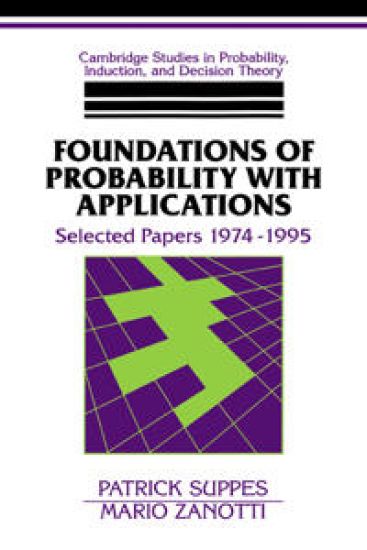
This is an important collection of essays dealing with the foundations of probability that will be of value to philosophers of science, mathematicians, statisticians, psychologists and educationalists. The collection falls into three parts. Part I comprises five essays on the axiomatic foundations of probability. Part II contains seven articles on probabilistic causality and quantum mechanics, with an emphasis on the existence of hidden variables. The third part consists of a single extended essay applying probabilistic theories of learning to practical questions of education: it incorporates extensive data analysis. Patrick Suppes is one of the world’s foremost philosophers in the area of probability, and has made many contributions to both the theoretical and practical side of education. The statistician Mario Zanotti is a long-time collaborator.
Foundations of Probability with Applications

Foundations of Probability with Applications

Patrick Suppes; Mario Zanotti

Cambridge University Press
1996
pokkari
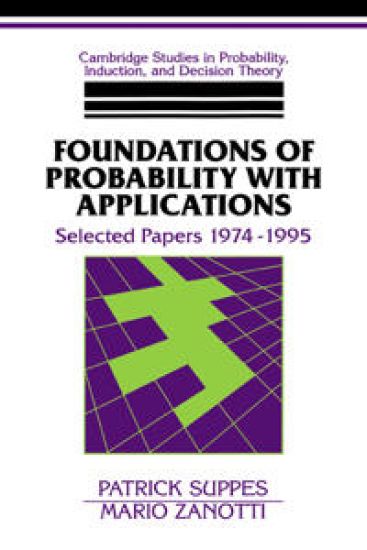
This is an important collection of essays dealing with the foundations of probability that will be of value to philosophers of science, mathematicians, statisticians, psychologists and educationalists. The collection falls into three parts. Part I comprises five essays on the axiomatic foundations of probability. Part II contains seven articles on probabilistic causality and quantum mechanics, with an emphasis on the existence of hidden variables. The third part consists of a single extended essay applying probabilistic theories of learning to practical questions of education: it incorporates extensive data analysis. Patrick Suppes is one of the world’s foremost philosophers in the area of probability, and has made many contributions to both the theoretical and practical side of education. The statistician Mario Zanotti is a long-time collaborator.
Language and Learning for Robots

Language and Learning for Robots

Colleen Crangle; Patrick Suppes

Centre for the Study of Language Information
1994
sidottu
Robot technology will find wide-scale use only when a robotic device can be given commands and taught new tasks in a natural language. How could a robot understand instructions expressed in English? How could a robot learn from instructions? Crangle and Suppes begin to answer these questions through a theoretical approach to language and learning for robots, and by experimental work with robots. The authors develop the notion of an instructable robot - one which derives its intelligence in part from interaction with humans. Since verbal interaction with a robot requires a natural language semantics, the authors propose a natural-model semantics which they then apply to the interpretation of robot commands. Two experimental projects are described which provide natural-language interfaces to robotic aids for the physically disabled.
Language and Learning for Robots

Language and Learning for Robots

Colleen Crangle; Patrick Suppes

Centre for the Study of Language Information
1994
pokkari
Robot technology will find wide-scale use only when a robotic device can be given commands and taught new tasks in a natural language. How could a robot understand instructions expressed in English? How could a robot learn from instructions? Crangle and Suppes begin to answer these questions through a theoretical approach to language and learning for robots, and by experimental work with robots. The authors develop the notion of an instructable robot - one which derives its intelligence in part from interaction with humans. Since verbal interaction with a robot requires a natural language semantics, the authors propose a natural-model semantics which they then apply to the interpretation of robot commands. Two experimental projects are described which provide natural-language interfaces to robotic aids for the physically disabled.