Kirjojen hintavertailu. Mukana 12 595 353 kirjaa ja 12 kauppaa.

Kirjailija

Patrick Weller

Kirjat ja teokset yhdessä paikassa: 11 kirjaa, julkaisuja vuosilta 2004-2023, suosituimpien joukossa Kevin Rudd. Vertaile teosten hintoja ja tarkista saatavuus suomalaisista kirjakaupoista.

11 kirjaa

Kirjojen julkaisuhaarukka 2004-2023.

International Organizations and Small States

International Organizations and Small States

Jack Corbett; Xu Yi-chong; Patrick Weller

Bristol University Press
2023
nidottu
International Organizations (IOs) are vital institutions in world politics in which cross-border issues can be discussed and global problems managed. This path-breaking book shows the efforts that small states have made to participate more fully in IO activities. It draws attention to the challenges created by widened participation in IOs and develops an original model of the dilemmas that both IOs and small states face as the norms of sovereign equality and the right to develop coincide. Drawing on extensive qualitative data, including more than 80 interviews conducted for this book, the authors find that the strategies which both IOs and small states adopt to balance their respective dilemmas can explain both continuity and change in their interactions with institutions ranging from UN agencies to the World Trade Organization.
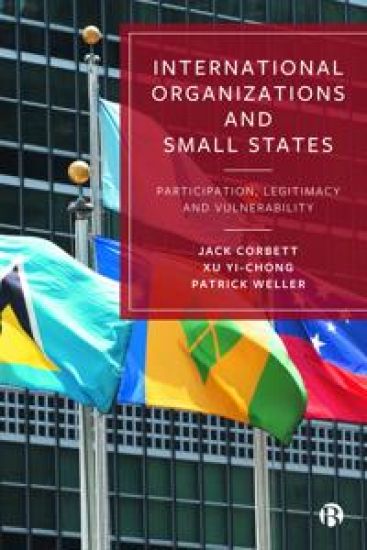
International Organizations and Small States

International Organizations and Small States

Jack Corbett; Xu Yi-chong; Patrick Weller

Bristol University Press
2021
sidottu
International Organizations (IOs) are vital institutions in world politics in which cross-border issues can be discussed and global problems managed. This path-breaking book shows the efforts that small states have made to participate more fully in IO activities. It draws attention to the challenges created by widened participation in IOs and develops an original model of the dilemmas that both IOs and small states face as the norms of sovereign equality and the right to develop coincide. Drawing on extensive qualitative data, including more than 80 interviews conducted for this book, the authors find that the strategies which both IOs and small states adopt to balance their respective dilemmas can explain both continuity and change in their interactions with institutions ranging from UN agencies to the World Trade Organization.
Kevin Rudd

Kevin Rudd

Patrick Weller

Melbourne University Press
2014
nidottu
It was a very different Kevin Rudd who returned to office in 2013. Kevin 07 was a fresh face and a new image- the convivial, Mandarin-speaking nerd who seemed so different from past leaders and who held so much potential. By 2013 Rudd retained some of his popularity but none of his novelty. The Opposition could say nothing derogatory about him that his colleagues had not already said. A series of policy grenades had to be defused. His second term was to be short, brutal and nasty. Yet, despite his defeat, Kevin Rudd was an unusual Labor leader and prime minister. Political scientist and biographer Patrick Weller spent several years observing and talking to Rudd and the people around him to explain how one person came to the job and sought to meet its demands. Weller takes us back to Rudd s boyhood in Nambour, son of a poor Queensland dairy farmer; to a member without a faction who led a bitterly factionalised party; to the only federal Labor leader to win a majority since Paul Keating in 1993; and to only the second prime minister since 1914 to be sworn in for a second time. This book has the advantage of interviews in 2008 and 2009 with ministers who were then support
Comparing Cabinets

Comparing Cabinets

Patrick Weller; Dennis Grube; R.A.W. Rhodes

Oxford University Press
2021
sidottu
Why is cabinet government so resilient? Despite many obituaries, why does it continue to be the vehicle for governing across most parliamentary systems? Comparing Cabinets answers these questions by examining the structure and performance of cabinet government in five democracies: the United Kingdom, Denmark, the Netherlands, Switzerland, and Australia. The book is organised around the dilemmas that cabinet governments must solve: how to develop the formal rules and practices that can bring predictability and consistency to decision making; how to balance good policy with good politics; how to ensure cohesion between the factions and parties that constitute the cabinet while allowing levels of self-interest to be advanced; how leaders can balance persuasion and command; and how to maintain support through accountability at the same time as being able to make unpopular decisions. All these dilemmas are continuing challenges to cabinet government, never solvable, and constantly reappearing in different forms. Comparing distinct parliamentary systems reveals how traditions, beliefs, and practices shape the answers. There is no single definition of cabinet government, but rather arenas and shared practices that provide some cohesion. Such a comparative approach allows greater insight into the process of cabinet government that cannot be achieved in the study of any single political system, and an understanding of the pressures on each system by appreciating the options that are elsewhere accepted as common beliefs.
The Prime Ministers' Craft

The Prime Ministers' Craft

Patrick Weller

Oxford University Press
2018
sidottu
Prime ministers are presented as ever-more powerful figures; at the same time they seem to fail more regularly. How can the public image be so different from the apparent experience? This book seeks to answer this conundrum. It examines the myth that prime ministers are growing more powerful or that prime ministerial government has replaced cabinet government, and explores the way that prime ministers work and how they use the available levers of power to build support across the political system. Prime ministers have the potential to exercise extensive power; to do so they need to exercise the skills and opportunities available: that is, they need to develop the prime ministers' craft. Using evidence from four countries with similar Westminster systems, Australia, Britain, Canada and New Zealand, the analysis starts at the centre by examining how prime ministers reach office and how they understand their new job -- those who win elections see it differently from those who replace leaders from the same party. The book then analyses the support prime ministers have from their Prime Ministers Offices and the Cabinet Offices, exploring their relations with ministers and the way they run and use their cabinet, and explains how governments work and why prime ministers are so central to their success. The book then explores their role as public figures selling the government to the parliament and the electorate and to the international community beyond. The Prime Ministers' Craft concludes by assessing how success can be judged and identifies how the different institutional arrangements have an impact on the way prime ministers work and the degree to which they are accountable.
The Working World of International Organizations

The Working World of International Organizations

Xu Yi-chong; Patrick Weller

Oxford University Press
2018
sidottu
International organizations (IOs) matter. This book uncovers the regular working world of IOs, examining whether, to what extent, and how these 'global governing bodies' can act independently of the will of states. This book explores this issue by asking who or what shapes their decisions; how and when decisions are made; how players interact within an IO; and how the interactions vary across IOs. The Working World of International Organizations examines three working groups in the higher echelons of IOs - state representatives, as proxy of states, serving in the Executive Boards or General Councils, chief officers of IOs, and the staff of the permanent secretariat. The book demonstrates that none of them are unified; in each there are contested ideas about strategy and appropriate projects, and analyses their interactions to explain who is able to shape or influence decisions. Six representative IOs are studied to identify the relevant critical determinants that shape the behaviour of players. The volume explores how these players have an impact over three dilemmas that are common to all IOs: priority and agenda setting, financing, and the centralization or decentralization of operations.
Comparing Westminster

Comparing Westminster

R. A.W. Rhodes; John Wanna; Patrick Weller

Oxford University Press
2011
nidottu
Comparing Westminster explores how the governmental elites in Australia, Britain, Canada, New Zealand, and South Africa understand their Westminster system. It examines in detail four interrelated features of Westminster systems. Firstly, the increasing centralisation in collective, responsible cabinet government. Second, the constitutional convention of ministerial and collective responsibility. Third, the role of a professional, non-partisan public service. And finally, parliament's relationship to the executive. The authors explain the changes that have occured in the Westminster model by analysing four traditions: royal prerogative, responsible government, constitutional bureaucracy, and representative government. They suggest that each tradition has a recurring dilemma, between centralisation and decentralisation, party government and ministerial responsibility, professionalisation and politicisation, and finally elitism and participation. They gone on to argue that these dilemmas recur in four present-day debates: the growth of prime ministerial power, the decline in individual and collective ministerial accountability, politicisation of the public service, and executive dominance of the legislature. They conclude by identifying five meanings of - or narratives about - Westminster. Firstly, 'Westminster as heritage' - elite actors' shared governmental narrative understood as both precedents and nostalgia. Second, 'Westminster as political tool' - the expedient cloak worn by governments and politicians to defend themselves and criticise opponents. Third, 'Westminster as legitimising tradition' - providing legitimacy and a context for elite actions, serving as a point of reference to navigate this uncertain world. Fourth, 'Westminster as institutional category' - it remains a useful descriptor of a loose family of governments with shared origins and characteristics. Finally, 'Westminster as an effective political system' - it is a more effective and efficient political system than consensual parliamentary governments. Westminster is a flexible family of ideas that is useful for many purposes and survives, even thrives, because of its meaning in use to élite actors.
Learning To Be A Minister

Learning To Be A Minister

Patrick Weller; Anne Tiernan

Melbourne University Press
2010
pokkari
Drawing on extensive interviews with current and former ministers, ministerial staffers, and senior officials, this in-depth examination offers insight into the Australian political and democratic processes. Exploring the lives of Australia’s federal ministers at work, this revealing account investigates how a new ministry learns and adapts to the responsibilities of governing as well as the means by which ministers learn to juggle time and other resources in their simultaneous, and sometimes conflicting, roles—as members of Parliament and Cabinet, as local constituency representatives, and as media spokespersons.
Comparing Westminster

Comparing Westminster

R. A.W. Rhodes; John Wanna; Patrick Weller

Oxford University Press
2009
sidottu
This book explores how the governmental elites in Australia, Britain, Canada, New Zealand, and South Africa understand their Westminster system. It examines in detail four interrelated features of Westminster systems. Firstly, the increasing centralisation in collective, responsible cabinet government. Second, the constitutional convention of ministerial and collective responsibility. Third, the role of a professional, non-partisan public service. And finally, parliament's relationship to the executive. The authors explain the changes that have occured in the Westminster model by analysing four traditions: royal prerogative, responsible government, constitutional bureaucracy, and representative government. They suggest that each tradition has a recurring dilemma, between centralisation and decentralisation, party government and ministerial responsibility, professionalisation and politicisation, and finally elitism and participation. They go on to argue that these dilemmas recur in four present-day debates: the growth of prime ministerial power, the decline in individual and collective ministerial accountability, politicisation of the public service, and executive dominance of the legislature. They conclude by identifying five meanings of - or narratives about - Westminster. Firstly, 'Westminster as heritage' - elite actors' shared governmental narrative understood as both precedents and nostalgia. Second, 'Westminster as political tool' - the expedient cloak worn by governments and politicians to defend themselves and criticise opponents. Third, 'Westminster as legitimising tradition' - providing legitimacy and a context for elite actions, serving as a point of reference to navigate this uncertain world. Fourth, 'Westminster as institutional category' - it remains a useful descriptor of a loose family of governments with shared origins and characteristics. Finally, 'Westminster as an effective political system' - it is a more effective and efficient political system than consensual parliamentary governments. Westminster is a flexible family of ideas that is useful for many purposes and survives, even thrives, because of its meaning in use to élite actors.
Cabinet Government in Australia, 1901-2006
This is the first comprehensive study of the development of the central institution of government over the first century of its life. Based on the author's detailed archival research and 30 years' experience writing about central government in Australia, it provides an understanding of both the history and the working of the institution. Patrick Weller has written a detailed history, as well as a politics primer. It is book packed with political insights and anecdotes, with lively portraits of our prime ministers and their cabinet colleagues along with the airing of many fascinating details of memos and meetings long buried in the archives.
The Governance of World Trade

The Governance of World Trade

Xu Yi-Chong; Patrick Weller

Edward Elgar Publishing Ltd
2004
sidottu
The Governance of World Trade focuses on the roles, influence and impacts of the so-called 'GATT operatives' or WTO practitioners. It is widely assumed that they have little influence on decisions and policies made, but, according to the authors, the GATT/WTO Secretariat has played an active role in promoting multilateral cooperation.This unique study of the internal operation of the GATT/WTO argues that the invisible yet indispensable international civil servants are the permanent machinery within the institution. They have, the authors ascertain, an important coordinating function and act according to a specific scale of values that transcend those of individual states, providing the continuity and the cement, the credibility and the connection among self-interest-driven states. The book concludes that as one of the most 'democratic' international organizations, operating on the principle of consensus, the WTO needs a creative Secretariat as a necessary condition for multilateral cooperation to work.Using case studies to analyse the workings of Secretariat officials in trade negotiations, and the influence and role of international civil servants, this book will be a fascinating read for a wide ranging audience including: political scientists and economists, international civil servants, think tanks, NGOs, and government agencies.